

Important for planning: Because of the airflow it must allow, a ventilation grille cannot be compared to a closed, watertight building envelope. The classification according to DIN EN 13030 describes water repellency under defined test conditions. The decisive factors are the type of grille, the intake velocity, the insect screen, the water drainage channel, and the specific installation situation.
Image credit: The cover image and the illustration in the section „Renson 450: Special Grille for Very High Rain Protection“ were edited using AI. The technical specifications and product features are based on the manufacturer’s documentation cited in the article.
Are you planning a weather-exposed facade opening, a roof hood, or a technical ventilation opening?
rotec assists architects, designers, metal fabricators, facade contractors, and industrial companies in selecting suitable ventilation grilles, weather protection grilles, rain protection louvers, and roof hoods.Brief Summary for Planners
The water tightness of a ventilation grille describes how effectively it reduces the penetration of rain and driving rain. Testing is conducted in accordance with DIN EN 13030. During the test, inspectors determine, under defined conditions, how much water penetrates through the ventilation grille. In this test overview, a driving rain simulation is directed at a 1 m² ventilation grille equipped with a stainless steel insect screen. Additionally, the test setup sprays 75 liters of water per hour onto the grille. The amount of water that passes through the ventilation grille is then measured. The watertightness classes range from A to D. Class A indicates very good water protection. Class B indicates good water protection. Class C indicates normal or moderate water protection. Class D, on the other hand, indicates low water protection. The air velocity on the intake side always remains a decisive evaluation factor. For particularly high requirements regarding rain protection and airflow, special water-repellent grilles are an option. These include, in particular, the Renson 450 and Renson 450V. If technical systems additionally require V-shaped louvers, privacy screening, puncture resistance, or stability, the Renson 452 and Renson 412 may be appropriate. The Renson 411 and rotec W11, on the other hand, remain good standard solutions, provided the installation situation is suitable and the design explicitly accounts for the water drainage channel if necessary. If additional sound attenuation is required, planners should evaluate soundproofing louvers separately. These louvers combine ventilation, weather protection, and sound reduction. However, they do not automatically provide the highest level of protection against driving rain. Therefore, the technical design must evaluate rain protection, airflow, pressure loss, and acoustics collectively.Why Rain Protection Is So Important for Ventilation Grilles
Ventilation grilles are often located at critical points in the building envelope. They are used in facades, mechanical rooms, ventilation shafts, roof hoods, roof enclosures, transformer stations, parking garages, and industrial facilities. There, they must allow outside air to enter or direct exhaust air to the outside. At the same time, these openings are often directly exposed to the elements. Rain, wind, driving rain, fog, snow, and airflow all impact the grille. Depending on the location, the environmental stresses can vary greatly. A sheltered courtyard side presents different challenges than a high-rise facade, a roof-mounted utility room, a coastal location, or a freestanding utility building. Therefore, it is not enough to consider only the clear cross-sectional area. The design must comprehensively evaluate airflow, pressure drop, water repellency, water drainage, installation position, maintenance, and connection details. Only then can a technically sound solution be achieved. For building owners, designers, and contractors, this means greater certainty. Clarifying these issues early on reduces the need for follow-up questions, simplifies the bidding process, and lowers the risk of subsequent change orders or technical problems.Properly Planning the Water Resistance of Ventilation Grilles
The watertightness of ventilation grilles must always be evaluated on a project-by-project basis. It is not only the test results for a particular grille type that are decisive. Equally important are the installation orientation, facade construction, airflow volume, air velocity, insect screens, water drainage channels, connection joints, and on-site drainage. Therefore, technical planning should determine—even before the request for proposals—whether standard weather protection is sufficient or whether there are heightened requirements for rain protection and water repellency. This clarification is particularly important for sensitive technical rooms, data centers, energy systems, roof hoods, and weather-exposed facades. rotec provides support precisely at this interface. After all, the right solution does not result solely from the selection of a product, but from the interplay of the ventilation grille, mounting frame, water drainage, fastening, and structural connection.What does "water resistance" mean in the context of ventilation grilles?
The term “water tightness” requires precise clarification when it comes to ventilation grilles. A ventilation grille does not form a sealed barrier; it must allow air to pass through. Therefore, water can penetrate under certain wind and rain conditions. From a technical standpoint, therefore, absolute watertightness is not the key factor. Rather, the decisive factor is how much water passes through the ventilation grille under defined test conditions. This is precisely why designers and manufacturers use watertightness classes. For design purposes, this means that a high watertightness class significantly reduces water ingress. However, it does not replace the proper execution of the entire construction. This includes water drainage channels, water deflectors, slopes, frame seams, waterstops, rear ventilation, drip edges, connection profiles, and on-site drainage.DIN EN 13030: How to Test Ventilation Grilles for Resistance to Driving Rain
Testing in accordance with DIN EN 13030 establishes a comparable technical basis. In the test overview, a driving rain simulation is directed at a 1 m² ventilation grille equipped with a stainless steel insect screen. During the test, the test setup sprays 75 liters of water per hour onto the grille. In addition, a defined wind load is applied to the structure. The testers then evaluate how much water penetrates through the ventilation grille.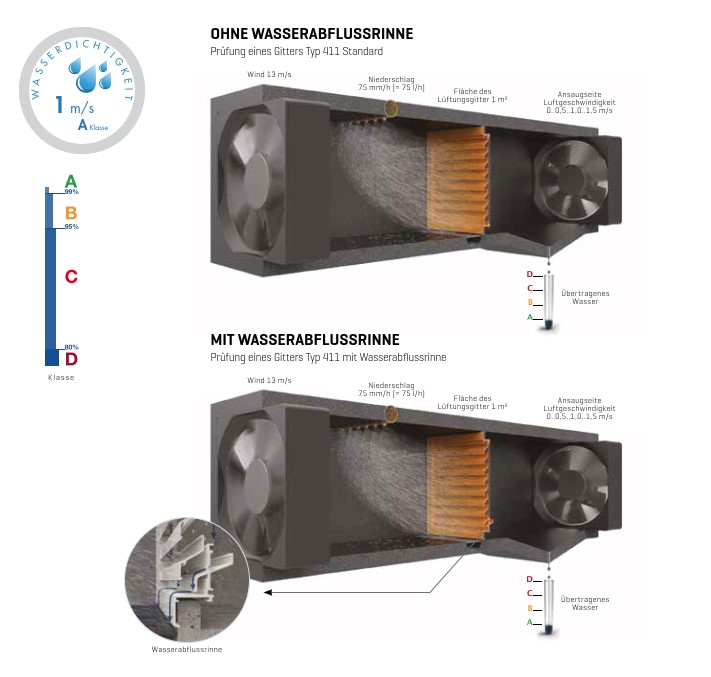 Water Tightness Test According to DIN EN 13030: The diagram shows a comparison between a ventilation grille without a water drainage channel and one with a water drainage channel.
Waterproofing Classes A, B, C, and D Explained in Simple Terms
The water resistance classes help designers better compare different ventilation grilles. Class A indicates very good water resistance. Class D indicates low water resistance. However, the respective air velocity must always be taken into account.| Water Resistance Rating | Rating | Water intrusion |
|---|---|---|
| A | Excellent water protection | 0 to 1 percent |
| B | Effective Water Protection | 1.1 to 5 percent |
| C | Normal or moderate water protection | 5.1 to 20 percent |
| D | Inadequate water protection | more than 20 percent |
Correctly Assessing Air Velocity on the Intake Side
The air velocity on the intake side is a key factor. The higher the air velocity, the more challenging it is to ensure water resistance. A ventilation grille can perform very well at low air velocities. At higher air velocities, however, the watertightness class may deteriorate. Therefore, a test value should not be interpreted in isolation. It is not enough to simply state a single class. The decisive factor is always the combination of class, air velocity, insect screen, water drainage channel, and the specific installation situation. For design firms, this means that the ventilation design and rain protection requirements must be integrated. When very high airflow volumes pass through small openings, air velocity and pressure loss increase. As a result, rain protection can become more critical.Calculate the preliminary grid area for planning purposes
This calculator can be used to estimate the required gross area of a ventilation opening based on the airflow rate and the desired maximum intake velocity. The result is not a substitute for project-specific design calculations.
Design Calculator for Ventilation Grilles
Enter your planning values and start the preliminary check.
The calculation uses: Gross area = airflow ÷ 3,600 ÷ intake velocity. Pressure loss, tested configuration, opening geometry, frame, insect screen, wind load, drainage, and manufacturer specifications must be verified on a project-by-project basis.
Planning Example
With an airflow rate of 10,000 m³/h and a maximum intake velocity of 1.0 m/s, the preliminary gross area is 2.78 m². For the Renson 450, with a physical free cross-sectional area of 57 percent, approximately 1.58 m² of this corresponds to the free cross-sectional area. As a square opening, the equivalent size is approximately 1.67 × 1.67 m. The final size also depends on pressure loss, installation conditions, rain protection requirements, and the selected model.Water Drainage Channel and Water Flange: A Small Feature with a Big Impact
Water drainage channels and water deflectors play an important role in weather-resistant ventilation grilles. They drain water in a controlled manner, thereby significantly improving water repellency. This point is particularly important because not every ventilation grille automatically includes a water drainage channel in its standard design. For weather-resistant ventilation grilles, Renson recommends the use of a water deflector or a drainage channel. Additionally, sealing the frame joints improves weather resistance. In practice, this very point often determines how well the system functions later on. If the inquiry, request for proposal, or order does not specify the water drainage channel, it may be omitted from the scope of delivery. Therefore, it should be specified early in the planning phase for weather-exposed facades, roof hoods, ventilation hoods, technical centers, transformer stations, and sensitive technical rooms. Furthermore, the connection details must be correct. Frame seams, sealing joints, drip edges, slopes, on-site drainage, and adjacent facade components together form the technical solution. Only then does a good ventilation grille become a reliable overall structure.Comparison: Ventilation grilles with and without a water drainage channel
A comparison between a model without a water drainage channel and one with a water drainage channel clearly illustrates the technical difference. The test summary confirms for grille types 411, 414, and 431 that the water drainage channel can improve water repellency. With a water drainage channel, types 411, 414, and 431 achieve Class A with 0.9 percent water penetration at an air velocity of 0.5 m/s on the intake side. At 1.0 m/s, the test summary lists Class B with 2.7 percent water penetration. Without a water drainage channel, however, the same grille type at 1.0 m/s falls into Class C with 6.7 percent water penetration. Therefore, the request for proposals must clearly specify the water drainage channel whenever rain protection plays an important role. Otherwise, the client may end up with a standard design, even though the installation situation requires better water drainage.Decision Matrix for Planners
The following matrix helps with the initial product selection. It is not a substitute for a project-specific evaluation, but it clarifies the technical direction.| Requirement | Appropriate Solution | Planning Note |
|---|---|---|
| Standard facade opening with normal weathering | Renson 411 or rotec W11 | Check the water drainage channel in exposed locations |
| High rain protection and high breathability | Renson 450 | Particularly suitable for data centers, power plants, IT applications, and technical facades |
| Excellent rain protection with a vertical facade effect | Renson 450V | Suitable for situations requiring high levels of rain protection and design flexibility |
| V Slats, Stability, and Water Resistance | Renson 452 | Suitable for technical systems and protected openings |
| Privacy protection, puncture resistance, and IP44 requirements | Renson 412 | Note the version with a water drainage channel and insect screen |
| Additional soundproofing is required | Soundproofing slats such as the L.150ACS | Check the rain protection separately and don't choose based solely on sound quality |
Renson 450: Special screen for very high rain protection

Renson 450V: Excellent rain protection with vertical louver action

Renson 452: V-shaped louvers for water resistance, stability, and technical systems
The Renson 452 is a water-repellent ventilation grille in a medium-duty design with V-shaped louvers. This design is particularly suitable when, in addition to rain protection, stability, privacy, and technical robustness are required. The technical data sheet describes the Renson 452 as a water-repellent ventilation grille in a medium-duty design with V-shaped louvers. It consists of AlMgSi 0.5 aluminum profiles and, in the standard version, is equipped with a 304 stainless steel insect screen measuring 6 x 6 mm. The document lists options including a water drainage channel, water deflectors, a removable insect screen, filters, and a version without a mounting frame. Typical applications include areas where high stability, weather resistance, and privacy are important selection criteria. High-voltage cabins are also mentioned. The technical data specifies a watertight rating of A4 at 1 m/s for the version with 6 x 6 mm wire mesh and a water drainage channel. Furthermore, an optical open area of 70 percent, a physical open area of 41 percent, IP2XD, and—for the aforementioned special version—IP44 are specified. This demonstrates once again that while the grille can achieve very good performance values, the specific design and air velocity remain crucial for proper planning.Renson 412: V-shaped louvers, privacy protection, and technical protection requirements
 Renson 412 ventilation grille with V-shaped louvers: a suitable solution for technical facades, sensitive equipment areas, and ventilation openings that require privacy protection, rain protection, and technical safety.
Renson 411 and rotec W11: Using Standard Grilles Correctly

Comparison Chart: Water Resistance of Various Renson Ventilation Grilles
The following table provides a preliminary technical overview. It is not a substitute for a project-specific review. However, it shows which types of grating are particularly relevant for rain protection and water resistance.| Grid Type | Main Function | Water resistance based on available test data | Planning Note |
|---|---|---|---|
| Renson 450 | Very high protection against rain and high breathability | A2 at 3 m/s according to the data sheet | Excellent for data centers, power plants, IT applications, coastal areas, and technical facades |
| Renson 450V | Very high rain protection with a vertical slat effect | A2 at 4 m/s according to the data sheet | Suitable for applications with high requirements for water repellency, air permeability, and façade aesthetics |
| Renson 452 | V Slats, Stability, and Water Resistance | A4 at 1 m/s according to the data sheet for the specified model | Suitable for technical facilities, high-voltage enclosures, and openings with privacy screens |
| Renson 412 | V. Louvers, Privacy Screens, and Technical Protection Requirements | A4 at 1 m/s according to the data sheet for the specified model | Suitable for IT rooms, high-voltage substations, and electrical equipment areas |
| Renson 411 or rotec W11 | Standard ventilation grilles for many types of facade openings | With a water drainage channel rated at 0.5 m/s (Class A) and 1.0 m/s (Class B) according to the test summary | A good standard solution; be sure to specify a water drainage channel for areas exposed to the elements |
| L.150ACS Soundproofing Slat | Ventilation, Weather Protection, and Sound Insulation | With a water drainage channel at 0.5 m/s (Class B) and at 1.0 m/s (Class C), according to the test summary | Recommended for acoustic requirements; however, check rain protection separately |
Water Resistance in Soundproofing Slats: Striking the Right Balance Between Rain Protection and Acoustics
Acoustic louvers are used when ventilation, weather protection, and sound reduction are all required simultaneously. Typical applications include mechanical rooms, evaporative cooling areas, rooftop systems, parking garages, ventilation centers, industrial facilities, and technical facades with heightened acoustic requirements. However, it is important to note during the planning phase that a soundproofing louver is not automatically the ventilation grille with the highest level of protection against driving rain. The acoustic design influences airflow, pressure drop, installation depth, water drainage, and installation conditions. Therefore, soundproofing and rain protection must be evaluated together. The test summary specifies Class A with 0.7 percent water penetration for the soundproofing louver 446/150 or L.150ACS with a water drainage channel at an air velocity of 0.0 m/s on the intake side. At 0.5 m/s, Class B with 3.4 percent is specified. At 1.0 m/s, Class C with 8.7 percent is specified. At 1.5 m/s, water penetration already falls into Class D with more than 20 percent. For designers, this means: Acoustic louvers can be a very sensible solution when sound insulation is a key project requirement. However, for facades exposed to severe weather, exposed roof systems, or sensitive utility rooms, it should also be verified whether a water drainage channel, water deflectors, connection details, drainage, or another special water-repellent grille is required. If sound attenuation is required in addition to rain protection, the selection should be made on a project-by-project basis. rotec can assist in finding the right balance between airflow, sound attenuation, pressure loss, rain protection, and installation conditions. Further information is available in the technical article A Comparison of Renson Soundproofing Louvers.Typical applications for ventilation grilles with enhanced water repellency
Ventilation grilles with enhanced water repellency are required wherever technical equipment needs to be protected. This includes data centers, power plants, transformer stations, technical control centers, machine rooms, ventilation centers, roof structures, and industrial buildings. A careful assessment is also advisable for parking garages, facade cladding, coastal locations, and freestanding utility buildings. In these locations, wind and rain often strike the facade openings directly. In Roof hoods and ventilation hoods Protection against the elements is particularly important here. Wind, rain, and snow often have a greater impact here than at sheltered wall openings. In addition, maintenance, drainage, and the connection to the roof waterproofing must be carefully planned.Avoiding Design Errors in Weather-Exposed Facades
A common mistake is focusing solely on the clear cross-sectional area. A high airflow capacity is important; however, it does not automatically indicate water resistance. A second mistake is failing to specify the water drainage channel. If it is not explicitly requested or specified in the bid, it may be omitted from the scope of delivery. This can lead to problems with openings exposed to the elements. A third mistake is confusing the watertightness class with the air resistance class. The letter denotes water repellency. The number describes the air resistance class. Both specifications must be evaluated separately. A fourth mistake occurs when the intake air velocity is not calculated. High air velocities can significantly affect rain protection. Therefore, air volume, grille area, and pressure loss should be planned early on. A fifth mistake concerns the connection details. Even a high-quality ventilation grille cannot fully fulfill its function if frame seams, connection joints, drip edges, and drainage are not properly planned.Request for Proposals: Specifically Name the Water Drainage Channel
In specifications, the water drainage channel should always be clearly specified when increased rain protection is required. General wording such as „supply weather protection grilles“ is often insufficient. A clear technical description is appropriate. It should include the type of grille, material, surface finish, insect screen, watertightness requirements, air velocity, water drainage channel, water flanges, connection details, and drainage.Text Template for Requests for Proposals
Supply of a water-repellent aluminum ventilation grille for weather-exposed facade openings, roof hoods, ventilation hoods, or technical building openings. The design must comply with DIN EN 13030 regarding water repellency. The required airflow rate, the air velocity at the intake side, the installation situation, and the connection details are decisive factors. In cases of increased rain exposure, a water drainage channel must be explicitly provided. In addition, water deflectors, frame seams, connection joints, slopes, and on-site drainage must be adapted to the specific installation conditions. The suitability of the selected ventilation grille must be verified on a project-by-project basis by the technical planning team.rotec provides support with selection, planning, and delivery
rotec assists architects, design firms, metal fabricators, facade contractors, construction companies, and industrial firms in selecting suitable ventilation grilles. In doing so, rotec takes into account the grille type, airflow, rain protection, water repellency, surface finish, fastening, installation, and the interface with the facade as a whole. For standard applications, the rotec W11 or Renson 411 may be a suitable solution. When there are high requirements for rain protection and airflow, rotec evaluates special water-repellent grilles such as the Renson 450, Renson 450V, Renson 452, or Renson 412. Acoustic requirements are evaluated separately for sound-insulating louvers. At its Berlin facility, rotec manufactures project-specific ventilation grilles, louver assemblies, roof hoods, and ventilation hoods. In-house metal fabrication, custom finishes, extensive experience with Renson systems, and a quality management system certified to DIN EN ISO 9001:2015 ensure reliable project execution. Customers can order standard models via the rotec Ventilation Grilles Profishop Select. Custom solutions and larger facade openings are coordinated directly with the engineering team.Technical Responsibility: Karl Marx, founder of rotec. This article was prepared based on the manufacturer’s documentation cited and rotec’s many years of planning experience.
Advice on Ventilation Grilles with Rain Protection
Are you planning an exposed facade opening, a roof hood, a ventilation hood, a technical facade, or a ventilation grille for sensitive equipment areas? For an initial technical assessment, rotec requires, if possible, the opening dimensions, the airflow rate, the flow direction, the desired maximum intake velocity, the surface finish and color, the location and weather exposure, insect protection, a water drainage channel, and the desired watertightness class. Coordinate the project with rotec View ventilation grilles in the ProfishopOverview of Standards and Manufacturer Documentation
The following primary sources support the preliminary technical review. The current manufacturer documentation and the project-specific technical plans remain authoritative.| Document | Content Relevant to Planning | Source |
|---|---|---|
| DIN EN 13030 | Test Methods and Classification for Weather Protection Grilles | DIN Media |
| rotec W11 / Renson 411 | 50 percent physical clear cross-sectional area and technical product data | Renson Data Sheet 411 |
| Renson 450 | Physical clear cross-sectional area of 57 percent and rain protection test | Renson Data Sheet 450 |
| Renson 450V | Technical Specifications for the Vertical Model | Renson Data Sheet 450V |
| Renson 452 | Physical clear cross-sectional area: 41 percent, and technical product data | Renson Data Sheet 452 |
| Renson 412 | Physical clear cross-sectional area: 39 percent, and technical product data | Renson Data Sheet 412 |
Downloads and Technical Documents
Data sheets, test reports, and technical specifications are particularly important for the technical design of ventilation grilles with enhanced water repellency. The following documents assist architects, design firms, metal fabricators, facade contractors, and technical buyers in the initial product selection process.- Download watertightness test reports in accordance with DIN EN 13030 for Renson ventilation grilles
- Download the Renson 450 Water-Repellent Ventilation Grille Data Sheet
- Download the Renson 450V Rain Protection Louver Data Sheet
- Download the Renson 452 V Louvered Ventilation Grille Data Sheet
- Download the Renson 412 V Louvered Ventilation Grille Data Sheet



 EN
 DE
 ES
 FR
 IT
 NL
 PL
 TR