

Retrofit your fence surveillance system before the first break-in occurs
The next morning, the damage becomes apparent. Cables are missing. Tools have disappeared. Vehicles have been damaged. In addition, repair costs, business interruptions, insurance issues, and an unpleasant sense of insecurity may arise.
This is exactly the problem that rotec APS Flexiguard solves. The system transforms a suitable existing fence into an actively monitored security perimeter. It detects typical mechanical attacks on the fence, such as cutting, climbing, prying, lifting, or tampering. As a result, the system alerts authorities to an attack while the perpetrator is still working on the fence.
A regular fence marks a boundary. A fence with barbed wire provides an additional deterrent. But only an electronic fence monitoring system can alert you when something is happening. That’s why rotec APS Flexiguard is particularly useful for unguarded commercial properties, industrial sites, recycling centers, solar parks, cable storage facilities, logistics sites, airports, military properties, and operators of critical infrastructure.
Retrofitting Fence Monitoring: A Quick Summary
Many industrial fences provide a sense of security but do not detect intrusions. As a result, operators often do not notice break-ins until damage has already occurred. rotec APS Flexiguard can monitor existing fences using sensors. The system operates without detectable high voltage and is therefore particularly well-suited for many facilities where an electric fence is not the appropriate solution.
Retrofitting fence monitoring, therefore, means more than just adding technology to the fence. Above all, it means earlier detection, better response, and greater control over the perimeter. rotec APS Flexiguard detects typical mechanical tampering with the fence and forwards relevant events to designated locations.
This transforms a passive barrier into an active security perimeter. The combination of NATO wire and rotec APS Flexiguard is particularly effective. Barbed wire mechanically hinders an attack, while rotec APS Flexiguard makes the attack detectable. rotec evaluates each system on a case-by-case basis, because the condition of the fence, gates, doors, vegetation, alarm zones, camera surveillance, and connection to the control center all determine the quality of the solution.
Retrofitting Fence Monitoring: How Operators Benefit from rotec APS Flexiguard
With rotec APS Flexiguard, an existing fence isn't just made taller or more visually intimidating—it's also monitored electronically. This creates a clear distinction from purely mechanical security measures.
The operator gains time because the system detects an attack earlier. Alarm zones help pinpoint the affected area. In addition, response options are improved because rotec APS Flexiguard forwards alerts to camera surveillance, the alarm system, security personnel, or the control center.
This time savings can be crucial, especially for unguarded commercial properties, off-site warehouses, airports, solar farms, and critical infrastructure. After all, the fence alone does not protect the site. What matters is whether an attack is detected early and properly escalated.
Why It Makes Sense to Retrofit Existing Fences with Fence Monitoring Systems
Many property owners have already invested a great deal of money in their fencing systems. Double-bar fences, industrial fences, lattice fences, chain-link fences, and palisade fences, in particular, look sturdy. If barbed wire or razor wire is also installed, it quickly gives the impression that the property is adequately protected.
But this impression can be dangerous.
A fence is, first and foremost, a physical barrier. It marks the property line and makes it difficult to gain access. It can slow down intruders. It can also act as a deterrent. However, without sensors, it cannot detect an attack.
Such a fence does not trigger an alarm when cut. Even an attempt to climb over it goes undetected. If an intruder lifts a section of the fence or operates in an area that is difficult to see, no alarm is triggered either.
This is precisely where the real risk lies. The operator has a perimeter fence but no early warning system. This creates a window of opportunity that perpetrators can exploit. The longer this window is, the greater the potential for damage, loss of equipment, and business interruption.
Anyone who has a fence monitoring system installed is closing exactly this security gap between the physical barrier and the active alarm notification. That’s why the key question shouldn’t be: Is my fence high enough? The better question is: Will I notice in time if someone is trying to breach my fence?
For more information on the overarching protection strategy, see the rotec article on Active outdoor security with a high-security fence.
Retrofit fence monitoring when barbed wire alone is no longer sufficient
NATO wire is an effective mechanical addition. It enhances protection against climbing over the fence and makes a fence system significantly more deterrent. However, without additional technology, NATO wire remains passive. It can make climbing over the fence more difficult, but it does not detect an intrusion.
If intruders cut through a section of fence below the barbed wire, no alarm will sound unless the breach is detected. If someone tampers with the anti-climb protection, the operator often doesn’t find out until later. Even a lifted section of fence remains invisible without sensors.
That is why barbed wire alone is not always sufficient. Especially in commercial areas with high-value materials, cables, machinery, vehicles, or critical infrastructure, a fence should not only be sturdy; it should also alert authorities if someone attempts to breach it.
rotec APS Flexiguard supplements this mechanical security measure with electronic detection. As a result, the existing fence remains part of the security concept. At the same time, it creates an active security perimeter that detects and reports typical attacks.
Retrofitting fence monitoring is a sensible next step, especially for existing barbed-wire systems, because it supplements the mechanical deterrent with electronic detection.
In line with this, rotec discusses the proper planning of Barbed Wire Installation, Uncoiled Length, and Bid Specifications.
Retrofit Fence Monitoring with Barbed Wire and rotec APS Flexiguard
NATO wire and Rotec APS Flexiguard do not have to be mutually exclusive. On the contrary: For many existing installations, combining the two can be particularly beneficial because each component serves a different purpose.
Barbed wire enhances mechanical deterrence. It makes it more difficult to climb over and clearly signals that an area is intended to be protected. However, without additional technology, barbed wire remains passive. It does not detect attempts to cut through it, climb over it, or tamper with the fence.
rotec APS Flexiguard fills exactly this gap. The system uses sensors to monitor the fence and detects typical mechanical impacts. When intruders cut, climb, pry, or tamper with the anti-climb protection, rotec APS Flexiguard detects these events and forwards the alerts.
This results in a particularly effective security strategy: The NATO wire delays and hinders the attack. rotec APS Flexiguard detects the attack and triggers an alarm. In this way, a purely mechanical security measure is transformed into an active security perimeter.
This combination is particularly appealing to operators of existing industrial fences. Following a technical inspection, the existing fence and barbed wire can often remain part of the security plan. At the same time, electronic fence monitoring significantly enhances the facility.
rotec always conducts a site-specific assessment to determine whether the condition of the fence, posts, fastenings, barbed wire top, gates, doors, vegetation, terrain, and alarm transmission are suitable for rotec APS Flexiguard. The result is not a one-size-fits-all standard solution, but a security concept tailored to the existing system.
The key message is simple: Your existing barbed wire was a step in the right direction. With rotec APS Flexiguard, it becomes an active, alarm-triggering security solution.
Retrofit Fence Monitoring and Continue Using Existing Fences
After a break-in, many property owners face the same question: Does the entire fence need to be replaced? The answer is: not always. If the existing fence is structurally sound, rotec can retrofit it with a fence monitoring system.
This is a significant economic advantage. After all, building a completely new fence involves high costs, a lengthy construction period, coordination efforts, and disruptions to ongoing operations. Access roads must be secured. Gates must be modified. Utility lines must be rerouted. In addition, temporary security vulnerabilities often arise during the construction phase.
A sensor-based retrofit makes use of existing structures, provided the fence is technically suitable. rotec inspects the existing fence and assesses whether rotec APS Flexiguard can be installed effectively. This is not just a matter of the fence’s length.
Key factors include the type of fence, fence height, post thickness, condition of the fence panels, fastenings, gates, doors, vegetation, terrain, existing cameras, and desired alarm routes.
Following a technical assessment, rotec converts a suitable existing fence into an active detection line. The operator continues to use the existing fence while still significantly increasing the level of security. This makes the investment easier to plan. In addition, rotec can often carry out the retrofit in practical sections.
Retrofitting a fence monitoring system does not change the purpose of the fence, but rather its role in the security plan.
Technical Information on the rotec APS Flexiguard Fence Monitoring can be found on the rotec Technology page.
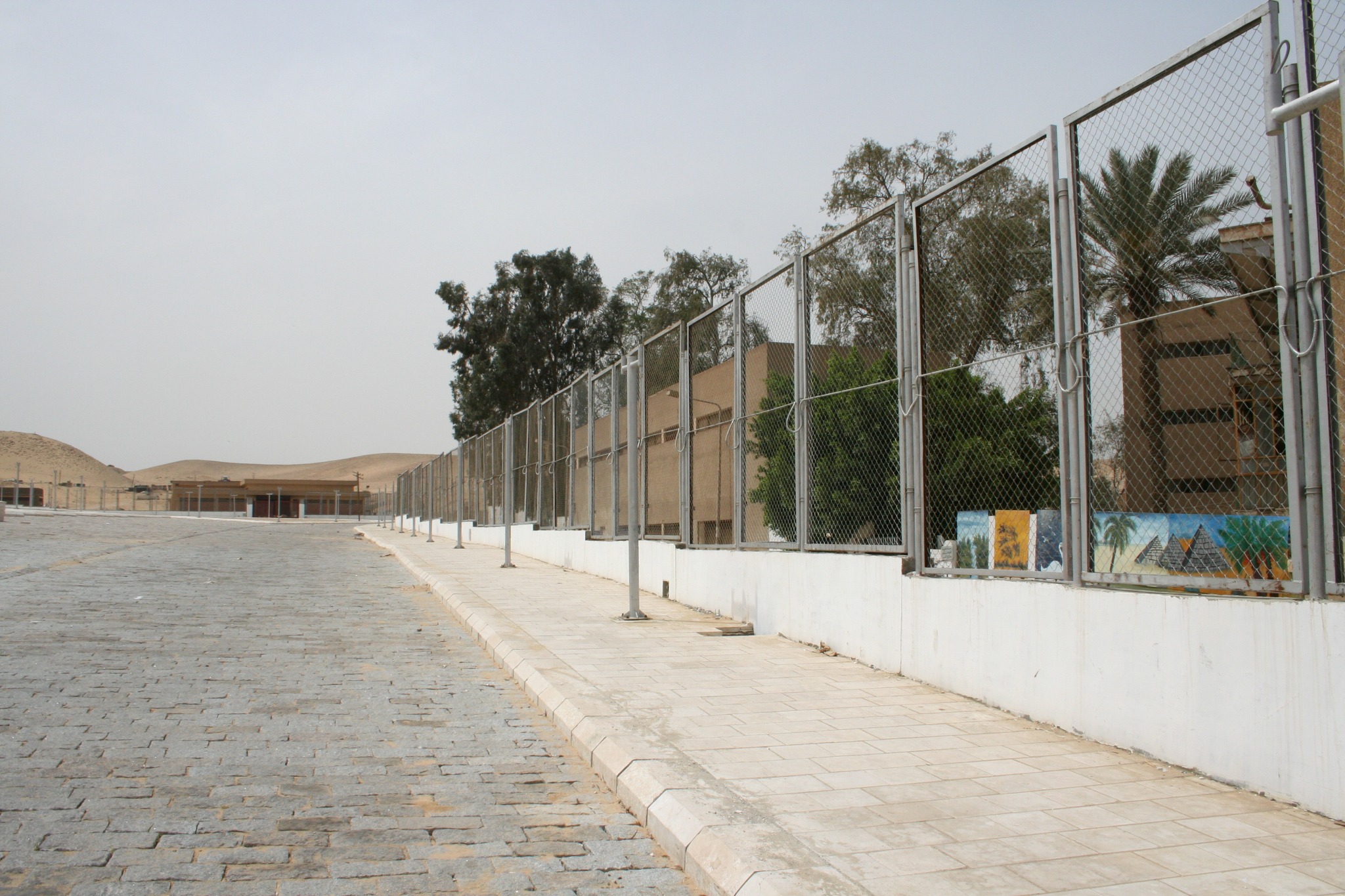 Existing fence systems can be monitored using the rotec APS Flexiguard sensor-based system, provided that the condition of the fence, its mounting, and the security requirements are technically suitable.
Retrofitting Fence Monitoring: A Before-and-After Comparison
Before the upgrade, the fence marks the property line but does not detect any intrusions. After the technical upgrade, rotec APS Flexiguard monitors the perimeter and detects typical tampering attempts.
Often, the operator doesn't notice the damage until the next morning. With rotec APS Flexiguard, an incident can be reported to security personnel, video surveillance, or the control center even while the attack is still in progress.
Without sensors, a fence system remains a passive barrier. Through sensor-based detection, rotec transforms it into an active component of the security concept.
While barbed wire provides mechanical protection, rotec APS Flexiguard supplements this security measure with electronic detection.
Retrofitting a fence monitoring system therefore does not diminish the value of the existing fence. Rather, rotec enhances the existing perimeter with advanced technology.
Retrofit Fence Monitoring with rotec APS Flexiguard: Detect Attacks on the Fence
Many security solutions only respond once the intruder is already on the premises. rotec APS Flexiguard takes action earlier. The system detects the attack at the fence—that is, right where the intruder is attempting to breach the perimeter.
The system consists of a sensor cable and a control unit. rotec attaches the sensor cable to the inside of the fence, where it detects mechanical vibrations along the monitored section. The control unit analyzes typical events, such as cutting, climbing, prying, or tampering.
For operators, this means that the fence gains technical awareness. It is no longer just a silent barrier. If someone is working on the fence, rotec APS Flexiguard can detect and report the event. This allows for an earlier response.
This early detection is the key benefit. After all, not every perpetrator is deterred by the system’s appearance alone. If an attack is detected as soon as it reaches the fence, the risk to the perpetrator increases. At the same time, the operator gains valuable time.
This time frame can determine whether damage is limited or a break-in is thwarted early on.
For technical planners, retrofitting fence monitoring is particularly interesting when existing fences, alarm systems, and camera surveillance are to be integrated into a single system. If you’d like to explore this topic beyond individual fence systems, you’ll find more information in the rotec technical article Retrofit Perimeter Protection with rotec APS A comprehensive overview of perimeter security for existing fences, walls, gates, solar farms, industrial sites, and critical infrastructure.
The Electronic Fence Monitoring with rotec APS Flexiguard This makes it particularly appealing to operators who want not only to reinforce their existing fence but also to actively monitor it.
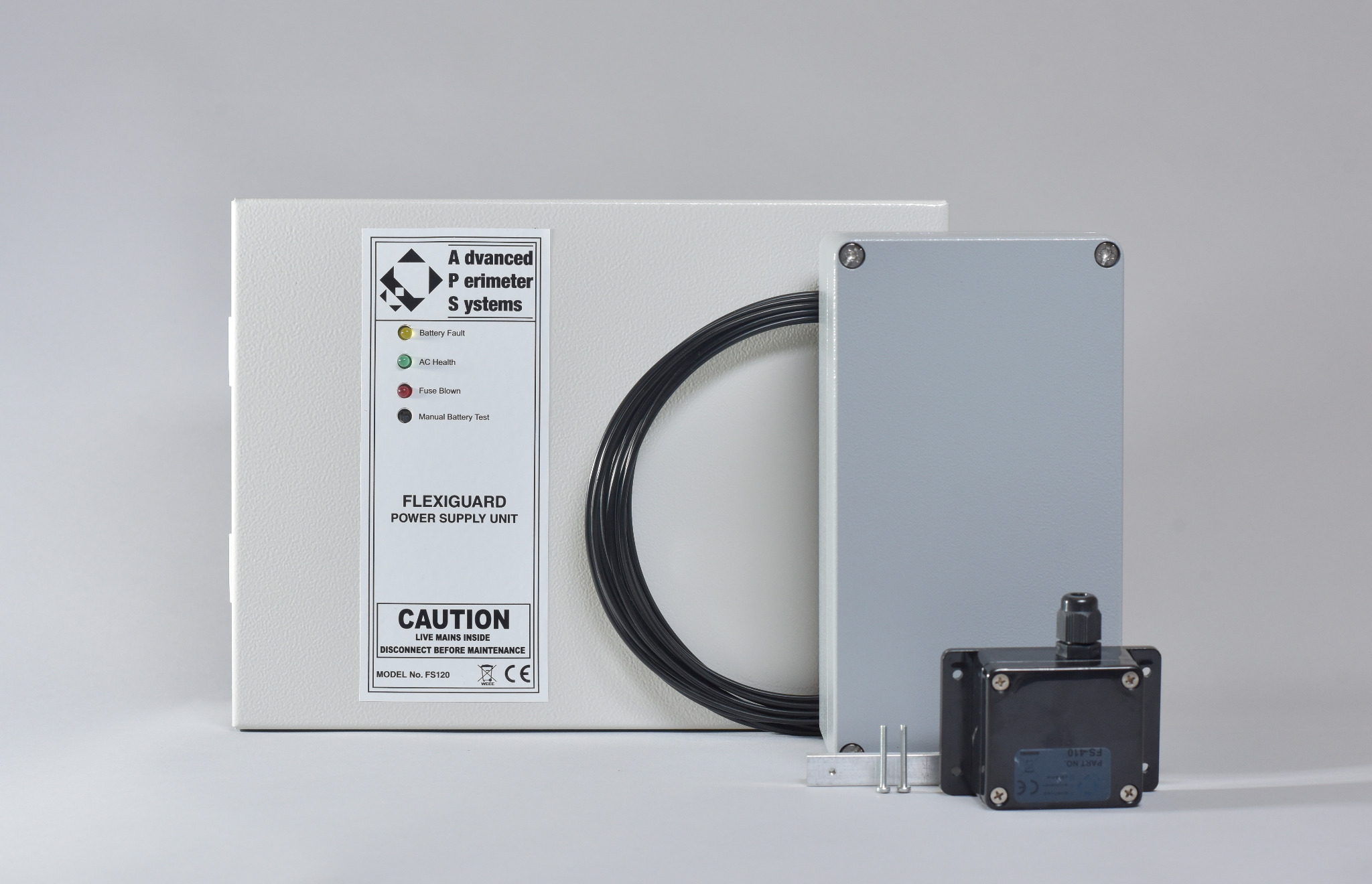 rotec APS Flexiguard FS30X Kit with control unit, sensor cable, and connection components for sensor-based fence monitoring.
rotec APS Flexiguard FS30X Technical Data Sheet
For technical planners, security managers, and operators, rotec also provides the technical data sheet for the rotec APS Flexiguard FS30X. It clearly outlines the operating principle, sensor cables, control unit, alarm types, zoning, RS485 network connection, MULTISYS integration, technical specifications, and planning guidelines.
Download the rotec APS Flexiguard FS30X Technical Data Sheet
Retrofitting Electronic Fence Monitoring Without Perceptible High Voltage
rotec APS Flexiguard operates without detectable high voltage. This distinguishes the system from a rotec APS electric fence. This feature makes Flexiguard particularly appealing for locations where a purely passive detection solution is desired or where existing barbed wire needs to be retained.
The system uses a sensor cable that detects mechanical vibrations along the fence. This allows for the early detection of attempts to climb over, cut through, pry open, or tamper with the fence.
The term used in security technology is "PIDS alarm system." PIDS stands for Perimeter Intrusion Detection System. In German, this refers to a system for detecting attempted intrusions along the property boundary.
A PIDS alarm system is not a standard fence. It is a technical perimeter monitoring solution. It detects relevant events and can relay them to a control unit, alarm system, video surveillance system, security service, or monitoring center.
Retrofitting fence monitoring is therefore particularly useful when operators do not want to use an electric fence but still need an active alarm system along the perimeter.
The operator receives an electronic fence monitoring system without the fence having to be an electrified fence. At the same time, rotec can integrate the system with camera surveillance, an alarm system, a control center, or a higher-level security management system.
However, it’s important to note that not every fence is automatically suitable. rotec always conducts a site-specific assessment. Loose components, heavy vegetation, unstable posts, poorly secured panels, or unsuitable gate areas can all affect the planning process.
That is why rotec does not sell off-the-shelf solutions, but first assesses the existing security perimeter.
Retrofit Fence Monitoring with Sensor Cable and Stainless Steel Sheathing
An important technical detail is the sensor cable with a stainless steel sheath. This robust sheath provides mechanical protection for the detection cable and supports its use in demanding perimeter security applications. Especially for outdoor facilities, industrial sites, airports, solar parks, or critical infrastructure, detection alone is not enough.
The mechanical strength of the components used is also important.
The sensor cable is attached to the fence and detects mechanical vibrations. When intruders cut, climb, pry, or tamper with the fence, typical movement patterns are generated. The sensor cable transmits these signals to the control unit.
The control unit evaluates the signals and triggers an alarm message when relevant events occur. The combination of the sensor cable, control unit, and video surveillance makes the alarm actionable. After all, a signal alone is not enough. What matters is that the alarm is technically processed, evaluated, and forwarded to the right place.
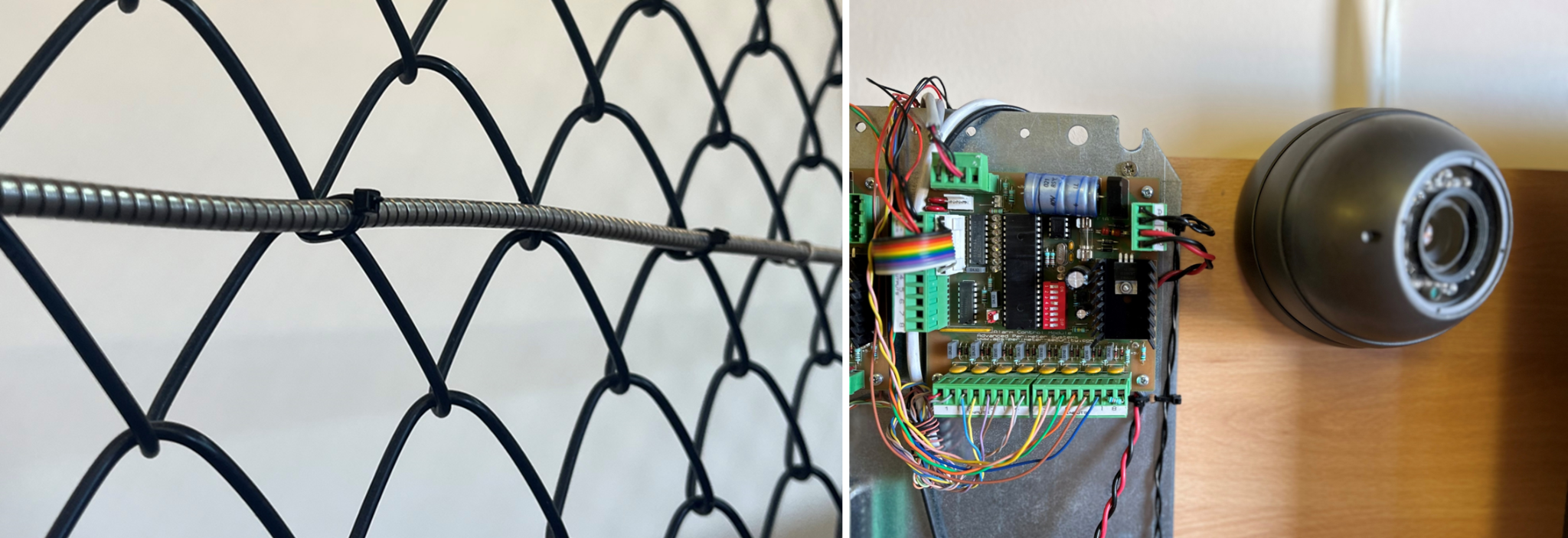 rotec APS Flexiguard sensor cables with stainless steel sheathing, analyzers, and camera monitoring demonstrate the integration of detection, evaluation, and visual event verification.
Retrofit Fence Monitoring with Two Versions of rotec APS Flexiguard
Not every site has the same risk profile. That is why the electronic fence monitoring system must be tailored to the specific task. rotec APS Flexiguard can be considered in two basic configurations, depending on the project.
Option 1: Retrofitting Fence Monitoring to Existing Fence Systems
This option is particularly relevant for many industrial sites, commercial properties, storage areas, recycling centers, solar farms, logistics facilities, and critical infrastructure. The sensor cable is attached to suitable sections of the fence. The control unit evaluates the mechanical signals. In the event of relevant incidents, the control unit triggers an alarm.
This option is particularly suitable for double-bar fences, chain-link fences, mesh fences, palisade fences, and other suitable existing fences. A technical inspection of the existing structure is always essential.
The more stable and well-defined the fence is, the better detection can be planned.
Typical incidents include cutting attempts, climbing attempts, levering motions, lifting fence panels, tampering with the anti-climb protection, and attempts to sabotage the system.
Option 2: Perimeter Monitoring for Sensitive and Potentially Explosive Areas
The second option is particularly suitable for highly sensitive or potentially explosive areas. Depending on the project, these may include chemical plants, tank farms, petrochemical sites, ammunition depots, mining sites, fuel storage facilities, or other high-risk areas.
In such areas, it’s not just about burglary protection. It’s also about ensuring that the technology used is designed safely. For particularly sensitive systems, rotec therefore assesses which design is required and what technical requirements apply.
For rotec, this means that the solution must be evaluated not only from a safety perspective but also with regard to the specific location. The result is not a one-size-fits-all solution, but a safety concept tailored to the specific risk profile.
When It Doesn't Make Sense to Retrofit Fence Monitoring Without an Inspection
rotec APS Flexiguard is not a one-size-fits-all solution for every fence. It is precisely this honesty that is important, because the quality of detection depends heavily on the specific conditions of the site.
Heavily damaged fence panels, loose posts, heavy vegetation, unsuitable gates, or components that move significantly can affect detection. Unfavorable cable routing, a lack of power supply, or unclear alarm pathways must also be taken into account.
That is why rotec inspects every system in advance. If the existing system is not suitable, rotec recommends repairs, modifications, or an alternative safety solution.
This provides planning certainty. It also helps avoid false expectations. After all, a good security strategy doesn't start with the product, but with an honest assessment of the existing perimeter.
Retrofitting Fence Monitoring for Long Fence Systems with Alarm Zones
For short fences, a simple notification may be sufficient. The situation is different for long perimeters. If a site has several hundred meters of fencing, the security team must not only know that an alarm has been triggered; it must also know where the attack is taking place.
That is why rotec divides long fence systems into practical alarm zones. A zone can cover a specific section of fence, a gate system, an area that is difficult to see into, or a particularly vulnerable spot.
This is particularly important for facility operators. After all, an inaccurate alarm notification wastes time. If a security team first has to search the entire fence, it loses valuable minutes. If, on the other hand, the system identifies the specific section affected, the response can be more targeted.
This benefit is even greater when rotec integrates cameras. In that case, the appropriate camera displays the affected area. This allows a security team or control center to more quickly verify what is actually happening at the fence.
For long fence systems, retrofitting fence monitoring therefore also means dividing the perimeter into sections that can be easily identified and analyzed.
Retrofitting Fence Monitoring with Camera Surveillance and Control Center Integration
An alarm notification is only useful if it is followed by a clear process. Who receives the notification? Who verifies the incident? Which camera shows the affected area? Who goes to the site? And what information does the control center receive?
For this reason, electronic fence monitoring should not be planned in isolation. It must be part of an alarm chain. rotec APS Flexiguard can be integrated with camera surveillance, alarm systems, security services, or control center connections.
This connection is particularly important for unattended commercial properties. An alarm must not simply go off somewhere and then go unnoticed. It must be assessed and handled.
If video surveillance is in place, the security team can monitor the affected area. An integrated control center responds according to a predetermined procedure.
This is how a technical signal is transformed into a practical security concept.
Retrofitting fence monitoring is particularly effective when detection, video verification, and the response process work together seamlessly.
For larger facilities, integration into overarching security solutions may be advisable. This allows for the consolidation of fence monitoring, video surveillance, alarm systems, and connection to control centers. rotec can plan such concepts and provide technical support.
Comparison: Barbed wire, camera, electric fence, and Rotec APS Flexiguard
Many operators wonder which solution is the right one. The answer depends on the location, the risk, the existing fence, and operational procedures.
Natural wire
Barbed wire enhances protection against climbing over the fence and acts as a deterrent. It is particularly useful in situations where a clear mechanical barrier is desired. However, barbed wire does not detect an intrusion. It does not detect a cut in the fence panel or any tampering along the perimeter.
Video Surveillance
Video surveillance aids in visual inspection and documentation. It is particularly valuable when an incident needs to be assessed. However, a camera does not automatically replace detection at the fence. Blind spots, darkness, weather conditions, incorrect viewing angles, or a lack of event logic can limit its effectiveness.
rotec APS Electric Fence
A rotec APS electric fence can deter, detect, and trigger an alarm. It is particularly useful when active deterrence via electrical pulses is desired and permitted. However, the specific design must be evaluated on a project-by-project basis and in accordance with applicable standards.
rotec APS Flexiguard
rotec APS Flexiguard operates using sensors and does not involve any detectable high voltage. It monitors mechanical tampering with the fence and can be retrofitted to suitable existing fences. This makes it particularly appealing when an existing fence is to be reused or when barbed wire is already in place.
Combination of NATO wire and rotec APS Flexiguard
The combination of barbed wire and rotec APS Flexiguard is particularly useful for existing industrial fences. Barbed wire provides a physical deterrent and makes it difficult to climb over the fence. rotec APS Flexiguard complements electronic detection and can alert authorities to attempts to breach the fence.
This results in a solution that continues to utilize existing security components and actively monitors the perimeter.
The most effective solution often comes from combining different approaches
In many projects, the best results are not achieved through a single product. It often makes sense to combine a physical barrier, electronic fence monitoring, video surveillance, alarm systems, connection to a control center, and clear intervention. This systems-based approach is precisely what rotec is all about.
Retrofitting Fence Monitoring Systems for Gates, Doors, and Driveways
Gates, doors, and driveways are particularly critical components of many fencing systems. While a straight section of fence is relatively easy to monitor, technical challenges often arise at these points of transition. This is precisely where perpetrators often try to exploit vulnerabilities.
That is why, during every planning phase, rotec evaluates not only the fence panels but also sliding gates, swing gates, pedestrian gates, driveways, and crossings. With rotec APS Flexiguard, gate areas can be integrated into the security concept on a project-by-project basis.
These include appropriate sensor cables, connection components, non-sensor cables, evaluation units, and defined alarm zones. rotec designs a double-leaf gate system so that the system also effectively monitors opening areas and adjacent fence sections.
The technical design always depends on the existing conditions. That is why rotec evaluates the door size, door type, direction of movement, mounting, cable routing, power supply, existing safety systems, and desired alarm forwarding.
This does not result in a one-size-fits-all solution, but rather in a site-specific concept for the entire perimeter.
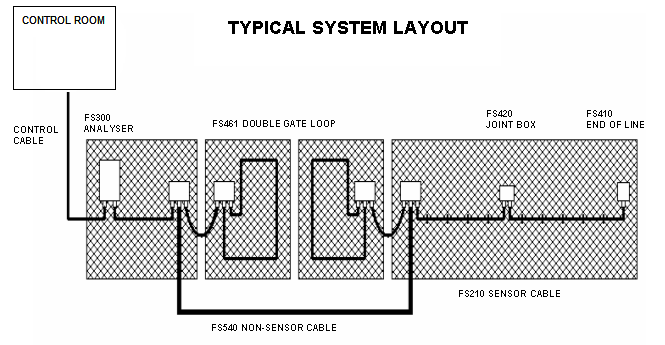 Schematic diagram of a double-leaf gate system featuring rotec APS Flexiguard, Sensor Cable, Non-Sensor Cable, Joint Box, End of Line, and Analyser.
Retrofitting Fence Monitoring: A Practical Example—486 Meters of Double-Bar Fence
The operator of an unguarded commercial property in Cologne has a 486-meter-long double-wire mesh fence topped with barbed wire. At first glance, the fence appears to be well secured. Nevertheless, there have been repeated break-ins. The perpetrators cut openings in the fence and took advantage of areas that were difficult to see into.
This presents a common problem for the operator. The fence is in place. The barbed wire is in place. Yet there is no active alarm system. The damage is not discovered until after the break-in has already occurred.
In such a situation, rotec APS Flexiguard may be a suitable solution. rotec would first inspect the existing fence. This involves assessing the fence height, post thickness, condition of the mesh panels, gates, doors, vegetation, terrain, lighting, and existing cameras.
rotec can then develop a plan with appropriate alarm zones. With 486 meters of fencing, this division is particularly important. After all, the security team must not only know that an attack is taking place; it must also know exactly which section of the fence is being breached.
If rotec integrates additional cameras, the appropriate camera displays the relevant area. This provides a better basis for assessment and intervention. So the operator doesn't just get technology—they get a solution to their specific problem.
Retrofitting Fence Monitoring Systems for Airports, Military Facilities, and Critical Infrastructure
The more sensitive a site is, the more important early detection at the perimeter becomes. Airports, military facilities, correctional facilities, energy plants, water treatment plants, data centers, telecommunications sites, and other critical infrastructure sites require more than just a visible property boundary.
Systems of this type are used internationally in areas that require a high level of protection. These include airports, military facilities, industrial sites, utility facilities, and other security-critical locations.
rotec applies this system logic to the rotec APS environment and designs each system on a project-by-project basis. In doing so, rotec takes into account the existing fencing, safety zones, alarm routes, and operational requirements.
For rotec, this leads to a clear positioning. rotec APS Flexiguard is not just a solution for a simple commercial fence. It is part of a professional system designed for sophisticated perimeter security.
Early detection is a critical security factor, especially in situations where operational disruptions, sabotage, vandalism, cable theft, or unauthorized access can have serious consequences.
At the same time, rotec remains deliberately realistic. No system can make a site completely secure. But a good perimeter security concept can reduce risks, help detect attacks earlier, and buy time to respond.
In line with this, rotec discusses the topic on its blog Protecting Power Poles and Critical Infrastructure.
Retrofit Fence Monitoring and Reduce False Alarms Through Planning
A fence is located outdoors. As a result, it is exposed to wind, rain, hail, temperature fluctuations, animals, vegetation, and loose components. Professional fence monitoring must take these environmental factors into account.
rotec APS Flexiguard uses intelligent analysis and object-specific parameterization to achieve this. The goal is reliable detection with a reduced tendency for false alarms.
Nevertheless, a blanket statement such as “no false alarms” would be unreliable. Proper planning is crucial. A sturdy fence, proper installation, appropriately configured alarm zones, correct parameter settings, tested wiring, and regular maintenance are essential.
That is exactly why rotec tests every system in advance. After all, the quality of a security solution is not determined by the product alone. It depends on the interaction between the fence, the surroundings, the sensors, the analysis, the camera, and the response process.
For which operators is retrofitting fence monitoring particularly worthwhile?
Retrofitting fence monitoring is particularly worthwhile in areas where outdoor spaces are valuable, at risk, or unguarded. This applies to many industries.
Retrofitting a perimeter surveillance system is particularly worthwhile when outdoor areas contain valuable assets or are not continuously monitored outside of business hours.
Retrofitting Fence Monitoring Systems for Industrial and Commercial Use
Industrial facilities and commercial properties often store machinery, raw materials, spare parts, vehicles, tools, or high-value goods outdoors. When these areas are unattended at night or on weekends, the risk increases. Electronic fence monitoring can detect perimeter breaches earlier.
Fence Monitoring for Recycling Centers and Metal Dealers
Recycling facilities, scrap dealers, and metal trading companies are particularly at risk because metals, cables, and recyclable raw materials are attractive to criminals. Active fence monitoring can help detect attacks earlier, especially at these locations.
Retrofitting Fence Monitoring for Solar Parks and Energy Facilities
Solar farms have long perimeter fences and are often located in remote areas. Cable theft can cause significant damage, downtime, and repair costs. rotec has already addressed this issue in a blog post Effectively Preventing Cable Theft in Solar Parks.
Fence Monitoring for Logistics Facilities and Cable Warehouses
Logistics facilities, off-site warehouses, and cable warehouses require clear alarm procedures because perpetrators often strike at night or on weekends. A combination of perimeter fencing, video surveillance, and connection to a monitoring center can be particularly effective in these situations.
Retrofitting Fence Monitoring for Critical Infrastructure
Operators of critical infrastructure require special attention. Unauthorized access that goes unnoticed can cause more than just property damage; it can also affect operational processes, the security of supply, and public safety. For this reason, the perimeter should be monitored early on.
Fence Monitoring for Airports and Military Properties
Airports and military facilities have strict security requirements. In these locations in particular, a multi-layered security approach—combining physical barriers, detection systems, video surveillance, and defined response protocols—is essential. Depending on the project, rotec APS Flexiguard can be part of such a security approach.
Retrofitting Fence Monitoring: The rotec Installation Process in 7 Steps
1. Understanding the Security Issue
rotec first determines what has happened so far and which areas are particularly at risk. Have there been any break-ins? Was the fence cut? Were any cables stolen? Are there any areas not covered by camera surveillance? This information is important because it influences the planning that follows.
2. Inspect the existing fence
rotec then assesses the existing fence system. This includes the type of fence, fence height, post thickness, condition of the fence panels, fastenings, gates, doors, vegetation, and the topography of the site.
3. Identify Vulnerabilities
Areas with limited visibility, passageways, gateways, previous problem areas, and areas with a high likelihood of criminal activity are given special consideration.
4. Plan Alarm Zones
rotec divides the perimeter into logical detection zones. This makes it easier for security personnel to identify the source of an alarm later on.
5. Fine-tune the technology
rotec inspects sensor cables, control units, cable routes, power supplies, housing positions, and interfaces with existing equipment.
6. Integrate the camera and control center
If desired, rotec can integrate fence monitoring with CCTV, an alarm system, a security guard service, or a control center.
7. Ensure Proper Installation, Commissioning, and Service
After installation and configuration, rotec provides training to the operator. rotec also offers maintenance, inspection, repair, and service contracts.
Retrofitting Fence Monitoring: What Data Rotec Needs for Testing
Specific details help us provide a quick and well-founded initial assessment. The better the initial data, the more accurately rotec can evaluate feasibility.
- Total length of the fence system
- Fence type, such as double-bar fence, chain-link fence, or picket fence
- Fence Height and Existing Climb-Over Protection
- Post Thickness and Post Spacing
- Number and Size of Goals
- Number and size of doors
- Photos of fences, gates, doors, and critical areas
- Geographic data or a map from Google
- Information on Existing Video Surveillance
- Information about any existing alarm system or monitoring center
- Description of Previous Breaches and Damaged Areas
- Desired alarm forwarding to the operator, security service, or control center
Based on this information, rotec can make an initial technical assessment. If necessary, this is followed by a detailed inspection of the property.
Why Rotec Is the Right Partner for Retrofitting Fence Monitoring Systems
Anyone looking to retrofit a fence monitoring system should consider not only the product itself, but the entire security process at the site. Retrofitting a fence monitoring system is not just about the sensors. It’s about the entire property. A fence can be sturdy or flimsy. Gates can have vulnerabilities. Vegetation can interfere with detection. Cameras can be improperly positioned. Alarm routes can be unclear.
That is why rotec brings together a range of expertise. This includes metal fabrication, fencing, outdoor security, safety technology, installation, maintenance, and service. It is precisely this combination that is crucial for existing facilities.
rotec does more than just supply a sensor cable. rotec inspects the existing fence, identifies weak spots, plans alarm zones, integrates gates and doors, and, upon request, connects the fence monitoring system to cameras, an alarm system, or a control center.
In addition, rotec places great emphasis on quality and transparent processes. Certifications such as DIN EN ISO 9001:2015, DIN EN 1090-1/2 EXC 1 and 2, and DIN EN ISO 3834-3 reinforce confidence in technical project management and manufacturing quality.
For operators, this means: rotec identifies the problem, assesses the existing system, and develops a suitable solution.
You can find more information about the company on the website of the rotec Berlin Metalltechnik GmbH.
For more information about the specialized system environment, visit rotec Open-Field Security and Perimeter Protection.
Tender Module for Retrofitting Fence Monitoring
The contractor will supply and install a sensor-based electronic fence monitoring system to retrofit an existing fence. The system detects mechanical attacks on the fence, specifically attempts to cut through it, climb over it, pry it open, lift fence panels, and tamper with the anti-climb protection.
The contractor divides the facility into appropriate alarm zones. Appropriate control units evaluate the signals and forward alerts to the alarm system, control center, security service, video management system, or comparable higher-level systems.
Prior to installation, the contractor will inspect the existing fence, gates, doors, fence posts, cable routing, power supply, and environmental conditions. Commissioning, parameterization, training, and a maintenance plan are included in the scope of services.
Conclusion: Retrofit fence monitoring to detect break-ins sooner
Anyone looking to retrofit a fence monitoring system usually has a specific problem. While the existing fence may appear sturdy, it does not detect an intrusion. That is precisely where the risk lies. Intruders gain time, while operators cannot respond until the damage is already visible.
rotec APS Flexiguard addresses this problem at its source. The system uses sensors to monitor suitable existing fences and detects typical mechanical breaches along the perimeter. This transforms a passive fence into an active security solution.
It is particularly effective when combined with existing barbed wire. Barbed wire makes it more difficult to climb over and increases the deterrent effect. rotec APS Flexiguard fills in the missing detection capability. This transforms mechanical protection into an active security perimeter.
This retrofit is particularly beneficial for operators of commercial properties, industrial sites, recycling centers, solar farms, logistics facilities, airports, military properties, and critical infrastructure. This is because it improves response times, enhances security, and allows for the continued use of existing fencing systems, provided they are technically suitable.
Retrofitting fence monitoring is therefore not just a cosmetic addition. It is a deliberate step from a passive fence to active perimeter protection.
If you would like to secure your existing fence, rotec will inspect the structure on a case-by-case basis. Please send us the fence length, fence type, fence height, post thickness, gate dimensions, door dimensions, photos, and geographic data. rotec can then prepare an initial technical assessment.
Technical Data Sheet for Your Professional Planning
If you would like to verify the technical suitability of this product for your project, you can download the technical data sheet for the rotec APS Flexiguard FS30X and forward it to your engineering team, safety department, or procurement office.
Download the rotec APS Flexiguard FS30X technical data sheet as a PDF
rotec Berlin Metalltechnik GmbH
58 Werner Voss Damm
12101 Berlin
Phone: +49 30 789039 50
Email: info@rotec-berlin.de
Website: www.rotec-berlin.de
Outdoor Security: www.freilandsicherung.org
Profishop: www.rotec-profishop.de
FAQ: Retrofitting Fence Monitoring with rotec APS Flexiguard
Is it possible to retrofit a fence monitoring system to an existing double-wire mesh fence?
Yes, in principle, this is possible depending on the condition of the fence. To determine this, rotec inspects the fence height, posts, fastenings, gates, doors, vegetation, and environmental factors. Based on this, it can be assessed whether retrofitting with rotec APS Flexiguard is feasible.
Is the combination of NATO wire and rotec APS Flexiguard a good idea?
Yes, this combination can be very effective for many existing installations. Barbed wire makes it mechanically difficult to climb over the fence. rotec APS Flexiguard complements the electronic detection system and alerts you to any attempts to breach the fence.
Can barbed wire be left in place when using a Rotec APS Flexiguard fence monitoring system?
In many cases, existing barbed wire can remain in place following a technical inspection. rotec APS Flexiguard does not function as an electric fence, but rather as a sensor-based detection solution. Nevertheless, each site must be evaluated individually.
Is rotec APS Flexiguard an electric fence?
No. rotec APS Flexiguard is not an electric fence system with detectable high voltage. The system uses a sensor cable that detects mechanical vibrations on the fence and reports relevant events.
What is a PIDS alarm system?
A PIDS alarm system is a perimeter intrusion detection system. It detects attempted intrusions along the outer perimeter of a property. With rotec APS Flexiguard, this detection is achieved using a sensor cable installed along the fence.
How does rotec APS Flexiguard detect an attempted break-in?
The system detects typical vibrations and movement patterns along the fence. These occur, for example, when cutting, climbing, prying, lifting, or tampering with the fence. The control unit analyzes the signals and can trigger an alarm.
Can the rotec APS Flexiguard detect when a fence is cut through?
Yes, the system is designed to recognize cutting attempts on the fence as a relevant attack pattern. However, the actual detection quality depends on the fence, the installation, the configuration, and the environment.
Which is better: an electric fence or sensor-based fence monitoring?
That depends on the location. An electric fence provides active deterrence through electrical pulses. rotec APS Flexiguard operates without detectable high voltage and detects physical tampering with the fence. rotec evaluates each property individually to determine which solution is most appropriate.
How does retrofitting fence monitoring work for long fences?
A long fence is divided into logical alarm zones. This makes it possible to identify in which section an intrusion is occurring. This simplifies camera assignment, monitoring center verification, and response.
Can gates and double-leaf gate systems be integrated?
Yes, gate systems can be integrated into the surveillance plan on a project-by-project basis. To do so, rotec evaluates the gate type, gate size, direction of movement, cable routing, mounting, and desired alarm routing.
Can the perimeter alarm system be connected to cameras?
Yes, rotec APS Flexiguard can be integrated with CCTV, PTZ cameras, alarm systems, control centers, and security services. This allows alarms to be visually verified and better documented.
For which companies is it worth retrofitting fence monitoring?
Retrofitting fence monitoring systems is particularly beneficial for industrial facilities, logistics sites, storage areas, recycling centers, energy plants, solar parks, business parks, airports, military properties, and critical infrastructure.
How does rotec APS Flexiguard reduce false alarms caused by wind and rain?
The system uses intelligent analysis and is configured on a property-by-property basis. This makes it easier to distinguish weather-related signals from typical intrusion patterns. In addition, installation, the condition of the fence, and maintenance are critical factors.
Does the existing fence need to be completely replaced?
Not necessarily. If the existing fence is structurally sound, rotec APS Flexiguard can be retrofitted. However, if any sections of the fence are damaged or unstable, it may be advisable to repair them first.
What information does rotec need to provide an initial quote?
It is helpful to provide the fence length, fence type, fence height, post thickness, number and size of gates, number and size of doors, photos, geographic data, and details regarding the desired alarm forwarding.
Is there a special version for areas at risk of explosion?
Yes, there are suitable system variants available for particularly sensitive or potentially explosive areas. rotec assesses on a project-by-project basis whether such a design is necessary.
People also often search for: What alternatives are there to electric fences made of barbed wire?
Sensor-based fence monitoring can be a practical alternative. rotec APS Flexiguard operates without detectable high voltage and, following a technical inspection, can electronically monitor suitable existing fences.
Frequently searched for: Is there a better way to secure unguarded company premises?
Yes, through a combination of mechanical security measures, electronic fence monitoring, CCTV, alarm transmission, and decisive intervention. rotec develops site-specific security concepts for this purpose.




 EN
EN  DE
DE  ES
ES  FR
FR  IT
IT  NL
NL  PL
PL  TR
TR