
Published on February 5, 2026 · Updated on
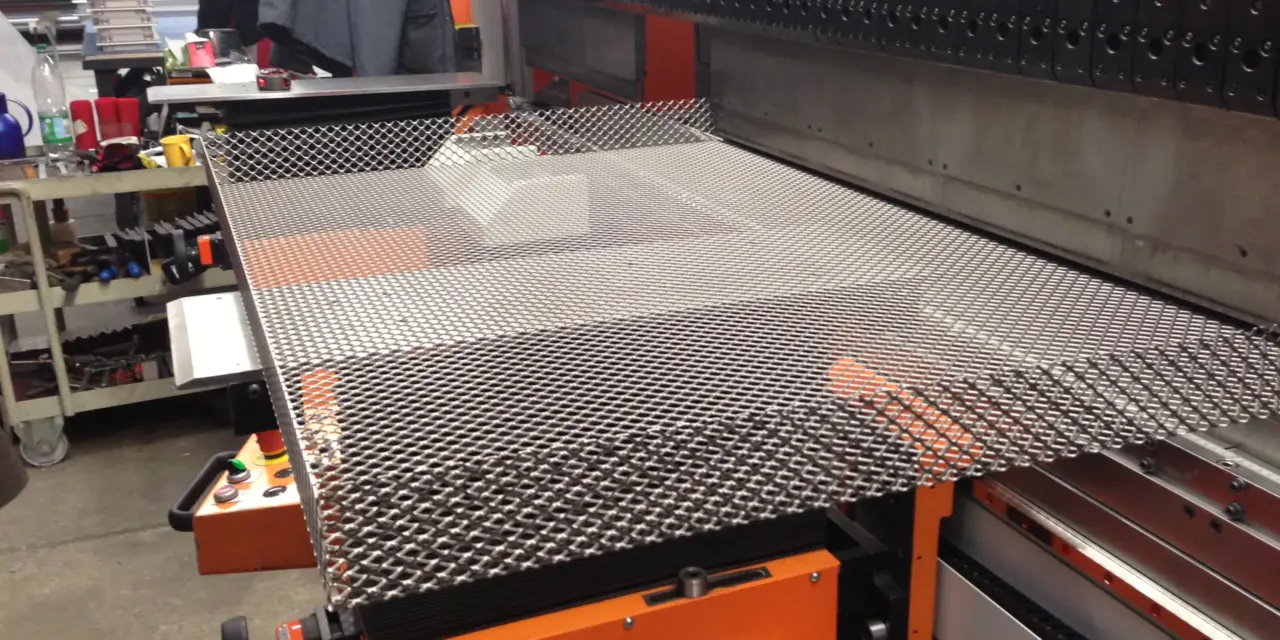
Cutting and Bending Expanded Metal in Berlin: rotec processes expanded metal into custom-cut pieces, framed panels, and ready-to-install assemblies. For railings and facades, we deliver the agreed-upon design, including galvanization and paint coating.
Whether it’s railing infill, ceiling panels, or cladding: what matters most is that the dimensions, edge design, and fastening method all work together. With our warehouse and metal fabrication facilities in Berlin, we’re here to help you bring your project to life.
Haven't finished your plans yet? Start by sending us a scaled sketch or a photo with the desired dimensions. Mercan Özsoy will assist you in coordinating your request.
Request an Expanded Metal Assembly Select standard items in the rotec Profishop
Ready-to-install expanded metal assemblies for railings and facades
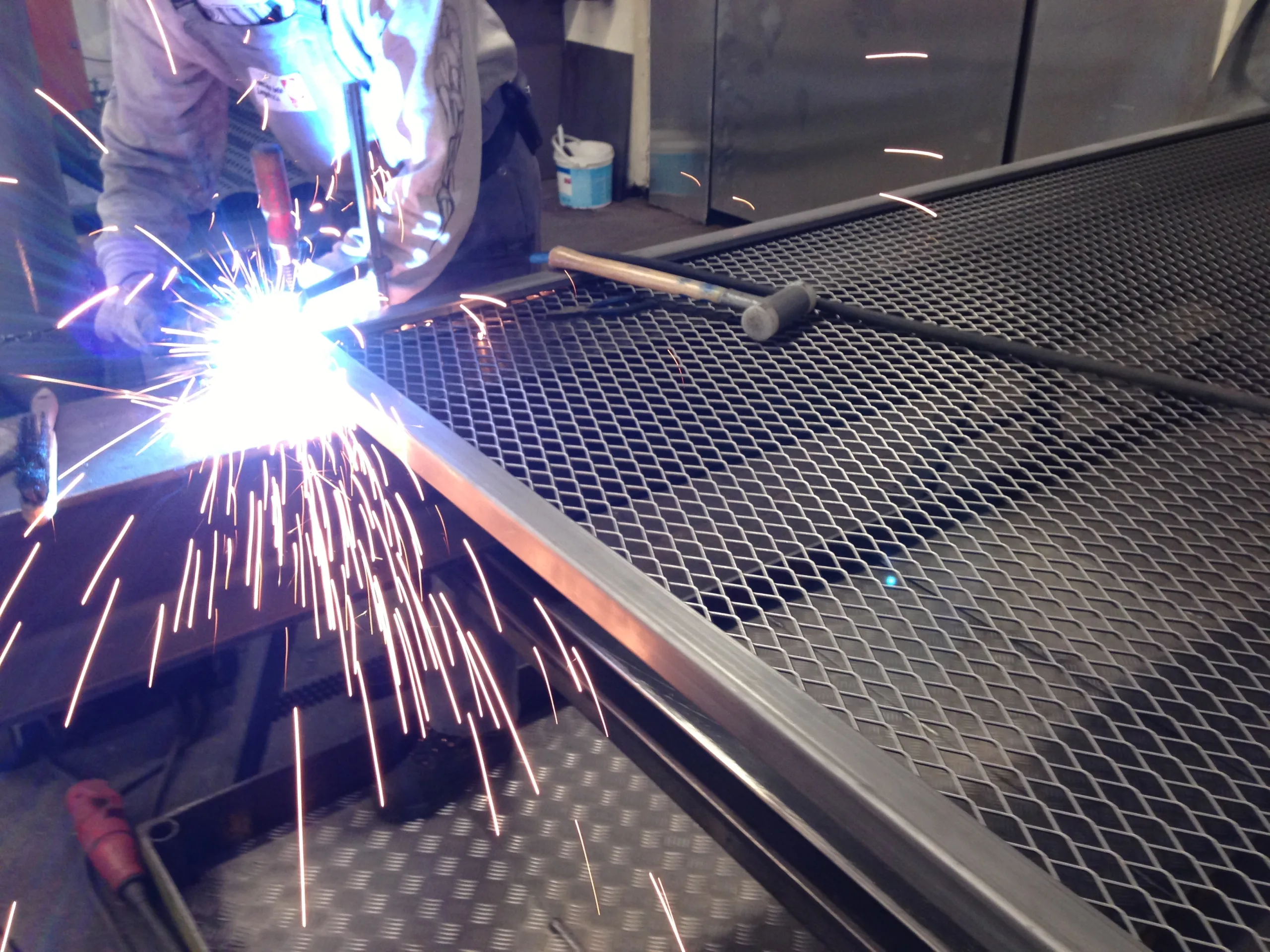
rotec supplies edged and ready-to-install expanded metal assemblies for railings and facades. We tailor the cut, edging, and finish to your design specifications. Galvanizing and paint coating are included in the scope of delivery in accordance with the agreed-upon specifications.
You will receive the assemblies ready for installation. This reduces the number of processing steps you need to perform and minimizes the coordination effort between manufacturing and surface finishing.
As early as the initial inquiry, we clarify component dimensions, mesh orientation, frame design, and mounting points. We also take into account the desired color and the requirements of the installation site. We specify which fasteners are included and who will handle the installation in the quote.
Quality and Project-Specific Documentation
For projects subject to competitive bidding and documentation requirements, we clarify the necessary documentation before awarding the contract. rotec’s certifications to date include DIN EN ISO 9001:2015, certifications for DIN EN 1090-1 and DIN EN 1090-2, as well as DIN EN ISO 3834-3.
As of September 2026: The renewal of expired certificates is scheduled for this month. The current validity status and scope of coverage are available upon request. Company certificates do not replace project-specific documentation for the entire railing or facade structure.
Expanded Metal and Expanded Mesh: Choosing the Right Material and Dimensions
What is the difference between expanded metal and expanded mesh?
The terms “expanded metal” and “expanded mesh” essentially refer to the same material. A sheet of metal is cut in a staggered pattern and then expanded. This creates a continuous mesh of bars and nodes. The connections are formed directly from the original sheet of metal.
The effect varies depending on the mesh pattern, material, and dimensions. Smaller meshes appear comparatively closed, while larger meshes allow more light to pass through. The viewing angle also influences the appearance, especially with raised expanded metal.
For this reason, a photo alone is often not enough to make a selection. Decorative cladding has different requirements than railing infill. Our page provides an overview Expanded Metal and Expanded Mesh at rotec. If, on the other hand, you need a grid made of interconnected wires or rods, our article on welded grating when making a distinction.
What measurements does rotec need for your cut?
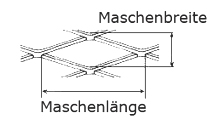
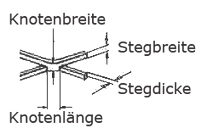
The description „expanded metal, approximately five millimeters thick“ is ambiguous. It could refer to different dimensions. To ensure a reliable selection, the mesh size, web width, web thickness, and type must be specified.
| Information | Implications for Planning |
|---|---|
| Mesh Length and Mesh Width | Describe the mesh geometry. For diamond-shaped meshes, the dimensions refer to the corresponding nodes, not to the clear opening. |
| Web width | Width of the individual web. Among other things, it affects the perceived openness. |
| Web thickness | Thickness of the raw material. |
| Total thickness | Spatial height of the expanded metal. In raised designs, this may differ from the web thickness. |
| Finished dimensions | Width and height of the cut-to-size or finished component. |
| Knitting Direction | Alignment of the mesh when installed. |
The drawings from our Technical Overview of Expanded Metal help with the assignment:
Our tip: If you don't know the exact name, please send a photo with a scale and describe the application. A material sample may also be required for a definitive identification.
Cutting Expanded Metal: Determining the Final Dimensions and Edge Finish Together
When cutting, it’s not just the outer dimensions that matter—it’s also where the cut runs through the mesh. A component may fit dimensionally but still have an unsightly visible edge.
A cut may leave open ends on the web. If you want the edge to be closed or symmetrical, this must be agreed upon before production begins. It is not always possible to achieve both a specific finished dimension and a particular stitch finish in every stitch at the same time. That is why we clarify which finish is critical for your design.
For framed panels, the insertion depth, intended clearance, and fastening method also affect the cutting dimensions. Anyone having expanded metal cut to size should specify the following points:
- Standard dimensions with clearly defined width and height.
- Alignment of the mesh when installed.
- Edges that are visible at first and later become hidden.
- Desired edge appearance and agreed-upon dimensional tolerances.
- Cutouts, mounting points, and subsequent machining.
The appropriate cutting method depends on the material, geometry, quantity, and quality requirements. Based on your specifications, we determine the most suitable machining process. This allows us to consider the final component as early as the cutting stage.
Bending, folding, and edging expanded metal
When bending, the mesh is part of the planning process
Expanded metal can be fabricated into angles, U-shaped cladding, and cassette-like components. The open structure behaves differently than solid sheet metal.
The bend line can run through webs, nodes, or open mesh areas. Together with the material and the direction of the mesh, this influences the achievable shape and the appearance at the bend.
A drawing should therefore also specify leg lengths, reference edges, internal or external dimensions, and the desired visible side. If there are multiple miter cuts, we also take the processing sequence into account.
For new geometries or visible production parts, a prototype can be useful. It allows you to assess the fit and visual appearance before the entire batch is produced. This is particularly helpful for elements that are mounted directly next to one another.
Our article explains the basics of preparation Sheet Metal Edging and Bending in Berlin. For expanded metal, we include the mesh geometry along with this information.
Edging for a defined finish
A frame or edging profile can cover exposed cut edges and create a clean connection to the substructure. The profile must be compatible with the total thickness of the expanded metal and the intended connection.
In addition, we coordinate corner construction, fastening, and surface treatment. For a railing infill, the entire structure—including its fastenings—is important. Our overview shows the profile shapes for Edge Profiles for Expanded Metal.
Selecting Flat-Rolled Expanded Metal
During flat rolling, the raised expanded metal structure is flattened. This changes the geometry and surface appearance. We determine whether a flat-rolled version is suitable for your application as early as the material selection stage.
Our article on the following topic describes additional manufacturing options: Sheet Metal Fabrication and Metalworking in Berlin.
Applications: Ceilings, railings, and facades
The following original photographs from streckgitter.com show expanded metal in installed structures. They illustrate important design details. The images serve as application examples; specific scope of supply for the projects shown is not specified here.
Cutting expanded metal to size and processing it into ceiling panels
In a cassette, a flat surface is transformed into a three-dimensional component with folded edges. The visible surface, cassette height, corner design, and fastening must all be coordinated.
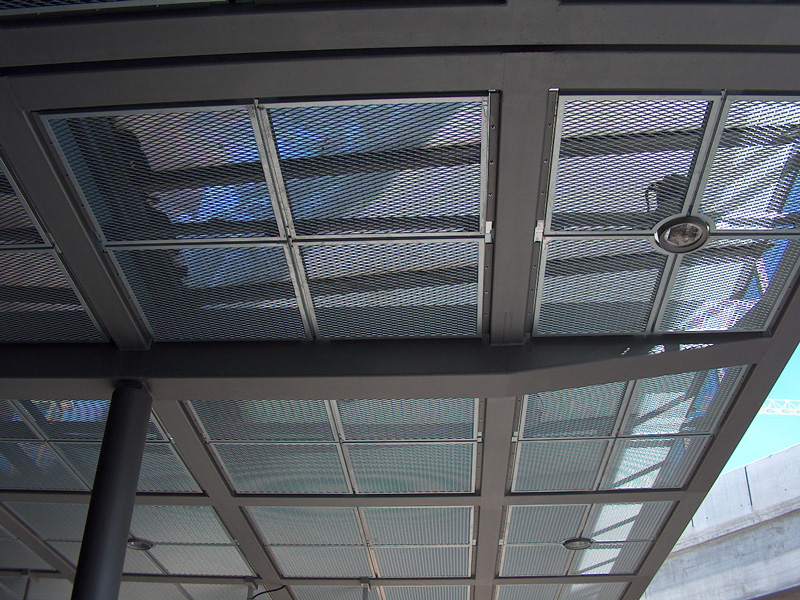
In the photo, the frame layout and the direction of the mesh define the overall appearance. During the planning phase, lighting fixtures and other built-in elements must also be taken into account. If an element is to be removable later on, it requires a suitable mounting system.
Clearly indicating the installation orientation makes installation easier. Therefore, please specify in your drawing whether a dimension refers to the visible surface or the finished external dimension. Acoustic or fire-resistant properties cannot be determined from the photo alone.
Framed interior railing panels
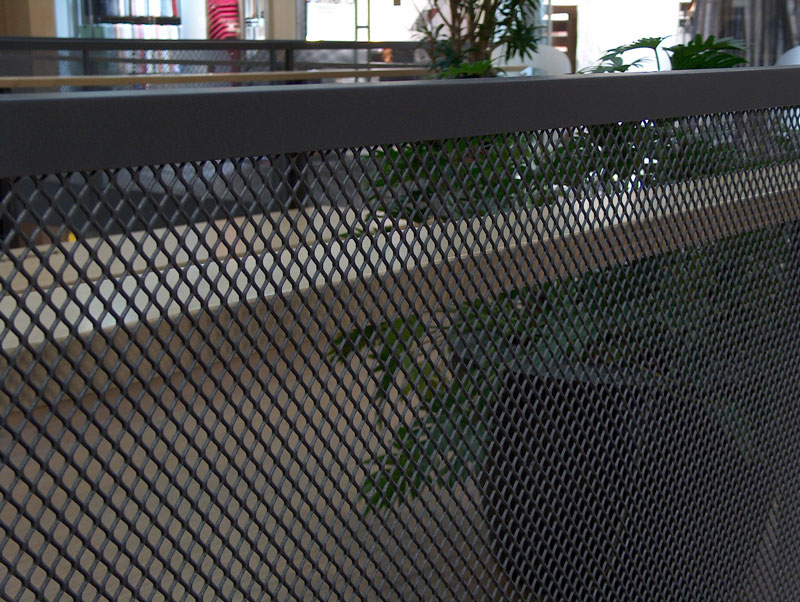
The photo shows how the mesh pattern and frame work together. Therefore, when placing an order, the panel dimensions and frame geometry must be specified together. For railings, the safety requirements for the specific installation situation must also be met.
When using room dividers, it’s also a good idea to examine samples from multiple angles. This is because the desired level of transparency depends on the direction of the weave and the lighting conditions.
Expanded metal on a parking garage facade
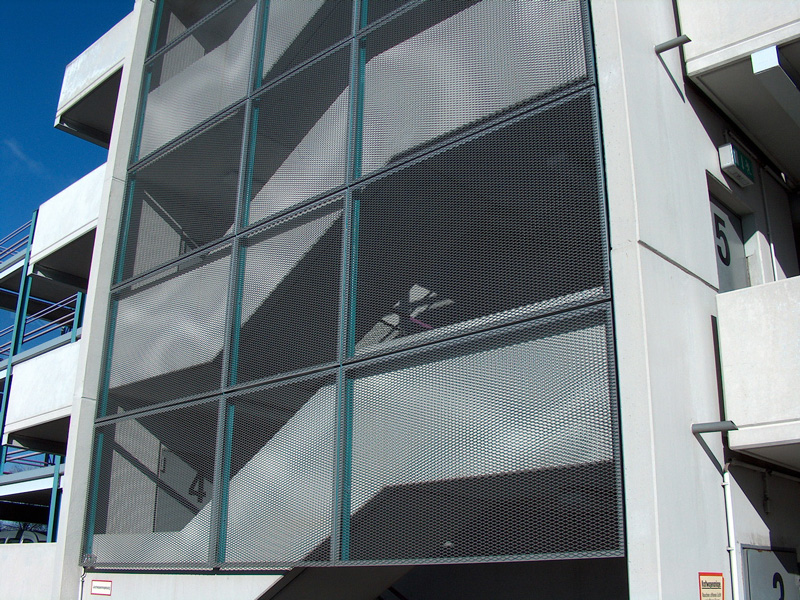
Here, the layout of the panels and the substructure determine the appearance of the facade. When designing the facade, fasteners, component movement, and external loads must be considered together. For more detailed information, see our article on Expanded Metal Facades: Design, Installation, and Cost Factors.
When it comes to technical covers, visual openness alone is not a sufficient selection criterion. Airflow and access for maintenance must also be taken into account during the planning process. Depending on the application, the following factors may also come into play: Ventilation grille or Weather protection grille in question.
Film: Expanded Metal and Expanded Mesh on Facades
In addition to the application photos, you can find the video „Expanded Metal & Expanded Mesh Facades“ on the rotec YouTube channel. It complements the topic of facade design with moving images.
Watch the expanded metal video on YouTube
Frame made of structural profiles
Aluminum profile frames are suitable for certain enclosures or modular structures. The key factors are how the infill is supported and how it is connected to the structure.
Our articles on Structures Made of Aluminum Profiles as well as to the Selection and Cutting of Structural Profiles explain the planning process. Additional product information can be found at rotec-aluprofile.de.
Match the material, galvanization, and paint coating
The choice of material depends on the application, the desired appearance, weight, and the stresses it will be subjected to. Aluminum, steel, and stainless steel each have different properties. For this reason, the exact material designation is important even within these groups.
For suitable steel assemblies, rotec can offer delivery that includes galvanizing and paint coating. We coordinate the material, surface finish, and color on a project-by-project basis. Surface finishing is performed by external specialized contractors.
For outdoor applications, cut edges, joints, and points of contact between different metals must be included in the design. Potential requirements for mounting, covering, and dimensional allowances for the coating must also be taken into account.
If you want to add to existing components, information about the current material and finish will be helpful. A color name or a screenshot alone is often not enough to ensure a reliable visual match.
What information will help speed up your quote?
A dimensioned sketch is often sufficient for an initial review. The following information will allow us to conduct a targeted review of your component and prepare a quote:
- Application and installation location.
- Material and desired expanded metal design.
- Mesh size, bar width, and bar thickness, to the extent known.
- Finished dimensions and quantity per item.
- Weave direction, right side, and desired edge appearance.
- Folds, edging, and cutouts.
- Surface, color, and mounting interfaces.
- Desired delivery date and delivery location.
A dimensioned PDF drawing makes coordination easier. If CAD data is available, please include it as well. We will determine the appropriate file format and required unfolded drawings for each specific order.
If any information is missing, please indicate the outstanding items. This will allow us to coordinate the material selection and the next planning steps with you in a targeted manner.
What factors influence the price of machined expanded metal?
In addition to the material, other factors include cutting costs, scrap, the number of pieces, and additional processing steps. A rectangular cut from a standard stock size is calculated differently than an assembled unit with a surface finish.
Fittings, packaging, and shipping can also affect the cost. In mass production, certain preparatory tasks are distributed across multiple components. Therefore, a reliable unit price requires specific order details.
Compare quotes based on the same scope of services: Do they include raw materials, cut-to-size parts, or fully machined assemblies? Are galvanizing and paint coating included? And which fasteners are included?
We check availability and delivery times at the time of your inquiry. For standard items, the rotec Profishop A general overview. Please contact us directly for custom dimensions and ready-to-install components.
Frequently Asked Questions About Expanded Metal Cutting and Assemblies
Can I order custom-sized expanded metal?
Yes, rotec offers custom cutting. We will coordinate the material, finished dimensions, weave direction, and desired edge finish with you.
Is expanded mesh the same thing as expanded metal?
Generally speaking, yes. Both terms refer to the material produced by cutting and stretching a sheet of metal. The technical dimensions are what matter when placing an order.
Can expanded metal be bent or folded?
Yes, suitable designs can be further processed. The geometry that can be achieved depends, among other things, on the material, mesh, and bend line.
Why is the direction of the stitches important?
It affects appearance, visibility, and processing. For elements placed side by side, the installation direction should be clearly specified.
Are cut edges automatically closed?
No. Depending on the cutting position, the ends of the webs may be open. A specific edge finish must be agreed upon before cutting.
Does rotec supply assembled and ready-to-install modules?
Yes. rotec supplies framed, ready-to-install expanded metal assemblies for railings and facades. We tailor the dimensions, frames, and mounting points to the agreed-upon design.
Are galvanizing and paint coating possible?
Yes. For suitable steel assemblies, the agreed scope of delivery also includes galvanizing and paint coating. We will determine the material, surface finish, and color before production begins.
Can an expanded metal panel serve as a railing without further testing?
The material designation alone is not sufficient. The filling, frame, and fasteners must meet the requirements of the specific project.
Do I need completed CAD data to submit a request?
A dimensioned sketch can also be helpful for initial coordination. All necessary dimensions and details must be clearly agreed upon before production begins.
What certificates can I request for my project?
Request the documentation required for your project, including its scope and validity. As of now, the renewal of expired rotec certificates is scheduled for September 2026.
Discuss your expanded metal assembly with rotec
Would you like to have expanded metal cut to size, bent, or ordered as a ready-to-install assembly? Send us your sketch, the quantity, and details about how it will be used. We’ll work with you to determine the material, processing, and finish.
Your contact person: Mercan Özsoy
Phone: 030 789039-80
Email: m.oezsoy@rotec-berlin.de
Image sources: Production photos from the rotec blog, as well as application photos and technical drawings from streckgitter.com. Video: rotec Berlin Metalltechnik GmbH on YouTube. For more information about the company, visit rotec-berlin.de, latest news at rotec.info.


 EN
EN  DE
DE  ES
ES  FR
FR  IT
IT  NL
NL  PL
PL  TR
TR