
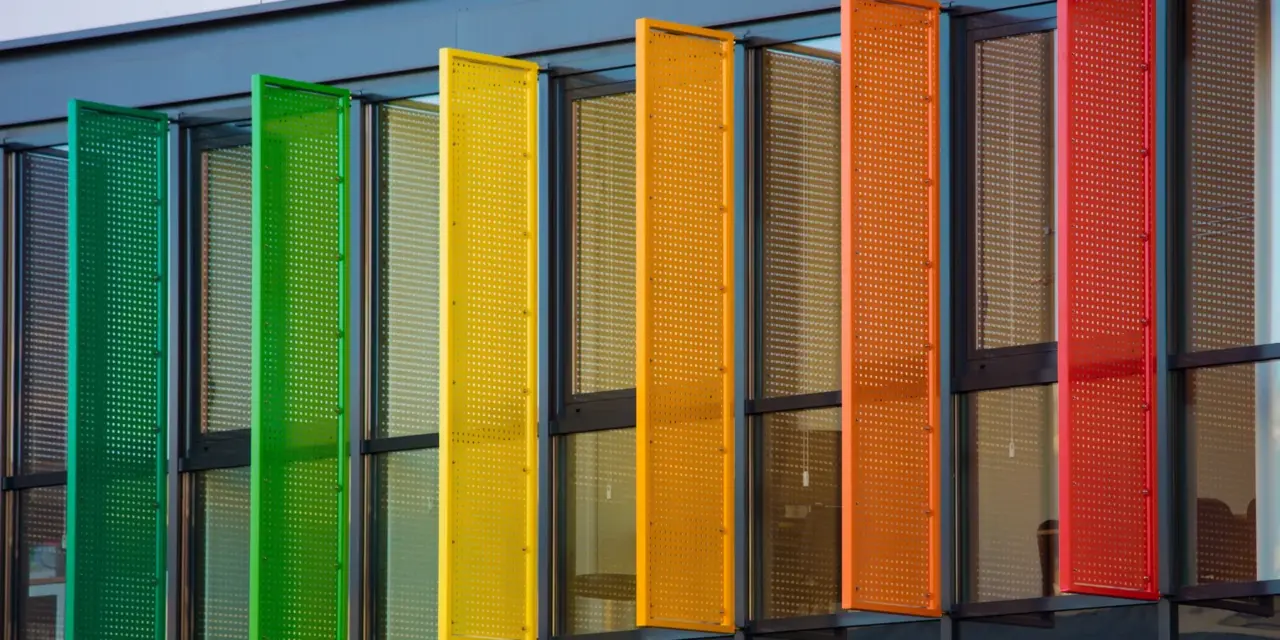
Custom Perforated Sheet Metal is the right solution when metal surfaces need to combine airflow, light, privacy, stability, and design. rotec Berlin Metalltechnik GmbH supplies perforated sheets, custom-cut parts, and further-processed sheet metal components for architecture, metal construction, facade construction, industry, ventilation technology, and storefitting. rotec supports its customers with a wide selection of materials, technical consulting, laser cutting, bending, welding, and professional sheet metal fabrication.
Perforated sheet metal is not simply a sheet of metal with holes. The material, type of perforation, hole pattern, open area, web width, edge clearance, material thickness, surface finish, and further processing all determine its eventual function. For this reason, a perforated sheet intended for a facade must be designed differently than one intended for ventilation, acoustics, mechanical engineering, grain drying, or technical protective cladding.
In short: What matters most when it comes to custom-made perforated sheet metal?
Perforated sheets are suitable for facades, ventilation, acoustics, privacy screens, railings, mechanical engineering, store fixtures, and industrial applications. rotec supplies standard perforated sheets, custom-cut perforated sheets, and custom-made products. Key factors include the material, thickness, hole pattern, open area, surface finish, and further processing. Providing this information in advance ensures you receive a reliable quote more quickly. Additionally, planning errors can be avoided if the hole pattern, fastening method, substructure, and surface finish are considered together early in the process.
Planning in Practice: The 7 Most Important Decisions When Working with Perforated Sheets
Anyone planning a custom-made perforated sheet should first clarify seven points: application, material, material thickness, hole type, open area, surface finish, and fastening. This is followed by cutting, bending, visible side, deburring, packaging, and installation. For facades, additional factors such as wind load, substructure, joint pattern, thermal expansion, and sample approval are important. For ventilation, not only the open area of the holes matters, but also pressure loss, rear ventilation, insect protection, and maintenance. Standard perforated sheets are not sufficient for walkable surfaces. In such cases, safety gratings or profiled sheet metal gratings should be considered.
For standard perforated sheets and quick delivery, rotec recommends the rotec Profishop for Perforated Sheets. For custom-made products, sheet metal cutting, laser cutting, edge finishing, welding, and assembly, it is advisable to contact rotec directly.
View perforated sheets and perforated sheet blanks from rotec
What is a perforated sheet, and what is it used for?
Perforated sheet metal is a flat sheet of metal that has openings arranged in a regular pattern or in a custom design. These openings can be round, square, rectangular, cross-shaped, hexagonal, decorative, or custom-shaped. Depending on the process, the openings are created by punching, nibbling, laser cutting, drilling, milling, waterjet cutting, or special processes.
Perforated sheets serve both technical and aesthetic purposes. They allow air to pass through, reduce weight, provide privacy, control light, protect machinery, serve as screening surfaces, and can be used in acoustic components. They are also used in facades, railing infills, ceilings, wall cladding, and technical enclosures.
For customers, it is crucial that a perforated sheet be considered within its overall context. An attractive perforation pattern alone is not enough. The component must also be suitable for fastening, surface finish, load-bearing capacity, environmental conditions, cleaning, and installation.
Decision Guide: Which perforated sheet is right for which application?
Perforated aluminum sheets, stainless steel perforated sheets, or coated steel perforated sheets are often suitable for facades and privacy screens. The key factors to consider are appearance, weight, corrosion protection, fastening, and sample selection.
For ventilation and weather protection, clear cross-sectional area, pressure loss, rear ventilation, insect screens, and ease of cleaning are particularly important. In this context, the hole pattern should not be chosen based solely on appearance.
In mechanical engineering and industry, stability, ease of cleaning, protective function, deburring, and fastening are key considerations. Steel, stainless steel, or galvanized steel are often the best choices.
For store design and interior finishing, surface finish, perforation pattern, lighting effects, visible side, and edge protection are key factors. Design perforations, stainless steel, aluminum, or powder-coated perforated sheets can be particularly appealing in these applications.
Standard perforated sheets should not be used for walkable surfaces. In those areas, Safety Grating and Profiled Sheet Metal Grating from rotec the correct product group.
Why Rotec Should Be Involved Early in the Perforated Sheet Metal Process
Many errors occur when hole patterns, materials, surfaces, and fasteners are designed separately. rotec can address these issues from an engineering perspective early on. This helps prevent incorrect hole patterns, unsuitable materials, critical bends, problematic hot-dip galvanizing, and unnecessary follow-up inquiries.
Early consultation with rotec is particularly worthwhile when it comes to facades, railing infills, custom perforated sheets, and assemblies. This is because aesthetics, feasibility, material availability, further processing, and installation must all align in these cases.
Custom Perforated Sheet Metal from rotec Berlin
Custom-made perforated sheet metal is required when standard sizes are insufficient. This applies to facades, railing infills, ventilation openings, machine enclosures, store fixtures, custom structures, and industrial components. In such cases, the perforation pattern, cutout, edge areas, fastening, surface finish, and further processing must all be planned together.
rotec combines stock items and Sheet Metal Fabrication at rotec. This allows customers to select standard perforated sheets and, if needed, have them cut to size, edge-finished, drilled, welded, or further processed. For custom shapes and individual components, the Laser Cutting of Sheet Metal available. This is how a perforated sheet is transformed into a component ready for assembly.
Buy perforated sheet metal or request a custom order?
Many customers start by asking whether they should buy a perforated sheet or request a custom-made product. The answer depends on the project.
If the format, material, hole type, and surface finish are available as standard options, purchasing a perforated sheet from the Profishop or our stock program may be a cost-effective choice. This is especially true for typical round, square, and slotted perforations, as well as common materials. You can find standard perforated sheets directly in the rotec Profishop for Perforated Sheets.
Custom fabrication is recommended when the perforated sheet must meet specific dimensions, edge requirements, bends, drill holes, cutouts, surface finishes, or mounting requirements. Facades, railing infills, machine enclosures, technical covers, and assemblies also frequently require project-specific fabrication.
Standard perforated sheet or custom perforated sheet?
When selecting perforated sheets, it is important to determine early on whether a stock perforated sheet will suffice or whether a custom perforated sheet is required. Stock perforated sheets are standardized perforated sheets made from common materials, in standard sizes, and with standard hole patterns. They are particularly suitable when quick procurement, a proven hole pattern, and a cost-effective solution are required.
Custom perforated sheets, on the other hand, are designed or further processed on a project-by-project basis. This is useful when specific dimensions, unperforated edges, bends, drill holes, cutouts, surface finishes, hole orientations, or custom hole patterns are required. Standard sheet metal is often insufficient, particularly for facades, railing infills, machine enclosures, store fixtures, and technical assemblies.
Terms: perforated sheet metal, perforated plate, perforated panel, and perforated sheet
In practice, various terms are used. The term “perforated sheet metal” is the most commonly used in metal fabrication, in the trade, and among many customers. The terms “perforated plate,” “perforated panel,” “perforated sheet,” and “punched sheet” generally describe the same basic principle.
For requests for proposals, bids, and technical clarifications, the term “perforated sheet metal” alone is not sufficient. Precise specifications regarding the material, sheet thickness, hole shape, hole size, pitch, hole pattern, dimensions, edge areas, surface finish, and further processing are essential.
Materials for perforated sheets: steel, stainless steel, aluminum, and galvanized steel
The choice of material affects weight, corrosion resistance, strength, appearance, machinability, cost, and service life. Therefore, the material should always be selected based on the intended application.
Perforated steel sheet
Steel is durable, cost-effective, and easy to work with. That is why steel is frequently used for technical cladding, mechanical engineering, industrial applications, warehouse technology, and metal structures. However, raw steel requires appropriate corrosion protection if it is expected to be exposed to moisture or outdoor weathering.
Perforated sheet metal made of galvanized steel
Galvanized steel combines the cost-effectiveness of steel with improved corrosion protection. It is suitable for many technical applications, cladding, ventilation surfaces, and heavy-duty components. However, special attention must be paid to cut edges and the inner edges of holes.
Hot-dip galvanizing of perforated sheets: Carefully inspect small perforations
In hot-dip galvanizing, the component is immersed in a molten zinc bath. Small openings—especially those smaller than about 10 mm—can be problematic in this process. This is because, depending on the sheet thickness, hole pattern, component geometry, and position in the zinc bath, smaller holes may sometimes close up.
For this reason, perforated sheets with small holes should be tested on a project-by-project basis prior to hot-dip galvanizing. Key factors include hole size, sheet thickness, zinc runoff, ventilation, the component’s location, and its intended function. If very small holes are required, stainless steel, aluminum, pre-galvanized material, or a suitable coating may be the better solution, depending on the application.
Technical Guidelines for Designing Structures Suitable for Hot-Dip Galvanizing
Stainless Steel Perforated Sheet
Stainless steel is used when corrosion resistance, hygiene, a high-quality appearance, or long-lasting quality are important. Typical applications include architecture, railing infills, interior finishes, technical cladding, food processing, and demanding outdoor environments.
Stainless Steel Perforated Sheets: 1.4301, 1.4571, and Other Materials
When it comes to stainless steel perforated sheets, the exact material grade is important. Stainless steel is not a single material grade, but rather a group of materials with varying properties. The rotec Profishop carries stainless steel grades such as 1.4301, 1.4571, and other variants for its perforated sheets.
Grade 1.4301 is a commonly used austenitic stainless steel. It is suitable for many indoor applications, decorative components, technical cladding, normal environments, and numerous general metal fabrication applications. If the material is exposed to more severe corrosion, chemical influences, or demanding outdoor conditions, the choice of material should be examined more closely.
Grade 1.4571 is a high-grade stainless steel containing molybdenum and stabilized with titanium. It is often chosen when improved resistance to certain corrosive influences is required. This can be relevant in industrial applications, humid environments, or for technical components subjected to heavy loads. Nevertheless, even 1.4571 must be evaluated to ensure it is suitable for the specific environment and application.
Aluminum perforated sheet metal
Aluminum is lightweight, easily formable, and suitable for many facades, ceilings, cladding, and design applications. In addition, aluminum can be powder-coated or anodized. This results in high-quality surfaces for visible components.
Aluminum Perforated Sheets: Common Grades and Applications
Depending on the application, different grades of aluminum are used for perforated aluminum sheets. Easily formable aluminum sheets are frequently used for decorative cladding, technical covers, lightweight facade elements, and interior finishes. For components subject to higher stress, higher-strength aluminum alloys may be appropriate.
Aluminum is particularly appealing when low weight, good machinability, and high-quality surfaces are important. For facades, privacy screens, and ceiling panels, factors such as thermal expansion, fastening, coating, and contact corrosion also play a significant role.
Perforated sheet metal made of brass, copper, and titanium-zinc
Brass and copper are often used for decorative, high-quality, or architecturally distinctive applications. Both materials create a warm and distinctive look. Copper’s surface changes over time due to natural weathering.
Titanium-zinc is primarily used in the construction industry and for architectural cladding. It is weather-resistant and has a distinctive surface finish. For perforated sheets made of titanium-zinc, the material thickness, perforation pattern, fastening method, and deformation behavior should be determined early on.
Types of holes: round holes, square holes, oblong holes, and custom holes
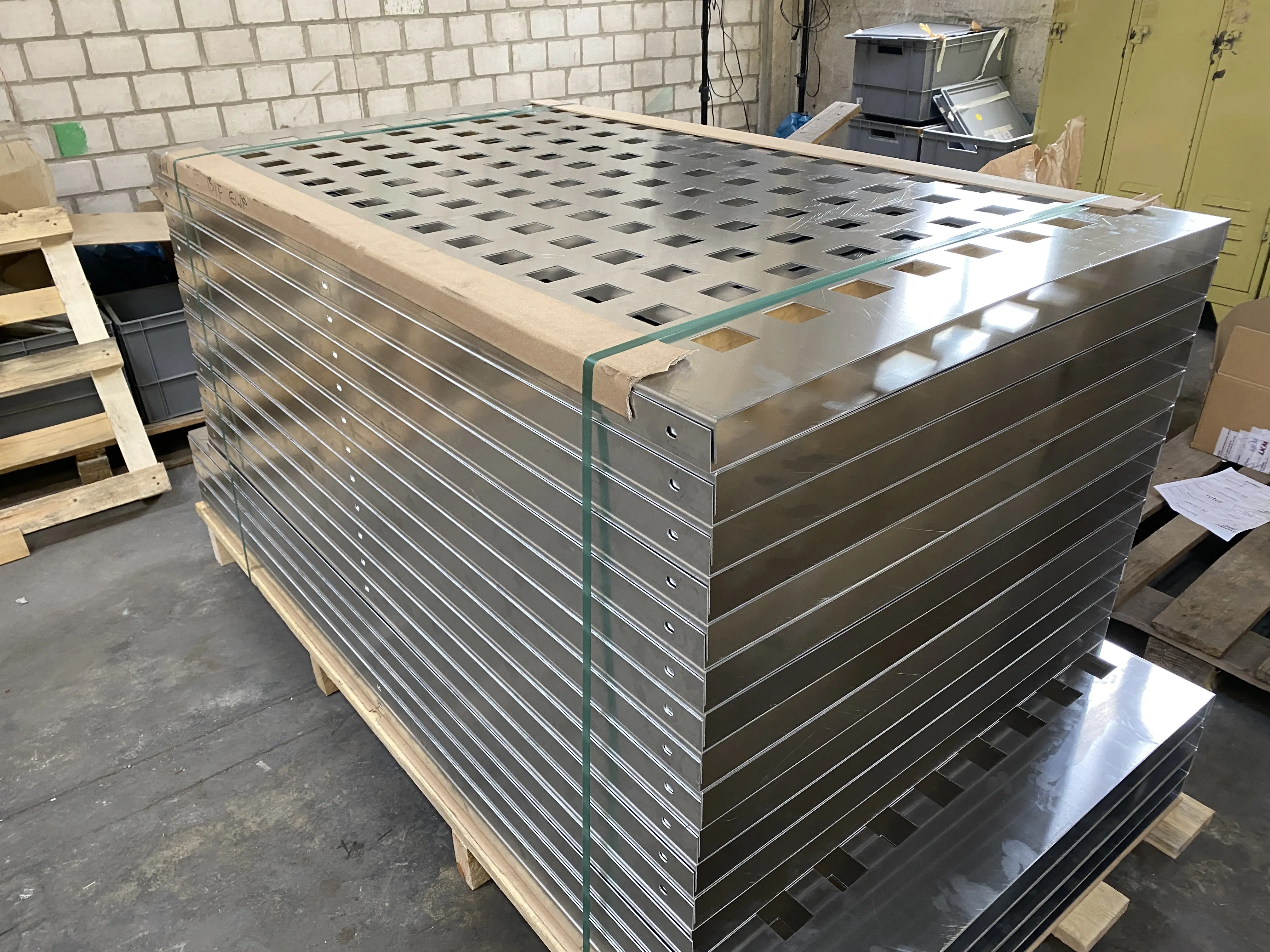
The type of hole affects appearance, clear cross-sectional area, stability, airflow, light transmission, and manufacturing costs.
The type of perforation does not merely determine the appearance. It also affects the clear cross-sectional area, stability, airflow, light transmission, ease of cleaning, and manufacturing costs. Therefore, the choice of perforation type is a key technical decision.
Round holes
Round perforations are one of the most common types of perforations. They are versatile, cost-effective, and technically predictable. Round perforations are used for ventilation, screening surfaces, machine enclosures, railing infills, facades, acoustic panels, and technical covers.
Square Perforation
The square perforation has a clean, modern, and technical look. It creates a linear grid pattern and is suitable for architecture, interior design, design surfaces, machine enclosures, and privacy screens.
Slotted holes
Slotted perforations consist of elongated openings. They can be oriented horizontally, vertically, or according to project requirements. This allows for directional control of airflow, light, and visual effects.
Cross-hole punching, hexagonal hole punching, and decorative hole punching
Cross-shaped perforations, hexagonal perforations, and decorative perforations are used when the perforation pattern itself is part of the design. Examples include ornamental patterns, historical motifs, decorative wall coverings, store interiors, and custom facade designs.
Hood Perforation and Blind Perforation
A hood-style perforation is a special embossed perforation featuring an upright, hood-like opening. It is also compared to blind-like perforation patterns. Unlike flat round perforations, this creates a three-dimensional structure in the sheet metal.
Special Perforation
Custom perforations are created when standard perforations are not sufficient. This can be the case for facades, signature architecture, mechanical engineering, ventilation systems, acoustics, or historical reconstructions. Custom perforations can be produced by punching, laser cutting, or using specialized processes.
Hole Patterns and DIN 24041 Explained in Simple Terms
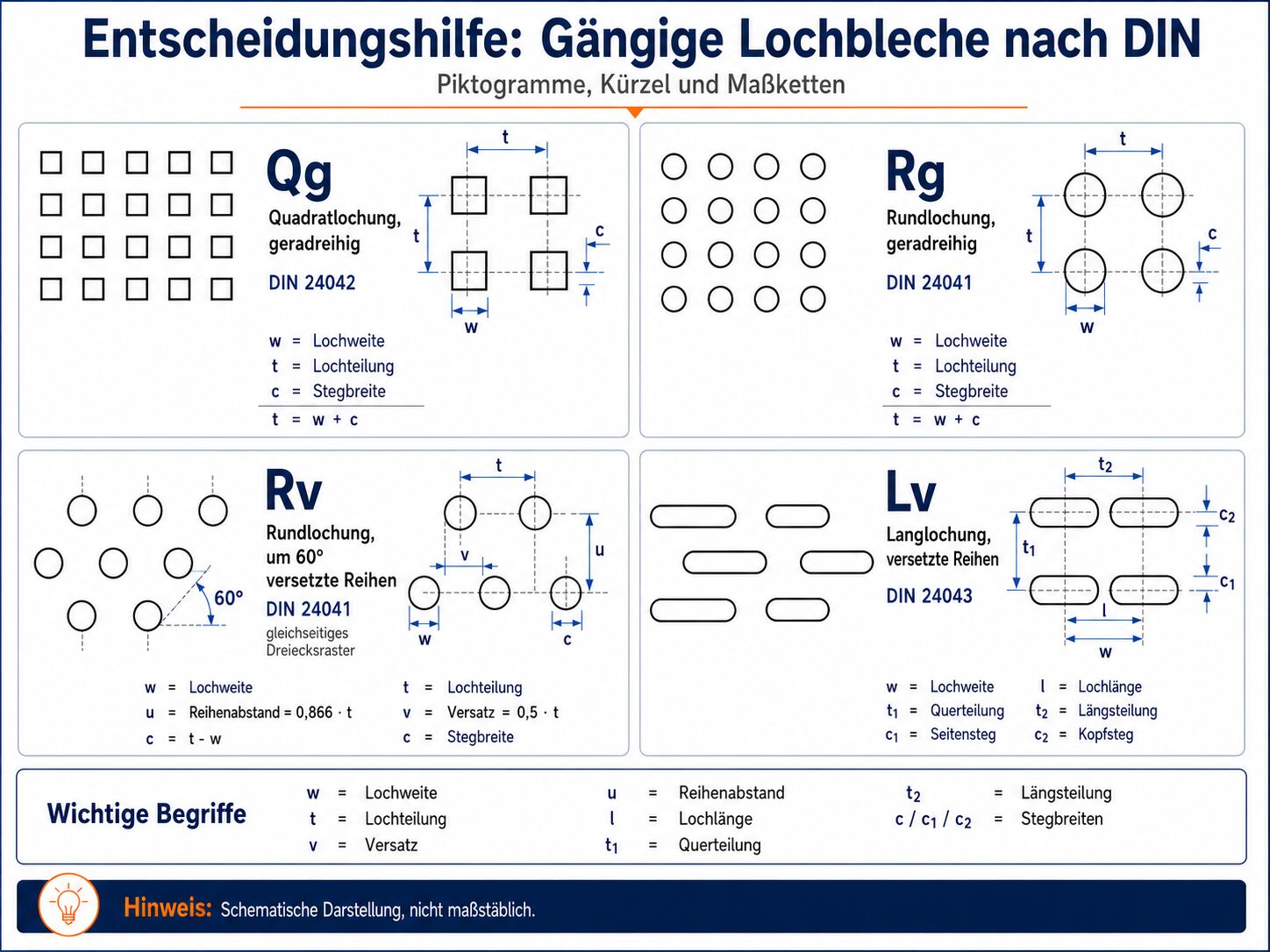 Technical decision-making guide for common hole patterns, dimension chains, and DIN references for perforated sheets.
Practical Application: Trapezoidal Profiles Made from Perforated Sheet Metal
One specific application of folded perforated sheets is trapezoidal profiles for control joints and concrete floor slabs. In the technical article Trapezoidal profiles made of perforated sheet metal for control joints and concrete floor slabs rotec explains the manufacturing process, the necessary project specifications, and how it differs from structural design.
Open Area Calculator for Perforated Sheets
You can use this calculator to estimate the open area of a perforated sheet. This value indicates what percentage of the surface area consists of openings. It is particularly important for ventilation, light transmission, privacy, acoustics, and technical applications.
Note: This calculation is a geometric approximation for the perforated panel. Unperforated edges, frames, fastening areas, fabric, nonwoven material, installation conditions, and manufacturing tolerances may affect the effective air or light transmission of the finished component.
Here's how to calculate the clear opening area
The open area of a hole pattern describes the proportion of open space within the hole pattern. It is expressed as a percentage. The value therefore indicates how much area remains open in theoretical terms and how much area consists of metal.
The basic formula is:
Free perforation area = open area / perforation pattern area × 100
Simplified formulas can be used for regularly spaced hole patterns. For square holes arranged in straight rows, that is, Qg, the following applies:
A0 = 100 × c² / t²
The focus is on c for the side length of the square hole. t refers to the pitch, that is, the distance from the center of one hole to the center of the next.
The sample example in the open-space calculator uses Qg 10 15. This means: square holes in straight rows, with a side length of 10 mm and a spacing of 15 mm.
Calculation:
A0 = 100 × 10² / 15²
A0 = 100 × 100 / 225
A0 = 44.44 percent
This result means that, mathematically speaking, 44.44 percent of the hole field is open. The remaining portion consists of metal.
It is important to note that the calculated value refers only to the perforated area. Unperforated edges, frames, mounting areas, mesh, nonwoven fabric, insect screens, or the installation conditions may further alter the actual effective open area of the finished component.
Hole Pattern Orientation and Panel Alignment
With perforated sheets, it is not only the type of perforation that matters. The orientation of the perforation pattern must also be clearly specified. This is especially true for slotted perforations, decorative perforations, facade panels, and technical ventilation panels. If the slots are to run horizontally or vertically, this orientation must be clearly specified in the request.
The direction of the hole pattern affects appearance, privacy, airflow, water drainage, and installation. On facades, a horizontally oriented slot pattern can create a very different effect than a vertically oriented one. For technical components, the direction can also influence airflow, cleanability, or fastening.
Web width, edge clearance, material thickness, and sheet size
The web width is the area of material between two openings. It affects stability, manufacturability, appearance, and cleanability. If webs are too narrow, warping, cracks, tooling problems, or rough edges may occur.
The edge clearance refers to the unperforated area between the perforated panel and the outer edge. This area is important for fastening, bending, framing, welds, and visual appearance. For facades and railings, a carefully planned edge is particularly important because it affects installation and the appearance of the joints.
The hole spacing, web width, and material thickness must be technically compatible. If the hole spacing is too small or the web is too narrow, this can lead to tool stress, warping, cracking, or rough edges. Subsequent bending or welding operations may also become more difficult.
How Perforated Sheets Are Made
Perforated sheets are produced by deliberately punching holes in metal sheets. The best method depends on the material, sheet thickness, hole pattern, quantity, tolerances, edge quality, budget, and subsequent processing.
Punching
In punching, a tool presses the desired hole shape through the sheet metal. In the process, material is cut away and the so-called blank is separated from the sheet metal. Punching is particularly cost-effective when many identical holes, regular hole patterns, and large quantities are required.
Edge, Visible Side, and Deburring
With punched perforated sheets, the top and bottom surfaces may appear different. Depending on the manufacturing process, slight rounding, cut lines, or burrs may occur. Therefore, for visible surfaces, areas that come into contact with the hands, and high-quality architectural components, it is important to determine early on which side will be visible later.
The desired visible side should be specified in the request. This is particularly important for facade elements, railing infills, cladding, store fixtures, and components that come into direct contact with people. In addition, it should be determined whether deburring, sanding, brushing, or an additional surface treatment is required.
CNC Punching, Nibbling, and Coil Processing
In nibbling, many overlapping individual strokes are performed. This allows for the creation of contours or larger openings. A CNC turret punch press uses various tools stored in a tool magazine. In coil-fed production lines, strip material is punched continuously. This process is particularly suitable for large quantities and recurring hole patterns.
Laser cutting
In laser cutting, a focused laser beam cuts through the material using heat. The process requires no tools and is highly flexible. This makes it suitable for custom shapes, individual parts, small production runs, lettering, decorative perforations, and complex internal contours.
Watch the video on the production of perforated sheet metal via laser cutting directly on YouTube
Punching or laser cutting?
Punching is usually a good choice when there is a regular hole pattern, large production runs, and suitable tools are available. In such cases, cycle times are short and unit costs are economical. Punching is also suitable for many standard hole patterns.
Laser cutting is usually the best choice when individual parts, small production runs, custom shapes, decorative perforations, or variable patterns are required. The process does not require tools and can quickly process CAD data. This makes it very flexible for custom projects.
rotec therefore evaluates on a project-by-project basis which process is most appropriate. The key factors are the drawing, material, thickness, quantity, hole pattern, surface finish, tolerance, and further processing.
Cutting, Edge Finishing, Welding, and Assembly Manufacturing
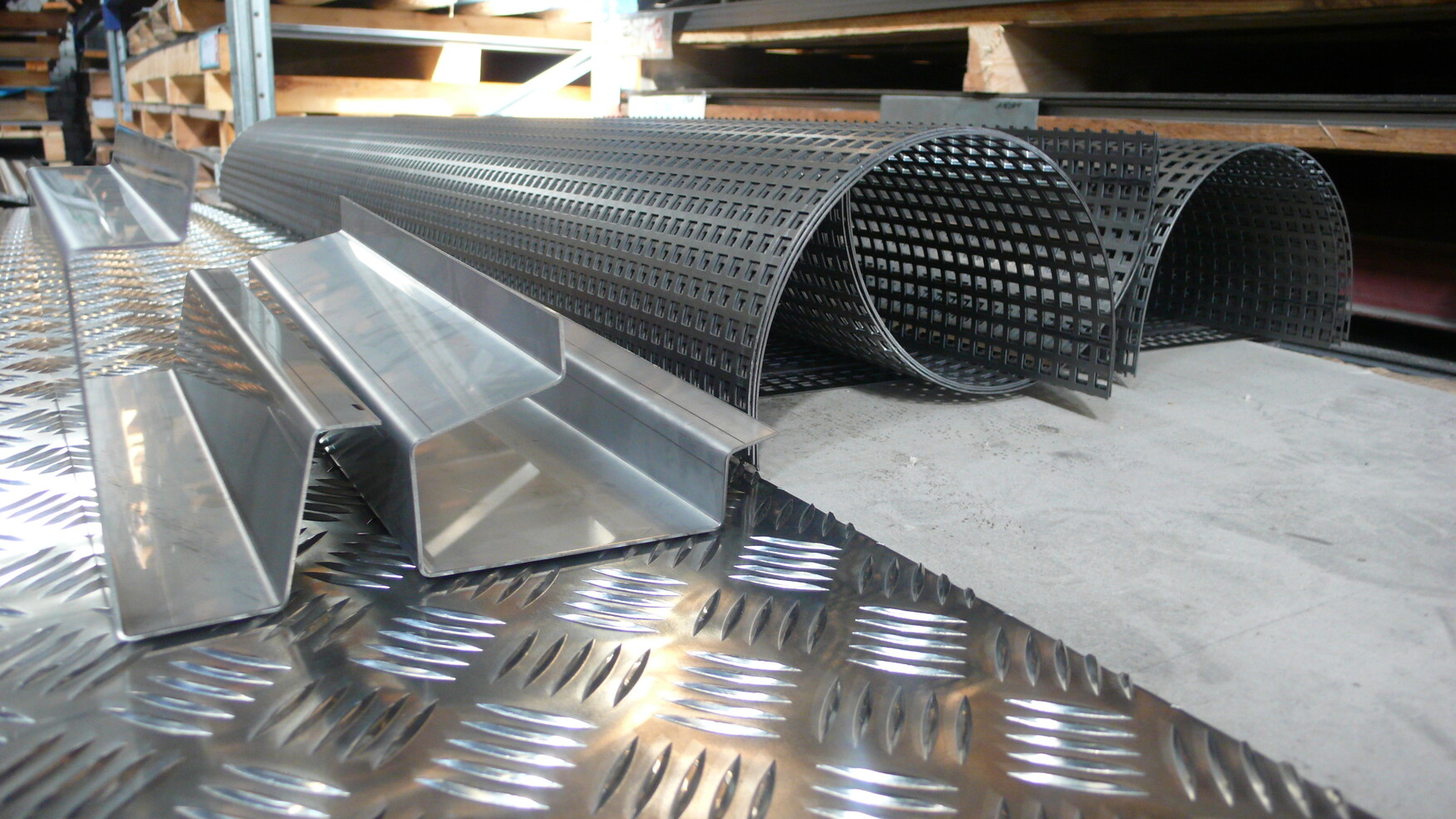
Many projects require more than just a perforated sheet. That is why further processing is crucial. rotec can cut, laser, edge, drill, weld, deburr, edge-band, coat, and assemble perforated sheets into subassemblies.
When bending, the hole pattern must be taken into account. If the bend line is too close to the holes, the holes may warp. The required distance depends on the material, material thickness, hole pattern, bend radius, and tool.
Perforated sheet metal as a semi-finished product or finished component
Perforated sheet metal can be supplied as a semi-finished product or further processed into a finished component. As a semi-finished product, it is usually supplied in standard sizes, with standard perforations, and made of common materials. This is sufficient for many simple applications.
For more complex projects, however, the perforated sheet metal is transformed into a finished component. This involves cutting to size, bending, drilling, edging, welding assemblies, coating, and preparing the component for installation. This is precisely where the difference lies between simply purchasing a material and obtaining a technical solution.
Surfaces and Corrosion Protection for Perforated Sheets
The finish protects the perforated sheet metal and defines its appearance. For this reason, it should be planned early on. Common finishes include raw, galvanized, hot-dip galvanized, powder-coated, anodized, sanded, or brushed.
Powder coating allows for colored surfaces according to the RAL color system or other color systems. It is suitable for facades, railings, privacy screens, store fixtures, and technical cladding. For aluminum, anodizing can create a high-quality metallic finish. Stainless steel can be polished, brushed, or otherwise mechanically finished.
Packaging, Protective Film, and Shipping
For polished, brushed, coated, or anodized visible surfaces, packaging, protective film, and shipping arrangements should be coordinated early on. This helps prevent scratches, scuff marks, and shipping damage.
Flatness and Warpage in Perforated Sheets
Depending on the percentage of holes, material thickness, size, manufacturing process, and subsequent processing, perforated sheets may be more susceptible to warping than solid sheets. This is particularly true for large sizes, high open areas, narrow webs, thermal cutting, welding, or subsequent coating.
This point is particularly important for visible architectural surfaces. A facade will only look high-quality if the panel size, perforation pattern, joint pattern, and fastening system all fit together seamlessly. rotec can assist customers with technical planning and determine which processing method is best suited for each project.
How to Properly Fasten and Install Perforated Sheets
Perforated sheet metal isn't just about selection and fabrication. It must also be installed safely and neatly. That's why fasteners, substructures, frames, screws, slotted holes, joints, and thermal expansion must be considered early in the planning process.
Visible or concealed mounting
When working with architectural perforated sheets, a decision should be made early on as to whether the fasteners should be visible or concealed. Visible screws are often cost-effective, easy to inspect, and maintenance-friendly. Concealed fasteners create a cleaner, more sophisticated look but require a carefully planned substructure.
Edge protection and edging profiles for perforated sheets
Edge profiles can stabilize perforated sheets, protect edges, and simplify installation. They are particularly useful for railing infills, technical covers, exposed edges, and components that come into contact with hands. In addition, edge profiles can enhance the visual appearance by providing a clean finish to the perforated sheet.
Perforated Sheet Metal for Facades, Architecture, and Privacy Screens
Perforated sheets are frequently used in architecture as facade elements, sunshades, privacy screens, balustrade infills, ceiling cladding, wall cladding, or decorative metal surfaces. They create a look that is both technical and high-end.
When it comes to facades, function and design must not be separated. Wind loads, substructures, corrosion protection, fire protection, cleanability, fastening, and thermal expansion must all be taken into account on a project-by-project basis. rotec can assist designers, facade contractors, and metal fabricators with material selection, cutting, processing, and fabrication.
Privacy, Transparency, and Viewing Angle
The transparency of a perforated sheet does not depend solely on its open area. The viewing angle, distance, color, lighting conditions, and background also influence its appearance. A perforated sheet may appear very open when viewed up close, while it appears significantly more closed from a greater distance.
Patterns and Sampling for Visible Perforated Sheets
For visible architectural surfaces, facades, and store design projects, requesting a sample may be a good idea. A sample illustrates the hole pattern, surface, color, transparency, and light effects much more clearly than a drawing or a data sheet.
Perforated Sheet Metal for Ventilation and Weather Protection
Perforated sheets are often used for ventilation openings, technical covers, and air inlets. The clear cross-sectional area is particularly important here, as it determines how much air can flow through the opening.
For ventilation applications, however, the clear cross-sectional area alone is not sufficient. Pressure loss, installation conditions, air velocity, rear ventilation, contamination, insect screens, and maintenance can also be important factors. If a ventilation area is technically significant, the design should be coordinated with specialized planners.
View ventilation grilles from rotec
Lining with nonwoven fabric, mesh, or insect netting
Depending on the application, perforated sheets can be combined with additional layers. Possible options include acoustic fleece, wire mesh, insect screens, filter layers, or substructures. This affects airflow, cleanability, privacy, and technical performance.
Perforated Sheet Metal for Acoustics
Perforated sheets can be used in acoustic components. They often serve as the visible outer layer over an acoustic fleece, insulation material, or cavity. However, the acoustic effect is not produced by the perforated sheet alone.
The overall design is crucial. This includes the percentage of perforations, perforation size, material thickness, cavity depth, nonwoven fabric, insulation material, substructure, and installation conditions. For this reason, acoustic requirements should always be planned on a project-by-project basis.
Perforated Sheet Metal for Mechanical Engineering, Industry, and Store Fixtures
In mechanical engineering, perforated sheets are often used as protective covers, enclosures, ventilation surfaces, or screening surfaces. They can protect moving parts, facilitate cooling, and provide a clean, finished look for technical equipment.
In industry, perforated sheets are used as filter surfaces, sorting surfaces, technical covers, partition surfaces, protective grilles, and cladding. Here, functionality, stability, ease of cleaning, and service life are the top priorities.
Perforated sheets for grain drying, warehouse ventilation, and bulk materials
Perforated sheets are also used in grain drying and storage ventilation. There, they serve a technical purpose because air must be directed through grain, rapeseed, corn, or other bulk materials.
Depending on the system, standard perforated sheets, nozzle plates, corrugated sheets, or air distribution plates are used. Key factors include hole size, air discharge, material thickness, corrosion protection, load-bearing capacity, and ease of cleaning.
Air-conveying plates for lateral air discharge and parts transport
One specialized technical application involves perforated sheets with directed airflow. In this case, the air does not merely flow vertically through the sheet but exits laterally through shaped openings, slits, nozzles, or hood-like perforations. This creates not only an air cushion but also a horizontal conveying effect.
rotec can provide support for the metalworking components in such applications. This includes material selection, blanking, laser cutting, bending, drilling, welded assemblies, frames, and sheet metal structures designed for assembly.
Special perforated sheets such as CONIDUR for process engineering
In addition to standard perforated sheets, there are specialty perforated sheets designed for demanding process engineering applications. These include fine-perforated sheets, slotted sheets, and special conical perforations. They are used in screening technology, air distribution, fluidized bed applications, centrifuges, mills, and the processing of bulk materials.
These specialized perforated sheets differ significantly from standard architectural perforated sheets. Therefore, the material, hole geometry, direction of the holes, sheet thickness, surface finish, and operating conditions must be precisely matched.
Anti-slip sheets, safety gratings, and profiled sheet metal gratings
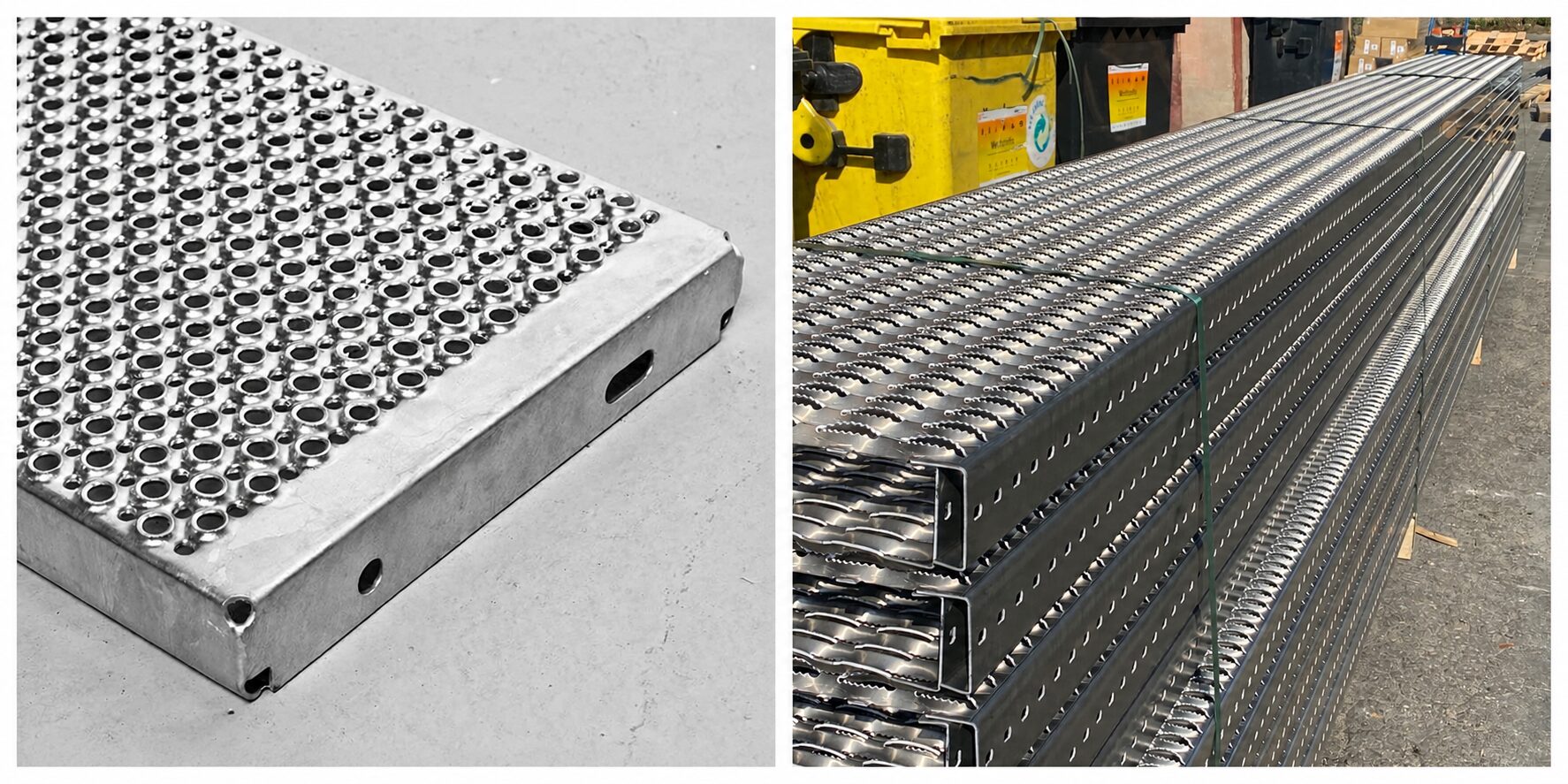
A product group related to traditional perforated sheets includes slip-resistant sheets, safety gratings, and profiled sheet gratings. They are also made of sheet metal, but are not merely perforated. Instead, they are additionally embossed, serrated, profiled, or folded.
Profiled sheet metal gratings are frequently used for walkways, stairways, platforms, accessways, ramps, maintenance platforms, industrial facilities, vehicle manufacturing, agriculture, and technical installations. At the same time, the profiled surface provides better slip resistance than smooth sheet metal.
View rotec's safety gratings and profiled sheet metal gratings
DGUV Information on the Selection and Operation of Grates
Materials for safety gratings, profiled sheet metal gratings, and ladder rungs
For safety gratings, profiled sheet metal gratings, stair treads, and ladder rungs, the appropriate material depends heavily on the intended application. Typical materials include galvanized steel, aluminum, stainless steel, and steel intended for further coating.
For ladder rungs, stair treads, and landings, additional factors such as slip resistance, support, span, load capacity, drainage, contamination, and installation must also be taken into account. Therefore, the selection should not be based solely on the material. The specific application is always the decisive factor.
Standard perforated metal sheets are not automatically walkable
Standard perforated metal sheets are not automatically suitable for use as walkable flooring surfaces. When planning walkways, platforms, stairs, maintenance areas, or industrial access points, safety gratings or profiled metal gratings should be considered.
Perforated sheet metal or expanded metal?
Perforated sheet metal and expanded metal are often compared. Both materials have openings, but they are produced differently.
In the case of perforated sheet metal, material is cut or punched out of a sheet. This creates clearly defined openings. The shape of the holes, the pitch, and the clear cross-sectional area can be easily specified. For this reason, perforated sheet metal is particularly well-suited when precise hole patterns, defined permeability, and a controlled appearance are desired.
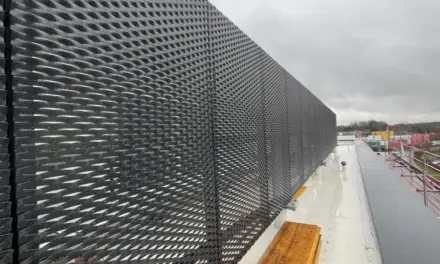
Expanded metal is created by making staggered cuts and then stretching the material. This results in a three-dimensional mesh structure. Expanded metal can be an attractive option when a sense of lightness, a sense of depth, directional privacy, or a dynamic facade effect is desired.
Consider expanded metal as an alternative to perforated sheet metal
Cleaning and Maintenance of Perforated Sheets
When selecting perforated sheets for outdoor use, ventilation, industrial applications, and bulk material handling, future cleaning should also be taken into account. Small perforations, narrow webs, and hard-to-reach back sides can make maintenance more difficult.
Dust, pollen, grease, oil, bulk material residue, or industrial contamination can reduce the clear cross-sectional area during operation. A well-designed perforated sheet therefore takes into account not only its installation but also its use over many years.
Common Design Mistakes with Perforated Sheets
- Select the hole pattern based on appearance only: A hole pattern must be suitable for airflow, structural integrity, cleaning, fastening, and surface finish.
- Setting the free cross-section too high: A large clear cross-sectional area can affect stability, flatness, and fastening.
- Do not define border areas: Unperforated edges are important for fastening, folding, framing, and appearance.
- Planning bend lines too close to the hole pattern: If the hole patterns are too close to the edges, the holes may become warped.
- Determining corrosion protection too late: Cut edges, inner edges of holes, and the surrounding area affect long-term quality.
- Plan perforated sheet metal and the substructure separately: Perforated sheet metal only works as part of the overall structure.
- Submit an incomplete request: Incomplete information will delay the quote and feasibility study.
Preparing a Perforated Sheet Inquiry: Here's the information rotec needs
- Applications, such as facades, ventilation systems, railings, machinery, store fixtures, or industrial applications.
- Material, such as steel, galvanized steel, stainless steel, aluminum, brass, copper, or titanium-zinc.
- Material grade, if known.
- Material thickness in millimeters.
- Type of perforation, such as round, square, oblong, or custom perforations.
- Hole size and pitch.
- Hole pattern, such as straight, staggered, or diagonal.
- Direction of the holes, for example, horizontal or vertical slotted holes.
- Desired clear cross-sectional area, if technically relevant.
- Sheet size or cut-to-size dimensions.
- Unperforated edge and fastening areas.
- Desired visible side and deburring requirements.
- Quantity.
- Surface finish, such as raw, galvanized, hot-dip galvanized, powder-coated, anodized, sanded, or brushed.
- Further processing, such as edge finishing, drilling, welding, deburring, or assembly.
- Drawing, sketch, or CAD file.
- Preferred delivery date and delivery address.
For simple inquiries, a dimensioned sketch is often sufficient. For technical components, PDF drawings, DXF files, DWG files, or STEP files are helpful. Photos can also be helpful if existing components are to be replaced or supplemented.
Send a perforated sheet inquiry to rotec
Quality, Documentation, and Manufacturing Reliability at rotec
rotec stands for professional metalworking and a strong commitment to quality. This is particularly important when perforated sheets are used not just as simple panels, but as machined components, assemblies, or visible architectural surfaces.
rotec’s relevant quality standards include DIN EN ISO 9001:2015, DIN EN 1090-1 and 2 for EXC 1 and EXC 2, as well as DIN EN ISO 3834-3. These certifications are particularly relevant for complex metal structures, welding work, and documented manufacturing processes.
Quick availability thanks to inventory and sheet metal fabrication
For many projects, it’s not just the technical solution that matters, but also the lead time. rotec maintains an extensive inventory of a wide variety of perforated sheets, solid sheets, expanded metal, and other semi-finished metal products. This allows us to review many inquiries more quickly and, depending on material availability, process them on short notice.
Thanks to the integrated sheet metal processing capabilities, perforated sheets for bearings can also be cut to size, folded, drilled, welded, or further processed. This is particularly valuable for metal fabricators, facade contractors, industrial customers, shopfitters, and design firms that need not just a sheet of metal, but a solution tailored to their specific project.
Select perforated sheets in the rotec Profishop
Sustainability and Recycling in Perforated Sheets
Perforated metal sheets can be durable, repairable, and easily recyclable. Steel, stainless steel, aluminum, copper, and brass can be returned to the material cycle, depending on the material and how it is separated.
However, the actual environmental assessment depends on the material, origin, manufacturing process, transportation, surface finish, service life, and recyclability. Therefore, sustainability should not be claimed across the board. It makes sense to design products to be durable, easy to repair, and appropriate for the materials used.
Why Rotec Is the Right Partner for Custom Perforated Sheets
rotec Berlin Metalltechnik GmbH combines experience, inventory expertise, technical consulting, and sheet metal fabrication. This offers a clear advantage to customers in the fields of architecture, architectural design firms, metal construction, facade construction, industry, the building trades, and retail store design.
rotec offers perforated sheets, expanded metal, solid sheets, laser cutting, bending, welding, metal structures, ventilation grilles, weather protection grilles, and louvered facades. In addition, rotec maintains an extensive inventory of many different types of sheet metal. This allows many projects to be completed more quickly and in a more practical manner.
Experience is especially important when it comes to custom-made products. After all, a perforated sheet doesn’t just have to look good—it must also be suitable for its intended function, surface finish, mounting, further processing, and the project workflow. rotec reviews these points together with the customer and provides support during the practical implementation.
Conclusion: Plan your perforated sheet metal properly and have it manufactured professionally
Custom-made perforated sheet metal is a versatile component used in both engineering and design. It can channel air, filter light, provide privacy, reduce noise, protect machinery, enhance building facades, and support technical systems. For this reason, the selection should not be based solely on appearance.
Important factors include the material, hole type, hole pattern, clear cross-section, web width, edge distance, material thickness, surface finish, fastening, and further processing. In addition, manufacturing processes such as punching, laser cutting, nibbling, drilling, waterjet cutting, or specialized processes must be properly classified.
rotec supports customers from selecting the right perforated sheet metal through to further processing. This includes cutting to size, laser cutting, bending, drilling, welding, deburring, surface treatment, and assembly. Anyone in need of custom-sized perforated sheet metal, special-purpose perforated sheet metal, or a technical sheet metal solution can count on rotec for expert support from Berlin.
Request a custom-sized perforated sheet or select one directly from the Profishop
Would you like to design, purchase, or have a custom-made perforated sheet processed? rotec can assist you with material selection, hole patterns, open area, cutting, laser cutting, edge finishing, surface treatments, and assembly production.
For standard perforated sheets, you can order directly through the rotec Profishop. For custom-made products, technical components, facade elements, or perforated sheets requiring further processing, we recommend submitting a direct inquiry along with a drawing, sketch, or project description.
FAQ on Custom Perforated Sheets
What is a perforated sheet?
Perforated sheet metal is a sheet of metal with holes cut into it in a specific pattern. These holes can be round, square, rectangular, cross-shaped, decorative, or custom-designed.
What does “custom-made perforated sheet metal” mean?
Custom-made perforated sheet metal means that the material, dimensions, hole pattern, edge finish, surface finish, and further processing are specified to suit the project. This results in a component that is tailored to the application and installation.
Can Rotec cut perforated sheet metal to size?
Yes, rotec can cut and further process perforated sheets. Depending on the project, laser cutting, bending, drilling, welding, deburring, and assembly are also possible.
What types of holes are there in perforated sheets?
Typical types of perforations include round, square, oblong, cross, hexagonal, decorative, dome, and custom perforations.
What does "clear cross-section" mean in the context of perforated sheet metal?
The open area describes the percentage of the surface that is open. It affects airflow, light transmission, privacy, weight, and technical performance.
How do you calculate the open area of perforated sheets?
The free hole area is calculated as the open area divided by the hole pattern area, multiplied by 100. For standard hole patterns, there are simplified formulas for Qg, Rg, and Rv hole patterns.
Which type of stainless steel is suitable for perforated sheets?
Common stainless steel grades include, for example, 1.4301 and 1.4571. The choice depends on the environment, corrosion exposure, cleaning requirements, appearance, and intended use.
Can perforated sheets be hot-dip galvanized?
Depending on the design, perforated sheets can be hot-dip galvanized. However, small perforations—especially those smaller than about 10 mm—should be carefully inspected, as they may become clogged in the zinc bath.
When is punching better than laser cutting?
Punching is generally better suited for regular hole patterns, large production runs, and when tools are already available. In these cases, the process is fast and cost-effective.
When is laser cutting better than punching?
Laser cutting is generally better suited for custom shapes, individual parts, small production runs, decorative perforations, and varying geometries. It does not require a special punching die.
What role does DIN 24041 play in perforated sheets?
DIN 24041 provides guidance on dimensions and terminology for regularly spaced round holes. However, project-specific requirements must also be reviewed.
What does "Rv" mean in the context of perforated sheets?
Rv refers to round perforations arranged in rows offset by 60 degrees. This pattern is frequently used for screening surfaces, ventilation, and technical perforated sheets.
Why is it necessary to specify the direction of the hole pattern?
The orientation of the holes affects the appearance, airflow, privacy, water drainage, and installation. Especially in the case of slotted holes, it should be clearly specified whether the slots run horizontally or vertically.
What does “visible side” mean when referring to perforated sheets?
The visible side is the side that will remain visible later on. With perforated sheets, the top and bottom sides may look different. Therefore, the visible side should be specified for high-quality components.
Can you walk on standard perforated metal sheets?
Standard perforated metal sheets are not automatically suitable for walking on. For walkways, stairs, platforms, and maintenance areas, safety gratings or profiled metal gratings should be considered.
What is the difference between perforated sheet metal and profiled sheet metal grating?
Perforated sheet metal is a sheet of metal with holes in it used for ventilation, facades, privacy screens, soundproofing, or technical covers. A profiled metal grating, on the other hand, is a walkable, profiled safety component.
What is the difference between perforated sheet metal and expanded metal?
With perforated sheet metal, holes are punched into a sheet of metal. With expanded metal, the material is cut and expanded, creating a three-dimensional mesh structure.
What information does rotec need for a perforated sheet inquiry?
rotec requires the application, material, thickness, hole type, pitch, format, edge, quantity, surface finish, further processing, drawing, and desired delivery date.

 EN
EN  DE
DE  ES
ES  FR
FR  IT
IT  NL
NL  PL
PL  TR
TR