

Technical Solution for Controlled Cracking and Safe Load Transfer in Concrete Floor Slabs
Trapezoidal profiles made of perforated sheet metal and controlled-crack joint profiles made of perforated sheet metal are key components for concrete floor slabs designed to withstand long-term loads in industrial and commercial construction. Concrete is a high-performance building material; however, stresses inevitably arise due to shrinkage, temperature changes, and traffic loads. Without controlled crack guidance, this leads to uncontrolled cracks that compromise the flatness, load-bearing capacity, and service life of the floor surface.
In construction practice, trapezoidal profiles made of perforated sheet metal are also frequently used as joint plates for concrete floor slabs. As a component of modern construction joint systems, they not only control crack propagation but also ensure the safe transfer of shear forces across the concrete joint.
rotec manufactures trapezoidal profiles made of perforated sheet metal and controlled-crack joint profiles made of perforated sheet metal. The profiles are developed in Berlin and manufactured to meet specific project requirements. This results in technically optimized solutions that offer planners, architects, and contractors a high degree of planning reliability.
Brief Overview
Concrete floor slabs are subject to mechanical and thermal stresses during curing and in service. Controlled-cracking joint profiles made of perforated sheet metal specifically define lines of weakness along which cracks develop in a controlled manner. Trapezoidal profiles made of perforated sheet metal further stabilize these joints and ensure safe load transfer. As a manufacturer, rotec produces these profiles on a project-by-project basis, tailored to the concrete thickness, load class, and intended use.
What are perforated metal control joint profiles?
Controlled-crack profiles made of perforated sheet metal are embedded in the floor slab during concrete placement. They create a defined controlled-crack location where the concrete will crack in a controlled manner. This prevents cracks from forming uncontrollably in locations that are structurally or functionally undesirable.
The perforations in the profile serve a functional purpose. The concrete mechanically interlocks with the perforated sheet. This stabilizes the joint edges and reduces spalling and height discrepancies. The floor slab maintains its flatness over the long term.
What Are Trapezoidal Profiles Made of Perforated Sheet Metal?
Trapezoidal profiles made of perforated sheet metal are structurally reinforced controlled-crack joint profiles with a trapezoidal cross-section. This geometry significantly increases the profile’s stiffness. As a result, loads can be absorbed and distributed across the joint.
The perforated sheet metal structure ensures a secure embedding in the concrete. At the same time, the profile remains relatively lightweight and easy to install. Trapezoidal profiles made of perforated sheet metal are used in particular where high wheel loads, forklift traffic, or dynamic loads occur.
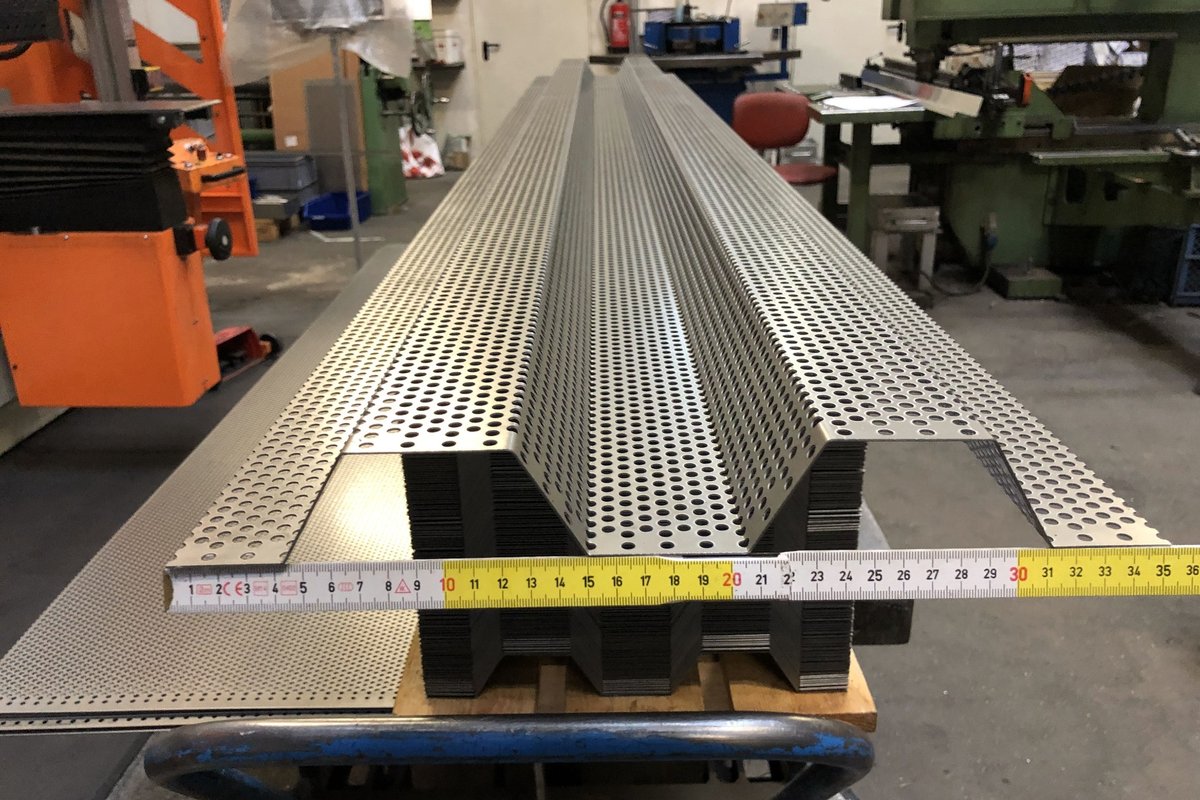
Trapezoidal profiles made of perforated sheet metal as joint plates for concrete floor slabs
In concrete floor slabs, trapezoidal profiles made of perforated sheet metal are often used as joint plates. They form the structural connection between two concrete sections and ensure that forces are safely transferred across the concrete joint.
Compared to simple construction joints without a profile, trapezoidal profiles made of perforated sheet metal significantly increase the durability of industrial floors. They reduce edge chipping, minimize height differences, and improve the floor’s usability.
Distinction from traditional construction joints without a profile
In practice, concrete floor slabs are sometimes still constructed using traditional construction joints without a structural joint profile. In this case, the concrete pouring sections are separated without any specific components for crack control or load transfer. Although this design is simple, it has functional drawbacks.
Without trapezoidal profiles made of perforated sheet metal, there is no controlled guidance for crack formation. Cracks develop uncontrollably and often outside the planned joint line. In addition, height discrepancies may occur between the concrete panels, since there is no structural connection for load transfer.
In contrast, trapezoidal profiles made of perforated sheet metal perform several functions simultaneously. They define the intended crack line, stabilize the joint area, and enable reliable shear force transfer. This improves the long-term serviceability of the concrete floor slab. This represents a decisive advantage, particularly for industrial floors subject to high traffic and point loads.
Why Are Control Joints Essential in Concrete Floor Slabs?
Concrete has high compressive strength but limited tensile strength. Changes in volume occur during curing. In addition, temperature stresses and mechanical loads resulting from operation act on the concrete.
Without controlled crack lines, uncontrolled cracks will form. These lead to increased wear, limited service life, and high maintenance costs. Controlled crack line profiles made of perforated sheet metal guide these cracks in a targeted and predictable manner.
rotec, a manufacturer of trapezoidal profiles and expansion joint profiles made of perforated sheet metal
rotec is the manufacturer of these profiles. Development, production, and quality control are handled entirely in-house. This ensures transparency, streamlined decision-making, and consistent quality.
As a manufacturer, rotec can precisely adapt profile heights to the concrete thickness. In addition, hole patterns can be customized for each project. Lengths and geometries are custom-manufactured. Furthermore, rotec can be involved in the planning process at an early stage. This manufacturing expertise is particularly beneficial for architects and structural engineers.

Manufacturing of Profiles at rotec
The trapezoidal profiles are manufactured from perforated sheet metal in clearly defined process steps.
- Selecting the Appropriate Raw Material
- Precise perforation for optimal concrete interlocking
- Profiling to a trapezoidal cross-section
- Cut to project-specific lengths
- Dimensional and visual inspection prior to shipment
This process produces dimensionally accurate, pre-cut joint profiles made of perforated sheet metal with consistent quality.

Load Transfer and Bearing Capacity
A key advantage of trapezoidal profiles made of perforated sheet metal is their load-bearing capacity. Wheel loads, point loads, and dynamic loads are distributed across the joint. This keeps the joint edges stable.
In design, trapezoidal profiles made of perforated sheet metal are therefore often considered a component of a construction joint system. They facilitate the transfer of shear forces in the concrete joint and reduce deformation in the transition zone of the floor slab.
The Effect of Concrete Thickness and Use on Profile Selection
The selection of trapezoidal profiles made of perforated sheet metal depends largely on the concrete thickness and the intended use of the floor slab. Thinner floor slabs are more susceptible to tensile stresses caused by shrinkage and temperature changes. In such cases, precise control of crack formation is particularly important.
With greater concrete thicknesses and heavy-duty use—such as from forklift traffic or heavy machinery—load transfer across the joint becomes increasingly important. In such cases, trapezoidal profiles made of perforated sheet metal are designed to ensure both crack control and shear force transfer.
For architects and structural engineers, this means that trapezoidal profiles made of perforated sheet metal should be incorporated into the structural design at an early stage. The profile height, the perforation pattern, and the integration into the concrete must be tailored to the respective service class.

Typical Applications
Industrial Buildings and Logistics Facilities
High wheel loads from forklifts and material-handling equipment require sturdy joint solutions. Trapezoidal profiles made of perforated sheet metal stabilize the joint and help maintain the long-term flatness of the concrete floor slab.
Parking garages and underground parking garages
Temperature changes and traffic loads generate high stresses in concrete. Perforated metal expansion joint profiles reduce uncontrolled cracking and improve serviceability.
Production Facilities
Machine foundations and traffic areas place high demands on joint areas. Trapezoidal profiles made of perforated sheet metal increase operational safety and reduce repair costs.

Design Guidelines for Architects and Planners
Proper planning is crucial to the performance of the floor slab. Joint spacing, profile height, and temperature fields must be taken into account. Coordination with the reinforcement and the construction sequence is also important.
- Joint Spacing Based on Slab Size and Intended Use
- Profile height matching the concrete thickness
- Consideration of Temperature Fields
- Coordination with Reinforcement and Construction Schedule
- Incorporation of the trapezoidal profile as a joint plate or construction joint system in the structural design
rotec supports planners from the early stages of a project. This allows technical details to be coordinated early on and helps reduce execution risks.
Installation and Assembly of Trapezoidal Profiles Made of Perforated Sheet Metal
The proper installation of controlled-crack joint profiles and trapezoidal profiles made of perforated sheet metal is crucial for the subsequent performance of the concrete joint. The profiles are positioned and secured along the planned joint line before concrete is poured.
It is important to ensure precise alignment in terms of height and position. Deviations can result in the crack line not running as planned or in restricted load transfer. During concrete placement, care must be taken to ensure that the concrete fully adheres to the profile and is properly compacted.
The perforations in the profiles promote mechanical interlocking with the concrete. This creates a strong bond after curing, which limits movement in the joint area and increases the durability of the floor slab.
Common Mistakes and How to Avoid Them
Incorrect profile height
A profile that is too low will not function properly. The profile height should be selected to match the thickness of the concrete.
Inadequate securing
Misaligned profiles lose their effectiveness. It is necessary to secure them properly before pouring concrete and to check their position.
Mismatched hole pattern
Inappropriate drilling reduces the interlock between the concrete. The drilling pattern should be adapted to the project's requirements.
Typical Use Case
A typical application involves large-area concrete floor slabs in industrial facilities and logistics buildings. There, folded profiles made of perforated sheet metal can be integrated into the designated joint areas in accordance with the structural engineering specifications. The profile height, perforation pattern, material, fastening method, and installation orientation must be clearly specified in the detailed design plans. rotec then manufactures the profiles according to the agreed-upon specifications.
Economic Benefits of Controlled Joint Solutions
For building owners, cost-effectiveness plays a key role alongside technical design. Although trapezoidal profiles made of perforated sheet metal incur additional costs compared to simple control joints without profiles, they significantly reduce long-term maintenance and repair costs.
Uncontrolled cracks, chipped edges, or height discrepancies often lead to restrictions on use and costly renovations. Using controlled-crack joint profiles made of perforated sheet metal can significantly minimize these risks.
A durable joint solution has a positive impact on total operating costs, particularly for large-scale industrial and logistics floors. For investors and operators, this means greater planning certainty and long-term preservation of the property’s value.
Standard-Based Supplement for Bidding and Planning
When designing and constructing concrete floor slabs, controlled-crack joints and construction joints must be taken into account in accordance with applicable technical codes. Trapezoidal profiles made of perforated sheet metal and controlled-crack joint profiles made of perforated sheet metal are used as structural elements to specifically control cracking and transfer loads across the concrete joint.
The application is carried out in accordance with the requirements of DIN EN 1992-1-1 (Eurocode 2) in conjunction with the National Annex DIN EN 1992-1-1/NA. These standards define the design of reinforced concrete members, taking into account constraint stresses, shrinkage behavior, and load transfer.
Perforated sheet metal controlled-crack joint profiles are used to deliberately induce cracks resulting from shrinkage and thermal stress. Trapezoidal profiles made of perforated sheet metal also serve to transfer shear forces within the concrete joint and can be incorporated as part of a construction joint system.
The selection of the profile geometry depends on the concrete thickness, load class, joint spacing, slab size, required shear force transmission, as well as the construction sequence and concrete pouring sections. The perforations in the profiles are designed to ensure sufficient interlocking between the concrete and the profile. This ensures the joint’s long-term functionality and reduces the risk of edge spalling and height discrepancies.
Trapezoidal profiles made of perforated sheet metal and pre-cracked joint profiles made of perforated sheet metal are suitable for use in industrial buildings, logistics facilities, parking garages, and production facilities. As a manufacturer, rotec produces these profiles to meet specific project requirements. Profile heights, perforation patterns, and lengths can be tailored to meet structural requirements and design specifications. Integration into the overall structural concept is carried out in consultation with structural engineers and the construction management team.
Note Regarding Specifications
Trapezoidal profiles made of perforated sheet metal are classified as control joint profiles and construction joint profiles. The structural engineer must determine the design of the concrete floor slab, including joint configuration and shear force transfer. The profiles serve to implement the planned joint function structurally and do not replace structural design calculations.
Conclusion
Trapezoidal profiles made of perforated sheet metal and controlled-crack joint profiles can be key components for durable concrete floor slabs. The key factors are the quality of manufacturing and proper integration into the structural design. rotec manufactures these profiles in Berlin and supports designers and contractors with practical advice and customized production.
What information does rotec need for an inquiry?
For a quick technical review, we need a dimensioned drawing or sketch, if possible. Additionally, please provide details regarding the profile geometry, profile height, length, quantity, hole pattern, material specification, concrete thickness, installation conditions, and the desired delivery date. Structural specifications and requirements for joint design should be determined by the responsible structural engineer.

Request trapezoidal profiles made of perforated sheet metal from rotec
Do you need trapezoidal profiles, expansion joint profiles, or folded perforated sheet metal parts for concrete floor slabs? rotec combines a large inventory of perforated sheet metal with in-house sheet metal fabrication and manufactures the profiles according to the agreed-upon project specifications.
Expert Advice on Perforated Sheets
Phone: 030 789039-16
Email: lochblech@rotec-berlin.de
Further Technical Articles
- Sheet Metal Bending and Folding in Berlin
- Perforated Sheet Glossary: Perforations, Materials, and Processing
- Perforated sheets from rotec's large inventory
- Sheet Metal Fabrication at rotec Berlin
Frequently Asked Questions About Trapezoidal Profiles Made of Perforated Sheet Metal
Are trapezoidal profiles made of perforated sheet metal or joint sheets?
Yes. Trapezoidal profiles made of perforated sheet metal are often used as expansion joints and serve as construction joints. They help control cracking and transfer loads.
What is the difference between joint sheet metal and trapezoidal profile?
The term "joint plate" describes its function in a concrete joint. Trapezoidal profiles made of perforated sheet metal are a structurally reinforced form of the joint plate, offering greater stiffness and better shear force transmission.
When Are Trapezoidal Profiles Required?
They can be particularly useful in cases of high wheel loads, dynamic use, and demanding industrial floors. The responsible planning team determines whether and in what configuration they will be used, based on the project requirements.
rotec manufactures custom profiles
Yes. Profile heights, hole patterns, and lengths are manufactured on a project-by-project basis and coordinated with the detailed design.
Are trapezoidal profiles made of perforated sheet metal suitable for all concrete floor slabs?
They are particularly suitable for concrete floor slabs subjected to medium to high loads. Their suitability depends on the concrete thickness, intended use, and structural design.
Do trapezoidal profiles need to be structurally analyzed?
Yes. The structural engineer is responsible for designing the concrete floor slab and the joint areas. Trapezoidal sections support the structural implementation but do not replace a structural analysis.
Can trapezoidal profiles also be used in renovation projects?
It is primarily used in new construction. For renovation projects, a case-by-case assessment is required, as integration into existing concrete slabs may be limited.
What information does rotec need to provide a quote?
It is helpful to provide a dimensioned drawing or sketch, as well as details regarding profile height, length, quantity, hole pattern, material, concrete thickness, and delivery date.
Who determines the profile height and joint configuration?
The specifications for the concrete floor slab, profile height, and load transfer are provided by the structural engineer in charge. rotec then verifies the technical feasibility of the design.
Can Rotec manufacture trapezoidal profiles according to drawings?
Yes. rotec manufactures folded perforated sheet metal profiles according to agreed-upon drawings and approved technical specifications.
Which type of perforation is suitable for trapezoidal profiles?
The hole pattern must be compatible with the intended function, profile geometry, and design. For this reason, it is tailored to each specific project.
Are standard perforated sheets available on short notice?
rotec maintains a large inventory of perforated sheets. You can find available standard sheets in the Profishop. Custom-machined trapezoidal profiles are manufactured following technical consultation.
Technically updated on August 5, 2026. The information provided here does not replace a structural analysis or project-specific construction planning.
Additional Sheet Metal Fabrication at rotec
Trapezoidal profiles made from perforated sheet metal are an example of the combination of cutting and bending. This article explains other processes, materials, manufacturing limitations, and points of contact. Sheet Metal Fabrication and Metalworking in Berlin.



 EN
 DE
 ES
 FR
 IT
 NL
 PL
 TR
0 Comments