
Updated on
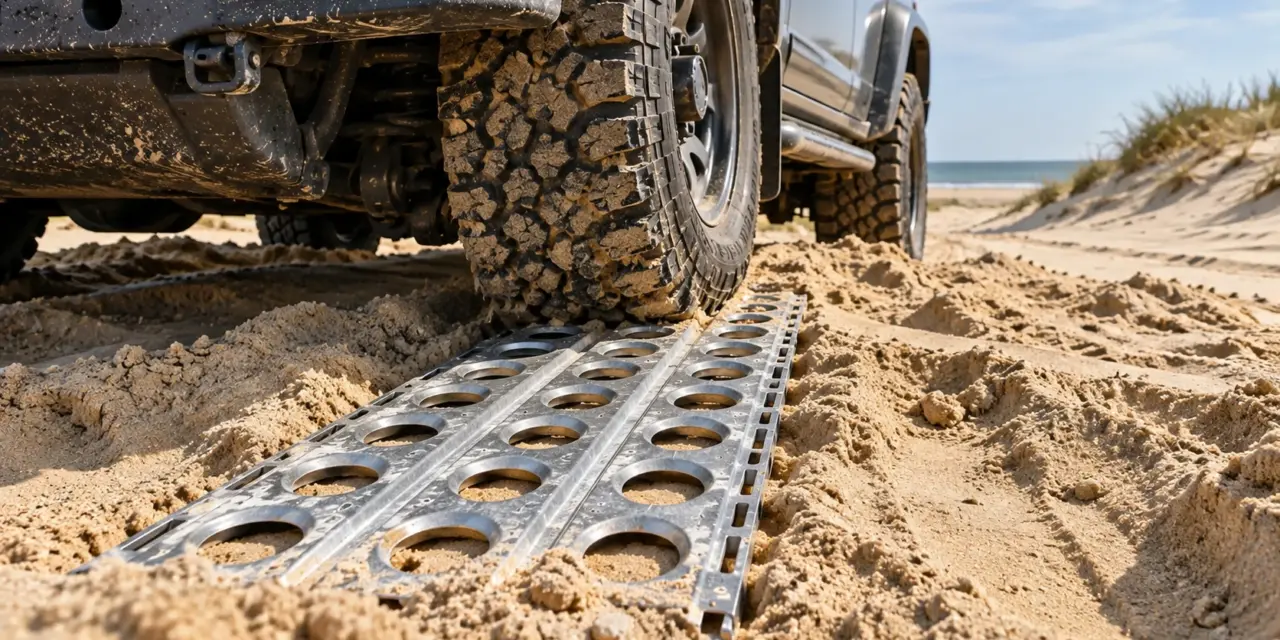
You're looking for Sand plates made of aluminum and steel For your off-road vehicle or a commercial application? At rotec, you can get both material options in the standard lengths of 1,520 and 3,040 mm. All versions are available individually.
Aluminum makes it easier to carry and store. Hot-dip galvanized steel offers an alternative for floor panel solutions, which you can customize based on load requirements and the underlying surface.
Our sand plates are usually available for immediate delivery. Subject to prior sale.
View sand plates and prices at the rotec Profishop or Request advice on the right model.
Image credit: The header image was generated using AI. The photo taken on the lakeshore is based on an older original photo, the contours of which were sharpened using AI. The remaining photos are original photographs. The accompanying dimensional drawing is a technical illustration.
Aluminum or Steel: Which Sand Plate Is Right for Your Application?
If you frequently carry, lay out, and stow sand sheets, aluminum is a particularly good choice because of its lighter weight. For commercial flooring applications, hot-dip galvanized steel sheets are also an option.
When making your selection, you should therefore first consider the intended use: Do you want to carry a portable approach aid with you, or do you want to mount one to a surface?
| Selection criterion | Aluminum sand trays | Steel sand plates |
|---|---|---|
| Material | EN AW-5754 | DD11 |
| Surface | Untreated | Hot-dip galvanized |
| Handling | Lighter, with the same sheet metal thickness and comparable geometry | Take the increased weight into account |
| Particularly relevant for | Frequent carrying, laying out, and transporting | Planned Floor Panel Solutions for Commercial Use |
| Standard Lengths | 1,520 and 3,040 mm | 1,520 and 3,040 mm |
| Sales Unit | Available individually | Available individually |
The permissible load depends on the specific design and operating conditions. A higher load-bearing capacity cannot be determined from the material designation alone.
Aluminum sand plates for off-road vehicles and mobile equipment
When preparing for a trip, every piece of gear counts. Sand plates should be easily accessible and easy to handle while on the go.
Aluminum has a lower density than steel. Therefore, aluminum sheets are lighter when they have the same thickness and comparable geometry. This makes them easier to carry, lay out, and stow away after use.
rotec offers Aluminum EN AW-5754 sand plates with an untreated surface. Vehicle equipment manufacturers and private users can choose from two standard lengths.

DD11 sand plates, hot-dip galvanized
The steel version consists of DD11 with a hot-dip galvanized finish. The zinc coating protects the steel sheet from corrosion.
This specification is particularly relevant for inquiries regarding commercial floor panel solutions. Factors to consider include the subfloor, the vehicles intended for use, and the frequency of traffic.
At the Profishop, you'll find the DD11 sand plates, hot-dip galvanized. If you are planning a contiguous area, please also provide details about its size and intended use.
Sand Plates: An Overview of Dimensions and Models
Rotec sand plates are 420 mm wide. Both materials are available in two standard lengths. This allows you to tailor your selection to your space requirements and intended use.
| Material and Surface | Length | Width | Sheet thickness | Profile height |
|---|---|---|---|---|
| Aluminum EN AW-5754, untreated | 1,520 mm | 420 mm | 3 mm | 21 mm |
| Aluminum EN AW-5754, untreated | 3,040 mm | 420 mm | 3 mm | 21 mm |
| DD11 steel, hot-dip galvanized | 1,520 mm | 420 mm | 3 mm | 21 mm |
| DD11 steel, hot-dip galvanized | 3,040 mm | 420 mm | 3 mm | 21 mm |
All four versions are available separately. You can therefore order exactly the number of items you need.
The dimensional chart corresponds to the standard models described. The confirmed specifications for the selected variant apply to your order.
What length is best for your vehicle?
The 1,520-mm-long version requires less storage space and is easier to store. The 3,040-mm version offers a longer support area but requires correspondingly more space during transport.
Therefore, measure the intended storage location before placing your order. Also, consider how you will access the sheets once they are in use.
For exterior mounting on the vehicle, the bracket and fasteners must be compatible with the selected model.
Correctly Classify Sheet Thickness and Profile Height
The sheet metal is 3 mm thick. Due to its formed structure, the component has a profile height of 21 mm.
This distinction is important when you are planning a mount or storage space. The material thickness alone does not fully describe the required installation space.

Three rows of holes, beads, and connecting edges
Rotec sand plates feature three parallel rows of holes. The hole diameter is 62.5 mm. Formed hole edges, beads, and side hook edges complete the design. For more information on the geometry, see the rotec Product Overview for Floor Panels and Sand Panels.
Perforations and profile shapes serve different purposes
Compared to a sheet of metal without holes, the punched-out openings reduce the amount of material and thus the weight. The ribs reinforce the profile.
When comparing products, you should therefore consider the external dimensions, material thickness, and profile shape together. Sheets with similar dimensions may have different constructions.
Side hook edges for connecting
The hook edges on the sides allow multiple floor panels to be connected to one another. This is particularly important for large-area applications.
How you arrange the elements depends on the planned route and intended use. Therefore, you should have a layout plan in place before ordering large quantities.

Sand plates as a starting aid when driving off-road
On soft ground, a tire can sink in and churn up the soil. A properly placed sand plate creates an additional layer of support between the tire and the ground. This can make it easier to get the vehicle moving.
For off-road vehicles, therefore, preparation involves not only selecting the right equipment but also storing it properly. A suitable recovery tool is only useful if you can reach it and use it when needed.
Plan for Transportation and Accessibility
Check to see if you can remove the panels even when the vehicle is in an awkward position. Also, make sure they are properly secured.
Especially on longer trips, you should check mounts and contact points regularly. This will allow you to spot loose fasteners or damage early on.

Clean and inspect after use
Remove sand and any dirt that has stuck to the sheets before storing them away. This will make it easier to spot cracks, significant deformations, and damaged edges.
It is advisable to wear appropriate protective gloves when handling sheet metal. Also, be sure to follow the usage instructions for the specific model.
Load Capacity: What Matters When It Comes to Sand Plates
Vehicle load, ground conditions, and the surface on which the vehicle rests all determine whether a sand plate is suitable for use. The vehicle's total weight alone is not sufficient for making an assessment.
A sheet of metal supported on the ground is subjected to different stresses than a section that is freely supported. Unevenly distributed wheel loads also alter the stress distribution.
For technical classification, we therefore need, in particular:
- Vehicle type and gross vehicle weight or known axle loads
- Description of the Substrate
- Intended surface and noticeable unevenness
- Type and Frequency of Crossings
- Required dimensions and quantity
Use as a trench bridge, access ramp, or vehicle support requires explicit confirmation of suitability for that specific application. Also, be sure to follow the product-specific instructions when using the product.
Floor panels for construction sites and commercial spaces
When it comes to a construction site access road or operational area, the entire traffic area is the focus. Here, different questions need to be addressed than in the case of a mounted approach aid.
Therefore, start by describing which vehicles will use the area and how long the paving is intended to last. Include information about the subgrade, as well as any transitions and edge areas.
For repeated passes, inspection and maintenance should also be included in the planning. This is because soil conditions can change due to weather and use.
If you need to cover larger areas or travel longer distances, it's also worth taking a look at the rotec's mobile roadways and ground protection plates. This allows you to compare different product groups for your project.
Steel sand plates in military and truck operations
Steel sand plates can be joined together to form continuous surfaces when soft ground needs to be temporarily made usable for vehicles. The photo shows them being laid on the marshy shore of a lake. For the military and truck operations described here, only steel plates are used. The individual elements together form a surface whose design must be tailored to the vehicles and ground conditions. Therefore, the expected wheel loads, the support structure, and the connection of the plates are critical factors. Are you planning a similar application? Tell rotec what you need: Please describe the vehicles to be used, the area size, and the condition of the surface. This will allow us to provide you with specific advice on the appropriate solution.
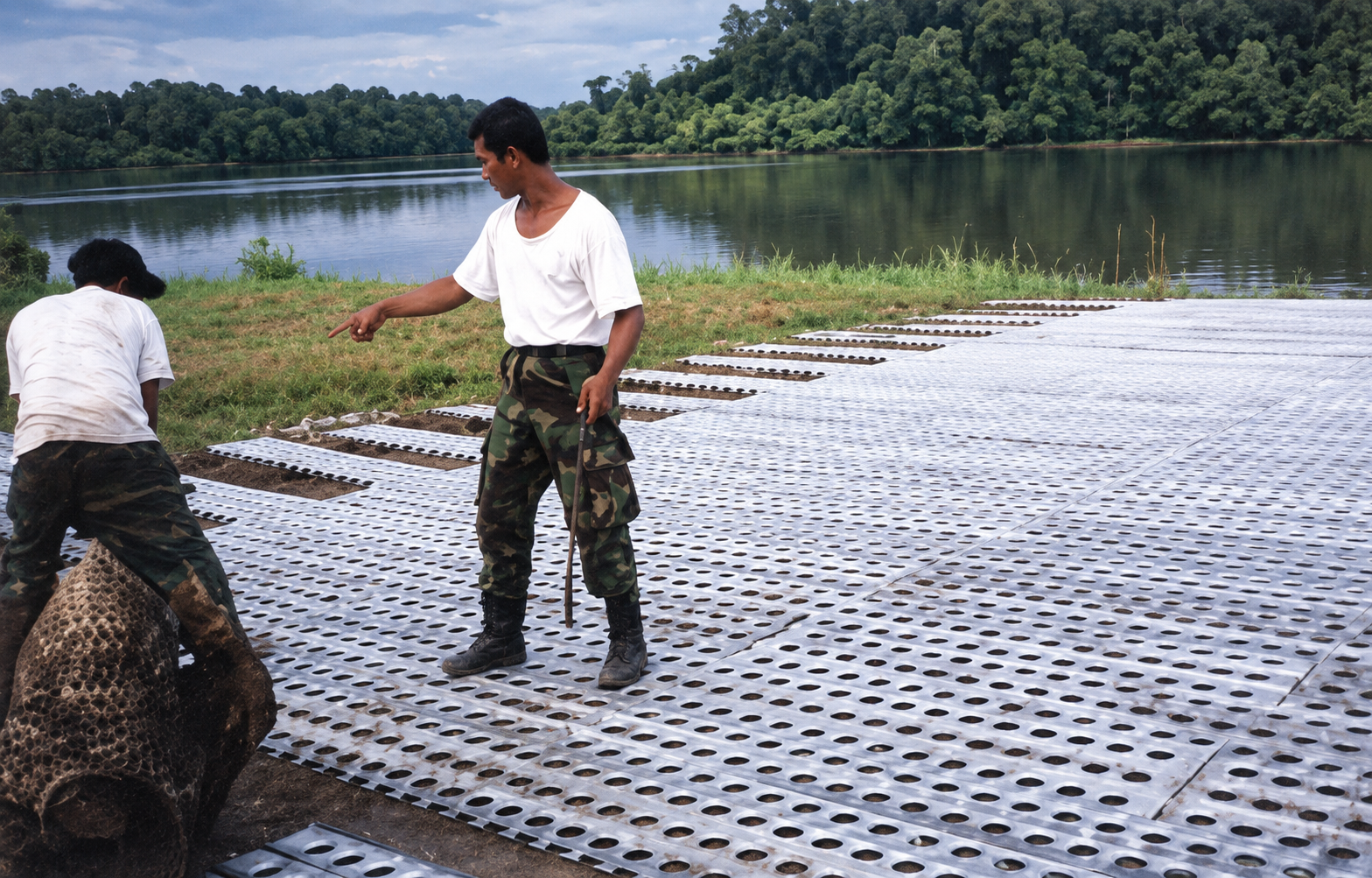
Image credit: The photo taken on the lakeshore is based on an older original photograph. During post-processing with AI, only the contours were sharpened.
Buy sand plates from rotec: individually and tailored to your needs
At rotec, you can purchase aluminum and steel sand plates individually. This allows you to add a single plate or equip multiple vehicles.
You can find the different options and their respective prices in the Pro Shop. If you have any questions about which option to choose, our customer service team will help you determine your needs.

Usually available for immediate delivery
The sand plates are available from rotec Usually available for immediate delivery. Subject to prior sale. When you place your order, we will confirm the availability of the desired model, as well as the delivery date and shipping details, with you.
Therefore, it is advisable to place your order early, especially if you have a fixed travel start date or project deadline.
Find the right offer with just a few details
For a specific inquiry, please provide us with the material, length, quantity, and delivery location. Please also briefly describe the intended application.
If you're torn between two options, vehicle specifications or a sketch can help. This allows us to address your inquiry specifically and clarify any outstanding questions with you.
Compare Sand Plates and Prices or Request a quote for the model you want.
Frequently Asked Questions About Aluminum and Steel Sand Sheets
What is a sand plate?
A sand plate is a profiled sheet of metal that serves, for example, as a driving aid on soft ground. Depending on the application, the terms “floor plate” or “air landing plate” are also used.
Are aluminum sand plates lighter than steel plates?
Yes. With the same material thickness and comparable geometry, aluminum sheets are lighter because aluminum has a lower density. This makes them easier to carry and store.
What kind of steel are rotec sand plates made of?
The steel version offered here is made of DD11 and has a hot-dip galvanized finish.
Which aluminum alloy is available?
The aluminum sand plates are made of EN AW-5754 and are available with an untreated surface.
What sizes are available?
The standard lengths are 1,520 and 3,040 mm, each with a width of 420 mm. The sheet thickness is 3 mm, and the profile height is 21 mm.
Can I order a single sand tray?
Yes. All aluminum and steel sand plates are available individually. You can choose the quantity based on your needs.
What length is right for my vehicle?
That depends on the intended use and the available storage space. The short version takes up less space, while the long version offers more support length.
Are sand plates available for immediate delivery?
Rotec sand plates are generally available for immediate delivery. Subject to prior sale. We will confirm the availability of your desired model when you place your order.
Can multiple floor panels be joined together?
Yes. The panels described have hook edges on the sides for joining. For large-area installations, adjust the layout to suit the substrate and intended use.
How much weight can the sand plates hold?
It is not possible to specify a general vehicle load without knowing the operating conditions. Wheel loads, the ground surface, and the support surface are particularly important factors. For special applications, we therefore need specific operating data.
Where can I find the prices?
You can find the prices for the available options in the rotec Profishop for Sand Sheets. When making your selection, consider the desired length, material, and quantity.
What information does rotec need for an inquiry?
Please provide us with your desired material, dimensions, quantity, and delivery location. If you have technical questions regarding material selection, please include the intended application and available vehicle data.
Select the right model now
Whether for your off-road vehicle or commercial use, rotec can help you choose the right sand plates made of aluminum or hot-dip galvanized DD11 steel.
All sand plates are available individually and are generally in stock. Subject to prior sale.
View sand plates in the rotec Profishop
Phone: 030 789 039-0
Email: info@rotec-berlin.de



 EN
 DE
 ES
 FR
 IT
 NL
 PL
 TR