
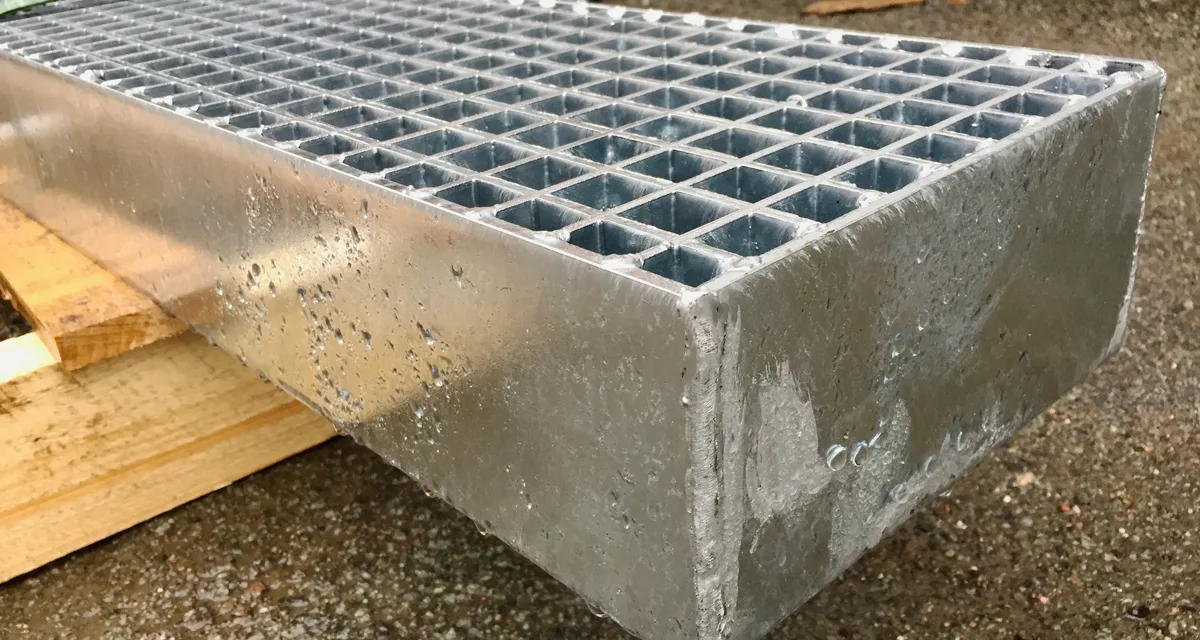

Heavy duty gratings
Heavy duty gratings hot dip galvanized

Heavy duty gratings 31×09 mm
Close mesh heavy duty gratings hot dip galvanized

Old Berlin heavy duty grate
Drive-on heavy-duty grate replicated from historical model

GRP heavy duty grate
Heavy duty GRP grating
Heavy duty grating application
Heavy-duty grates from rotec Berlin are used when standard grating cannot safely support the intended loads. As custom-designed heavy-duty gratings for industrial, transportation, and special-purpose applications, they are selected based on load type, wheel contact area, span, support configuration, direction of travel, and fastening method. rotec supports engineering firms, metal fabricators, industrial companies, and building owners in finding a durable, cost-effective, and project-specific solution.
Image credit: All images shown in this post are original project and product photos from rotec. They were neither created nor edited using AI.
What are heavy-duty grating panels?
Heavy-duty grating is designed to provide exceptional load-bearing capacity for high-traffic floor surfaces, covers, and walkways. In metal versions, it consists of sturdy support bars, crossbars, and a perimeter edge. The support bars are responsible for the primary load transfer between the supports.
Unlike standard industrial grating, heavy-duty grating is designed to withstand significantly higher loads. These include, for example, wheel loads from trucks, forklifts, or fire trucks. Machine loads, container loads, and high surface loads are also factors to consider.
However, the term “heavy-duty grating” does not specify a specific load-bearing capacity. This is because two gratings of the same size can differ significantly in terms of bar height, bar thickness, mesh size, and span. Therefore, every safety-critical application must undergo technical testing.
Where are heavy-duty grating panels from Berlin used?
Heavy-duty grating from Berlin is ideal for construction projects that require a combination of load-bearing capacity, permeability, and a compact design. At the same time, water, dirt, air, and light can pass through the open structure.
Industry and Logistics
Typical applications include loading areas, production areas, maintenance access hatches, machine platforms, and traffic routes. These areas are often subject to concentrated wheel loads or varying loads.
Fire Department and Service Access Roads
Coverings within areas open to vehicle traffic must be designed to accommodate the specified vehicles. In addition to the axle load, the individual wheel load is particularly important.
Drainage and Sewer Covers
The open grid surface allows rainwater to drain away. At the same time, the structure must be secured against shifting, lifting, and excessive deflection.
Special Projects and Infrastructure
In bridges, fish ladders, transportation structures, and technical facilities, heavy-duty gratings combine load-bearing capacity with light, air, or water permeability.
Project Example: Heavy-Duty Grating Over a Fish Ladder
The video shows an unusual project with unique requirements. Heavy-duty grating spans an inclined traffic surface over a fish ladder. Therefore, it had to support the traffic loads while also allowing a specified amount of light to pass through.
In this case, the open mesh pattern was a functional element of the design. This was because light was still needed to reach the area below. At the same time, the load-bearing capacity of the traffic area could not be compromised.
How to Properly Plan Heavy-Duty Grating
Reliable planning begins with complete load specifications. Statements such as “suitable for vehicle traffic,” “suitable for trucks,” or “extremely durable” are not sufficient. Instead, the load size, load distribution, and installation conditions must be clearly described.
| Planning Specification | Why It's Important | Typical examples |
|---|---|---|
| Load Type | Point loads and distributed loads place different stresses on the grate. | Wheel load, machine base, evenly distributed load |
| Tire contact patch | A smaller contact area results in higher localized stress. | Forklift tires, truck tires, steel rollers |
| Clear span | As the span increases, so do the stress and deflection. | Distance between two load-bearing supports |
| Direction of the load-bearing member | The support members must span from support to support. | Direction of travel: perpendicular or parallel to the support bar |
| Support width | The support transfers the forces from the grating to the frame or substructure. | Angle frames, steel beams, concrete bases |
| Installation Situation | Moisture, chemicals, dirt, and temperature affect the material and its surface. | Outdoor areas, production, wastewater treatment plant, port |
| Mounting | The grate must be secured to prevent it from sliding or lifting. | Clamps, screw connections, project-specific brackets |
The direction of the load-bearing member and the support must match
In a grating, not all bars bear the load equally. The load-bearing bars span the clear distance between the load-bearing supports. Therefore, the direction of the load-bearing bars must be clearly indicated in drawings and purchase orders.
In addition, the frame and substructure must reliably absorb the forces that act on them. Even a high-performance grating cannot compensate for an unsuitable support structure. That is why a sound design approach treats the grating, frame, substructure, and fasteners as a single integrated system.
Evaluate point loads, wheel loads, and surface loads separately
A uniformly distributed surface load acts differently than a vehicle wheel. With a wheel, the load is concentrated on a limited contact patch. Therefore, the type of wheel, tire pressure, and road surface can be critical factors in the design process.
Dynamic loads must also be taken into account. These include braking, starting, maneuvering, and impact loads. The responsible engineering team must determine whether and how such factors should be accounted for.
Select the mesh spacing and overall height based on the specific project
The mesh size affects light transmission, drainage, weight, and usage. An open mesh provides high permeability. A tighter mesh, on the other hand, reduces the size of the open spaces.
The appropriate design depends on the project. Factors such as vehicle wheels, small casters, falling objects, and accessibility requirements all play a role. In addition, the desired mesh size must be compatible with the required load-bearing capacity.
Close-mesh heavy-duty grating with 31 × 9 millimeters
A mesh size of 31 × 9 millimeters may be appropriate when narrower openings are desired. At the same time, the grate remains permeable to light, air, and liquids. The specific support bar design is still selected based on the load.
Steel, stainless steel, or fiberglass-reinforced plastic: Which material is right for the job?
The material must be suitable for the load and the environment. That is why rotec evaluates more than just the required load-bearing capacity. Corrosion, moisture, chemicals, electrical properties, and maintenance are equally important.
| Material | Typical Benefits | Important Planning Question |
|---|---|---|
| Hot-dip galvanized steel | High mechanical strength and proven corrosion protection for many industrial applications. | What are the ambient conditions, humidity, and mechanical stresses? |
| Stainless steel | Suitable for applications with increased requirements for corrosion resistance or hygiene. | Which grade of stainless steel is best suited for the medium and the environment? |
| GRP | Corrosion-resistant, electrically non-conductive, and relatively lightweight. | What resin grade, span, and surface texture are required? |
Hot-dip galvanized heavy-duty grating
Hot-dip galvanized steel is suitable for numerous industrial and outdoor applications. The zinc coating protects the steel surface from corrosion. However, the environment, cleaning agents, and mechanical stress must be evaluated in advance.
Heavy-duty stainless steel grating
Stainless steel is often used when corrosion resistance or hygiene are particularly important. However, stainless steel is not automatically resistant to every substance. Therefore, the material grade must be specified on a project-by-project basis.
FRP Grating for Corrosive Environments
FRP grating is particularly well-suited for corrosive environments and areas with electrical requirements. However, it has different material properties than steel grating. Therefore, dimensions and load-bearing capacities cannot simply be carried over.
For more information, visit the rotec resource page on FRP Grating. A real-world example also illustrates the Use of FRP Grating in the Rail Sector.
Custom-made products for demanding projects
Heavy-duty grating from Berlin is often required as a custom-made product. This is because existing openings, machines, or structural geometries rarely conform to a standard grid. Therefore, dimensions, cutouts, and edge details can be customized on a project-by-project basis.
- Custom sizes based on the installation situation
- Round or square cutouts
- Notches and cuts
- Perimeter Edging
- Smooth or textured surfaces
- Customized frames and mounts
- Square or Rectangular Mesh Sizes
To ensure safe manufacturing, all cutouts must be dimensioned and assigned to the direction of the load-bearing members. Furthermore, a cutout must not unduly weaken load transfer. Therefore, changes should be avoided after technical approval has been granted.
rotec describes the options on the page Grating Custom-Made to Your Specifications.
Historic heavy-duty grate modeled after the Berlin design
Historical structures can also present unique challenges. The original photo below shows a heavy-duty grating designed to withstand vehicle traffic, which was recreated based on a historic Berlin model. The project required harmonizing functionality, appearance, and the existing installation conditions.
Standards, Occupational Safety, and Technical Regulations
For metal grating used as flooring, the DIN 24537-1 at DIN Media an important foundation. The standard covers grating made of metallic materials. Depending on the specific project, additional standards, guidelines, and building codes may apply.
The DGUV Information: Grates—Selection and Operation explains how to select and use them safely. For installation work, the DGUV Information: Grates, Installation relevant.
The RAL Quality Mark for Grating: RAL-GZ 638 describes requirements for quality, dimensional accuracy, and structural analysis. Requirements for the slip resistance of floors are addressed in the BAuA ASR A1.5.
Determine the appropriate slip resistance level based on the intended use
In wet, oily, or dirty areas, a textured surface may be required. The required slip resistance depends on the intended use and the risk assessment. Therefore, it should be specified in the initial inquiry.
Secure grating to prevent it from lifting or shifting
Heavy-duty grating must rest securely and remain permanently in its intended position. Therefore, appropriate fasteners are an important component of the system. At the same time, they must allow for maintenance and removal, if such operations are intended.
Why should rotec Berlin design heavy-duty grating on a project-by-project basis?
rotec Berlin combines technical consulting with decades of experience in metalworking, grating, and project-specific custom solutions. As a result, designers and clients receive not just a grating, but a tailored solution that takes into account load requirements, installation conditions, materials, and logistics.
- Project-Based Consulting for Industry, Construction, and Infrastructure
- Assistance in Selecting Support Bar Height and Thickness
- Heavy-duty grating made of steel, stainless steel, and select FRP systems
- Custom sizes, cutouts, and customized edge details
- Assistance with the orientation of load-bearing members, support arrangements, and fastening
- Quality Management According to DIN EN ISO 9001:2015
- Experience with complex special projects
- Shipping within Germany and to other European countries
You can find an overview of the program on the rotec website Grating and Grating Steps. The product page also provides specific information Heavy-duty grating for extreme loads.
Additional rotec Projects Featuring Grating
Grating does more than just fulfill structural requirements. It can also serve architectural, design, and railway engineering functions. Read the project report on Aluminum Grating at Stuttgart 21 Central Station. In addition, the article on the rotec Berlin-Type Facade Grating The possibilities in facade construction.
Request heavy-duty gratings from rotec Berlin for your project
Complete project data is essential for the technical preselection of suitable heavy-duty gratings from rotec Berlin. Therefore, please provide us with the following information if possible:
- Shelf dimensions and quantity
- Clear span, support width, and support type
- Point load, wheel load, or surface load
- Size of the load contact area and direction of travel
- Desired mesh size
- Material and Surface
- Drawings, Photos, and Delivery Location
Frequently Asked Questions About Heavy-Duty Grating
1. What is a heavy-duty grating?
A heavy-duty grating is a grating designed for particularly high load-bearing capacity. The height and thickness of the bearing bars, the mesh size, and the support configuration are selected to suit the intended load.
2. How does a heavy-duty grating differ from a standard grating?
Heavy-duty grating typically has significantly sturdier support bars and is designed to withstand higher point loads, wheel loads, or distributed loads. Therefore, standard grating must not be used for heavy traffic without proper verification.
3. Can heavy-duty grating be driven over by trucks?
Yes, provided that the rust, supports, frame, and fasteners have been designed to withstand the actual wheel loads. The designation “suitable for vehicle traffic” alone does not replace a project-specific structural analysis.
4. Can heavy-duty grating be used for fire department access roads?
Use may be possible. However, the specified vehicle loads, tire contact patches, spans, supports, and safety requirements must be fully known and verified.
5. Why is the direction of the load-bearing member important?
The support bars span the distance between the load-bearing supports. If the direction of the support bars and the supports are incorrectly matched, the grating cannot reliably achieve its designed load-bearing capacity.
6. What information is needed to calculate a load?
The following information is required: dimensions, clear span, support width, load type, load size, wheel contact area, direction of travel, desired mesh size, installation conditions, and special safety requirements.
7. What is the difference between a point load and a distributed load?
A point load acts on a small area, such as that created by a wheel. A distributed load is spread over a larger surface area of the grate. These two load cases result in different stresses.
8. When is a mesh size of 31 × 9 millimeters appropriate?
A tighter mesh may be useful if you want to prevent smaller objects from falling through as easily or if you need to accommodate narrower rollers and wheels. However, the design must still be suitable for the load.
9. What are the advantages of a hot-dip galvanized heavy-duty grating?
Hot-dip galvanizing provides long-lasting protection against corrosion for steel surfaces. However, the actual duration of this protection depends on the atmosphere, humidity, mechanical stress, and maintenance.
10. When is stainless steel used for heavy-duty grating?
Stainless steel is suitable for applications with high requirements for corrosion resistance or hygiene. The appropriate grade of material must be selected based on the actual environmental conditions.
11. Is a fiberglass-reinforced plastic (FRP) grating always a heavy-duty grating?
No. GRP gratings have different material properties than steel gratings. Depending on the system, they can support heavy loads, but they require their own structural analysis and appropriate supports.
12. Are custom shapes and cutouts possible?
Yes. Depending on the project, custom sizes, round or square cutouts, notches, edge frames, and customized frames are possible. All details should be clearly agreed upon before production begins.
13. How are heavy-duty grating panels secured to prevent them from shifting?
The fastening method is selected based on the type of grating, the substructure, and the intended use. Fasteners must prevent the grating from lifting or shifting without compromising its load-bearing capacity.
14. What documents should be included in a request to rotec?
It is helpful to provide drawings, installation dimensions, load assumptions, information about vehicles or machinery, support details, preferred materials, surface finish, quantity, delivery location, and photos of the installation site.
Conclusion: Plan Heavy-Duty Grates from rotec Berlin Safely
Heavy-duty gratings from rotec Berlin are designed for applications that require both high load-bearing capacity and an open design. To ensure the system functions reliably over the long term, the load, span, direction of the support bars, supports, material, and fasteners must all be properly matched.
rotec Berlin supports you from the initial technical consultation through to project-specific delivery. This provides architects, design firms, metal fabricators, and industrial companies with a transparent and cost-effective solution for demanding applications.
Planning Note: For safety-critical applications, the technical preselection does not replace a verifiable structural analysis. Loads, support conditions, and fastenings must always be verified on a project-by-project basis.
Heavy duty gratings from rotec: precision and quality
Our heavy duty gratings are manufactured with the highest precision and care to meet even the most demanding requirements. As standard, they serve as a means of crossing over enormous loads, whether from heavy trucks or fire engines. But these gratings can do much more.
Adaptable heavy duty grating
The special feature of our heavy duty gratings is their adaptability. In a video that you can find on our website, you can see an impressive example: heavy-duty gratings to guide a mountain pass road over a fish ladder. This required not only handling high loads of flowing traffic on an inclined road, but also ensuring a specified light passage to allow fish to use the fish ladder without difficulty.
The light penetration was achieved through the generous mesh spacing of our heavy duty gratings. If necessary, we can adjust the material thickness and height of the gratings to meet the specific requirements of your project.
Supply of gratings and heavy duty gratings
rotec GmbH Berlin prides itself on not only manufacturing high quality products, but also delivering them promptly and reliably. Our gratings and heavy duty gratings are available in the material variants steel, stainless steel and GRP. We deliver to our customers every working day in the greater Berlin, Munich, Stuttgart, Cologne, Leipzig, Hamburg, Frankfurt, Dortmund, Saarbrücken, Essen and Düsseldorf areas.
We also offer twice weekly deliveries to Switzerland, Austria, Luxembourg and Poland. If you are located in another country, do not hesitate to contact us. We will do our best to meet your requirements as well.
For more information about our heavy duty gratings and other products, please visit our website at the following link: rotec GmbH Berlin - Heavy duty gratings
At rotec, we place great emphasis on quality and precision, and this is reflected in each of our products. If you're looking for heavy-duty gratings for demanding applications, you've come to the right place. Contact us today to learn more about our products and services.
This blog post will give you an insight into the world of heavy duty gratings from rotec GmbH Berlin and how we offer the highest quality and adaptability for demanding applications. If you have any questions or are interested, please do not hesitate to contact us. We are at your disposal with pleasure.


 EN
 DE
 ES
 FR
 IT
 NL
 PL
 TR
Strong contribution