
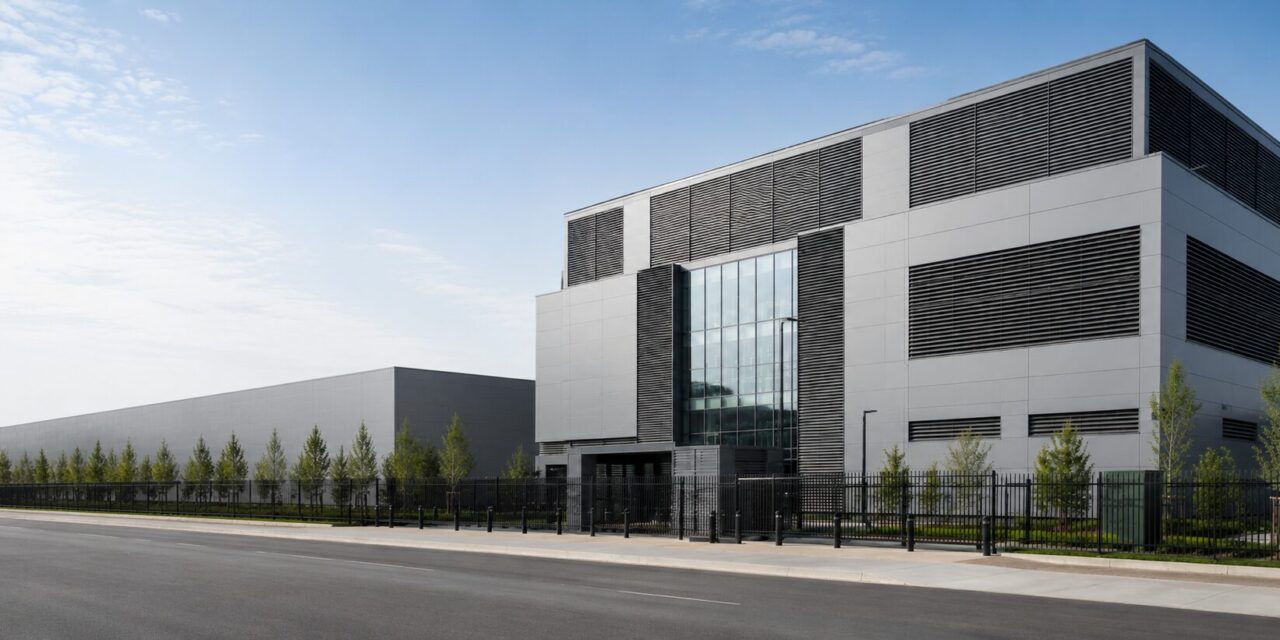
Intrusion-resistant ventilation grilles for data centers are a key component when it comes to ensuring that technical buildings are reliably ventilated while also being protected against unauthorized access. Data centers, server rooms, technical facilities, and security-critical industrial buildings require specific air inlets. However, it is precisely these inlets that must not become a weak point in the building envelope.
While doors, gates, and windows are often examined very closely in security planning, ventilation openings are sometimes overlooked until it’s too late. Yet larger facade openings, weather protection grilles, or ventilation grilles in accessible areas can pose a particular risk. If an opening is large enough to allow air to pass through, it should also be evaluated from a security perspective.
rotec supports architects, MEP engineers, security planners, facade contractors, metal fabricators, industrial companies, and facility operators in selecting suitable ventilation solutions. This involves more than just a single grille; it encompasses the interplay of airflow, weather protection, burglary resistance, mounting, maintenance, and integration into the building envelope.
Updated on June 30, 2026: This article has been technically revised and updated to reflect current requirements for burglar-resistant ventilation grilles, RC2 and RC3 solutions, secure building openings, clear ventilation cross-sectional area, weather protection, and data centers.
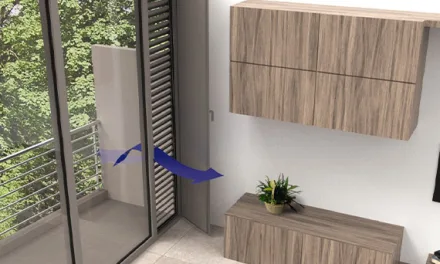
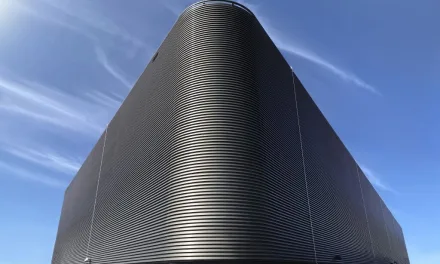
Image credit: The cover image and the illustration in the article were created using artificial intelligence. They are for illustrative purposes only and do not depict any specific object.
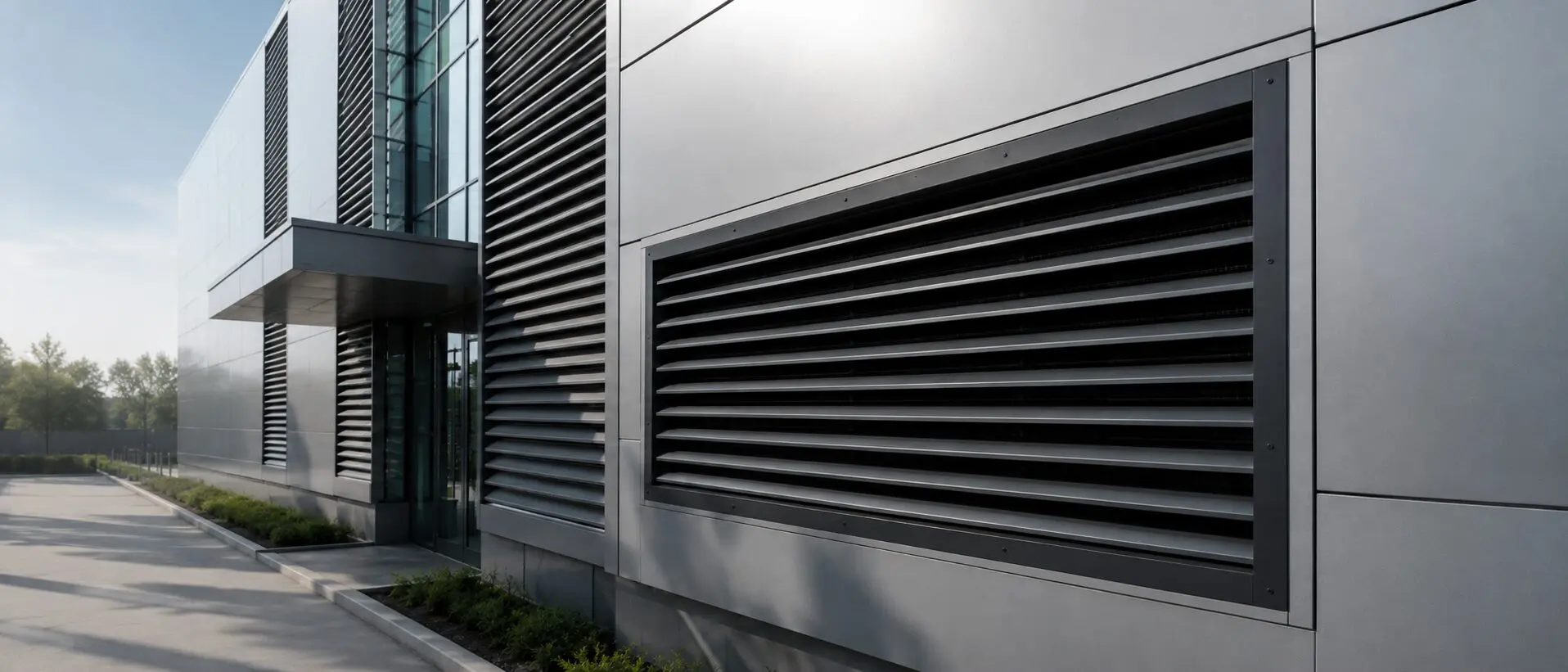

Why Burglary-Resistant Ventilation Grilles for Data Centers Must Be Planned Early
Data centers are among the most sensitive technical facilities. Servers, storage systems, network infrastructure, and security systems must remain available at all times. That is why cooling plays a central role. At the same time, ventilation openings must not make it easier for unauthorized persons to gain access to technical areas.
A ventilation opening connects the interior of the building to the outside air. It may be necessary for supply air, exhaust air, free cooling, night cooling, or mechanical ventilation. This always creates an interface between ventilation systems, weather protection, and building safety.
A simple ventilation grille can allow air to pass through and provide some protection from the elements. However, this is not always sufficient for security-sensitive areas. If the opening is accessible, if sensitive equipment is located behind it, or if the facade is part of a security plan, a burglar-resistant ventilation grille should be considered.
For more information on the energy-efficient use of outdoor air, see the rotec technical article on Nighttime Cooling in Data Centers. This article, on the other hand, focuses specifically on secure ventilation openings, burglary resistance, and access protection.
What Secure Ventilation Openings with Burglary Protection Must Do
A burglar-resistant ventilation grille must fulfill two functions at the same time. It must allow the necessary airflow while also increasing the mechanical resistance at the building opening.
This includes a sturdy frame construction, suitable slats or grille profiles, a durable mounting system, and a proper connection to the existing structure. After all, a component can only be as safe as its installation. If the wall opening, substructure, or fastening does not meet safety requirements, a weak point will result—even with a high-quality product.
It is therefore important for designers to understand that burglary resistance is not determined by a product designation alone. It results from a coordinated system consisting of the component, fasteners, installation conditions, and connection details.
Correctly Classify RC2 and RC3 Ventilation Grilles
For burglar-resistant components, resistance classes according to DIN EN 1627 are often specified. These classes describe how resistant a component is to defined methods of attack. For ventilation openings in data centers, it is particularly important to determine the desired resistance class early on.
RC2 ventilation grilles can be a practical solution for accessible building openings when increased mechanical resistance is required. If higher requirements apply, RC3 models can be evaluated on a project-by-project basis. The decisive factors here are always the current test documentation, the installation situation, the required airflow, and the property’s security concept.
For requests for proposals, this means that the desired resistance class should not be described in general terms. It is better to provide a clear description of the required function, the installation situation, the mounting method, the test criteria, and the necessary airflow capacity.
Intrusion-resistant ventilation grilles for data centers Therefore, these factors should not be selected only after the fact. The sooner the resistance class, airflow rate, mounting, and installation conditions are coordinated, the more reliably technical requirements and cost-effective implementation can be aligned.
Comparison: Standard Grille, RC2 Ventilation Grille, and RC3 Ventilation Grille
For data centers, equipment rooms, and security-critical building openings, a standard ventilation grille is not always sufficient. The following overview shows the fundamental differences between standard solutions, RC2 ventilation grilles, RC3 ventilation grilles, and soundproof louvers.
| Design | Typical Applications | Distinctive Feature | Planning Note |
|---|---|---|---|
| Standard Ventilation Grille | General ventilation openings without specific safety requirements | No defined resistance class. Weather protection is possible depending on the slat geometry. | Suitable for data centers only if there are no security-related openings. |
| RC2 Ventilation Grille | Accessible building openings, utility rooms, data centers, and industrial buildings | Increased mechanical resistance. Air permeability, weather resistance, and clear ventilation cross-section must be tested. | A good solution when both airflow and access protection are required. |
| RC3 Ventilation Grille | Sensitive technical areas with heightened security requirements | Higher resistance than RC2. The design must be reviewed on a project-by-project basis. | Recommended for situations with higher requirements for building security and access control. |
| Soundproofing slats | Equipment rooms, recoolers, data centers, and noise-sensitive locations | Air ventilation and sound insulation can be combined. However, this solution does not automatically provide burglary resistance. | If safety requirements apply, the design must be coordinated separately. |
Not sure which version is right for your project?
Whether a standard ventilation grille, an RC2 ventilation grille, or an RC3 model is the right choice depends on the airflow rate, installation conditions, security requirements, weather protection, and maintenance needs. rotec can assist you with the technical evaluation as early as the planning phase.
Air vents and burglar-resistant ventilation grilles must be compatible
A common design mistake is to consider safety and ventilation separately. A ventilation grille may be mechanically very sturdy, but still provide insufficient open area. Conversely, a grille may allow a lot of air to pass through but fail to provide adequate protection against unauthorized access.
The free ventilation cross-sectional area is crucial. The visible opening size is not necessarily the usable air area. Frames, louvers, protective layers, insect screens, safety profiles, and fasteners reduce the clear area. If this is not taken into account, pressure loss increases. As a result, fans must work harder, or the planned airflow rate will not be achieved.
This issue can be particularly critical in data centers, server rooms, and technical facilities. Ventilation must function reliably because technical equipment continuously generates heat. Therefore, airflow, clear space, pressure drop, and safety requirements should be evaluated together.
That is precisely why we must Burglary-resistant ventilation grilles for data centers should always be viewed as a functional interface. They combine ventilation, access control, weather protection, maintenance, and facade integration into a single safety-critical component.
For general ventilation applications, technical building openings, and project-specific custom solutions, you can find more information on the rotec topic page for Custom-Made Ventilation Grilles and Weather Protection Grilles.
Free ventilation cross-sectional area for burglar-resistant ventilation grilles
The clear ventilation cross-section is particularly important for burglar-resistant ventilation grilles. It describes what portion of the visible opening actually remains usable for airflow.
Especially when it comes to burglar-resistant ventilation grilles for data centers The free ventilation cross-sectional area must not be estimated. Frames, louvers, safety profiles, insect screens, and fasteners reduce the free area. This can increase pressure loss and compromise the planned airflow.
In terms of planning, this means that the visible wall opening is not automatically the usable ventilation area. Therefore, airflow, clear ventilation cross-section, pressure loss, weather protection, and resistance class should be evaluated together at an early stage.
Planning Note from rotec: For data centers, server rooms, and technical facilities, the clear ventilation cross-sectional area should always be evaluated in conjunction with the required air volume. This helps ensure that a grille that meets safety requirements is not later found to be undersized for ventilation purposes.
Weather protection for secure ventilation openings in data centers
In addition to burglary protection, weather protection plays a key role. Ventilation openings in data centers must be designed to withstand rain, driving rain, snow, and other external elements. Moisture must not be allowed to penetrate technical areas unchecked.
Weather protection grilles and louver systems divert rainwater while also providing the necessary ventilation. However, the louver geometry, installation orientation, wall connection, and facade configuration must be suitable for the specific application.
A safety-oriented ventilation grille that does not adequately account for weather protection does not fully address the issue. Similarly, a good weather protection grille alone is not sufficient if the opening is safety-critical. For data centers, both requirements must be planned together to ensure that secure ventilation openings function reliably over the long term and that sensitive technical areas remain protected.
For more information on technical weather protection solutions, visit the rotec page for Weather protection grilles for facades and building openings.
Comparison of Requirements: Air, Rain, Safety, and Noise
Burglary-resistant ventilation grilles for data centers often have to meet several requirements at once. Therefore, the design process should not be based solely on the resistance class. Airflow capacity, weather protection, sound insulation, maintenance, and installation conditions also influence the correct selection.
| Requirement | Significance for the Project | Recommendation from rotec |
|---|---|---|
| Air vent | The technical system requires specific air flow rates. Available space and pressure loss must be checked. | Determine the air volume and free ventilation cross-sectional area early on. |
| Burglary resistance | Accessible openings must not create a weak point in the building envelope. | Check for RC2 or RC3 on a project-by-project basis. |
| Weather protection | Rain and driving rain must not endanger technical areas. | Consider the vane geometry and installation configuration early on. |
| Soundproofing | Technical equipment can transmit noise to the outside. | Clarify acoustic requirements as early as the planning phase. |
| Maintenance | Contamination can reduce the clear area and increase pressure loss. | Plan for cleaning access and maintenance access. |
Maintenance of Burglar-Resistant Ventilation Grilles
When using outside air, insects, leaves, dust, and foreign objects must also be taken into account. A stainless-steel insect screen can be a practical solution for technical buildings because it is sturdy, durable, and high-quality. At the same time, an insect screen also affects the clear cross-sectional area.
Therefore, insect screens should not be treated as a minor afterthought. They are part of the technical design. Maintenance must also be taken into account. Ventilation grilles, weather protection louvers, and insect screens can become dirty. If cleaning is not possible, the clear opening area decreases during operation.
A good solution doesn’t just work on the day it’s installed. It remains maintainable, inspectable, and technically reliable even years later. That’s why burglar-resistant ventilation grilles should be incorporated into the design from the outset so that inspection, cleaning, and maintenance remain possible.
Sound Insulation for Safe Ventilation Openings
Data centers and technical buildings can generate noise. Recoolers, fans, ventilation systems, and power generators often emit noise to the outside through openings in the building facade. If there are residential areas, office spaces, public walkways, or sensitive uses nearby, noise control measures should be evaluated early on.
Soundproofing louvers can combine airflow with acoustic attenuation when ventilation openings must also meet acoustic requirements. However, they require more installation depth and must be designed to accommodate the planned airflow. Therefore, soundproofing should not be considered only after complaints arise.
For many projects, a combination of solutions makes sense. Some openings require high airflow, others require burglary resistance, and still other areas require additional sound insulation. rotec helps you systematically organize these requirements.
Burglary-Resistant Ventilation Grilles in the Data Center Design
Burglary-resistant ventilation grilles are one component of a broader security and building design strategy. They are not a substitute for comprehensive security planning, but they can significantly reduce a critical vulnerability in the building envelope.
Data centers often have to meet multiple requirements simultaneously. These include cooling, operational safety, access control, weather protection, fire protection interfaces, maintenance, sound insulation, and architectural integration. For this reason, the ventilation opening should be coordinated early on with building services engineering, security planning, facade design, and operator requirements.
The supplementary rotec article Efficient Ventilation and Sun Protection for Data Centers It also demonstrates how ventilation, sun protection, and the building envelope can work together in technical buildings.
Typical applications for burglar-resistant ventilation grilles
Burglary-resistant ventilation grilles aren't just needed in large data centers. Smaller server rooms, equipment rooms, power facilities, telecommunications rooms, industrial buildings, underground parking garages, utility buildings, and public facilities may also require secure ventilation openings.
Openings on the ground floor, in courtyards, on accessible facades, on accessible roof areas, or in areas that are difficult to see into are particularly critical. In these locations, a ventilation opening without proper protection can become a vulnerability.
Access protection must also be checked in cases of nighttime cooling, free cooling, or natural ventilation. If air vents are used outside of operating hours, this must not pose a safety risk.
Avoiding Design Errors in Safe Ventilation Openings
Many problems arise when ventilation openings are not evaluated for security purposes until the very end of the planning process. By that point, wall openings, facade grids, airflow rates, and budget constraints have often already been finalized. If a burglar-resistant solution is required later on, this results in rework, delays, and additional costs.
Another mistake is an imprecise request for proposals. If you simply specify a ventilation grille with burglary protection, you leave too many technical questions unanswered. It is better to provide clear specifications regarding opening size, airflow, clear area, resistance class, weather protection, insect protection, material, surface finish, installation location, mounting, and maintenance options.
The interface with the on-site structure must also be clearly described. In many projects, the substructure, load-bearing capacity, structural analysis, and wall connections are the responsibility of the client. rotec tailors its own building components to the specific installation situation and assists in selecting a suitable solution.
Who Burglary-resistant ventilation grilles for data centers Taking these factors into account early in the planning and bidding process reduces the number of follow-up inquiries later on. In addition, it allows for much better coordination of airflow, resistance class, weather protection, and installation.
What information rotec needs for an initial assessment
For an initial technical assessment, it is helpful to provide project details that are as specific as possible. These include the type of building, its use, installation conditions, opening size, airflow rate, desired safety requirements, weather protection requirements, sound insulation requirements, material, surface finish, and project phase.
Drawings, facade sections, photos, elevations, and details about the building’s structure are also helpful. If a safety plan, building services plan, or request for proposals is already available, rotec can more accurately determine the location of the ventilation opening.
The sooner this information is available, the easier it is to develop technical and economic solutions. Especially in data centers, ventilation systems, building security, weather protection, and maintenance should be integrated at an early stage.
rotec: Your Partner for Secure Building Entrances
In projects of this kind, rotec acts as a consulting systems partner for architects, specialist planners, and technical decision-makers. At the same time, rotec serves as a manufacturing and supply partner for facade contractors, metal fabricators, general contractors, and industrial companies.
This is not intended to replace the overall building services planning or the complete security concept. These tasks remain the responsibility of the relevant specialist planners. rotec provides support at the interface between building openings, air passage, weather protection, burglary resistance, sound insulation, and metal fabrication. This results in secure ventilation openings that are technically, economically, and structurally suited to the respective project.
This clear division of roles leads to better technical solutions, fewer coordination issues, and greater reliability in project execution.
Conclusion on Burglary-Resistant Ventilation Grilles for Data Centers
Burglary-resistant ventilation grilles for data centers are more than just sturdy facade grilles. They are security-critical components that must combine airflow management, weather protection, access control, mounting, maintenance, and facade integration.
Planning ventilation openings early on helps avoid rework later on and creates a solid foundation for engineering, safety, and architecture. This early coordination is especially crucial for data centers, server rooms, technical facilities, and industrial buildings.
rotec supports you in the technical evaluation, selection, and project-specific implementation of secure ventilation openings. If you are planning a data center, server room, or technical building with burglar-resistant ventilation grilles, we would be happy to discuss the right solution with you early on.
Planning burglar-resistant ventilation grilles for your data center?
Are you planning a secure ventilation opening for a data center, a server room, a mechanical room, an underground parking garage, or an industrial building? If so, the design should be reviewed early on to ensure that airflow, clear ventilation cross-section, weather protection, burglary resistance, mounting, and maintenance are all reliably coordinated.
rotec assists you with the technical evaluation and project-specific selection of suitable RC2 and RC3 ventilation grilles. For an initial assessment, please provide drawings, opening dimensions, airflow specifications, facade cross-sections, photos, and details regarding the desired security requirements.
Discuss the project now:
Inquiries by phone or in writing via www.rotec-berlin.de
Email: info@rotec-berlin.de
Additional rotec technical articles and topic pages
If you'd like to delve deeper into this topic, you'll find relevant rotec content here to help you gain a more in-depth understanding:
- Nighttime Cooling in Data Centers with Secure Ventilation Grilles
- Ventilation and Sun Protection for Data Centers
- Custom-Made Ventilation Grilles and Weather Protection Grilles
- Weather protection grilles for technical building openings
- Roof Hatches and Technical Roofing Solutions
- rotec Berlin Metal Technology
- rotec Profishop for Technical Components
FAQ on Burglary-Resistant Ventilation Grilles for Data Centers
What are burglar-resistant ventilation grilles?
Burglary-resistant ventilation grilles are ventilation elements that combine airflow with increased mechanical resistance. They are used when technical building openings need to be ventilated while also being protected against unauthorized access.
Why are ventilation grilles in data centers important for security?
Data centers require reliable airflow for cooling and operational safety. At the same time, ventilation openings must not become points of entry for unauthorized persons. Therefore, airflow, weather protection, and access control must be planned together.
Is a standard ventilation grille sufficient for a data center?
Not always. A standard ventilation grille can provide airflow and weather protection. If the opening is accessible or if there is sensitive equipment behind it, you should consider installing a burglar-resistant ventilation grille.
What do RC2 and RC3 mean in the context of ventilation grilles?
RC2 and RC3 refer to resistance classes for burglar-resistant components. For ventilation grilles, it is important that the selected model is suitable for the installation situation, the mounting method, the airflow, and the building’s security concept.
What does "free ventilation cross-sectional area" mean in the context of ventilation grilles?
The clear ventilation cross-sectional area describes the actual area of a ventilation opening that is available for airflow. For burglar-resistant ventilation grilles, this value must be carefully checked because frames, louvers, security profiles, insect screens, and fasteners can reduce the clear area.
What information does rotec need for an initial assessment?
Important factors include the type of building, installation conditions, opening size, airflow, desired safety requirements, weather protection requirements, material, surface finish, drawings, facade sections, and photos of the planned opening.

 EN
 DE
 ES
 FR
 IT
 NL
 PL
 TR