

Perforated steel steps with CE marking are a robust and cost-effective solution for many stair systems. However, it is crucial that the design, sizing, manufacturing, and documentation are tailored to the intended application. rotec manufactures custom steel checker plate steps in Berlin and assists metal fabricators, engineering firms, industrial companies, and construction firms with technical consultations.
Depending on the order, we produce either standard-sized stair treads or custom-designed ones with side mounting plates. Cutting, folding, welding, and preparation for corrosion protection are coordinated. A CE marking is required when the step is classified as a load-bearing construction product that falls within the scope of the applicable harmonized technical specification and is placed on the market.
When do perforated steel steps require a CE marking?
A blanket answer based solely on the term “perforated steel step” is not sufficient. The decisive factors are the intended use, the load-bearing function, the scope of delivery, and whether the product is covered by a harmonized technical specification. If a checker plate step is placed on the market as a load-bearing steel component for a building structure and falls within the scope of DIN EN 1090-1, the verification and marking requirements specified therein must be observed.
The CE marking is not a general seal of quality and does not replace either the structural analysis or approval by the responsible designer. Rather, it documents that the manufacturer has assessed the declared performance characteristics in accordance with the prescribed procedure and has complied with the relevant requirements.
In cases of pure contract manufacturing, components supplied by the customer, or services that are only integrated into an overall structure on the construction site, the division of responsibility may differ. Therefore, it should be clarified before placing an order who the manufacturer of the construction product is, who specifies the component requirements, and who provides the declaration of performance.
Video: Manufacturing Perforated Metal Steps
CE Marking, Declaration of Performance, and Factory Production Control
CE Marking
The CE marking indicates that, for a construction product covered by the regulation, the manufacturer assumes responsibility for the declared performance. It may only be affixed if the necessary requirements are met. These include the assessment of the relevant characteristics, documentation, and the required monitoring.
Statement of Performance
The declaration of performance specifies the essential characteristics of the construction product and the performance levels declared for it. Which characteristics are relevant depends on the product, its intended use, and the technical specification. For designers and clients, the declaration of performance is therefore an important basis, but it does not replace project-specific design calculations.
In-House Production Control
In-house production control ensures that materials, manufacturing processes, inspections, and documentation are properly managed. For load-bearing steel components, this includes, among other things, clearly defined responsibilities, qualified personnel, appropriate welding procedures, inspections, and traceable manufacturing documentation.
rotec operates in accordance with a quality management system compliant with DIN EN ISO 9001:2015. In addition, rotec holds certifications in accordance with DIN EN 1090-1, DIN EN 1090-2, and DIN EN ISO 3834-3. This enables the controlled and traceable manufacture of sophisticated metal components.
What do EXC1 and EXC2 mean in the context of tear plate steps?
EXC1 and EXC2 are execution classes. They describe requirements for the construction of steel structures and influence, among other things, fabrication drawings, welding supervision, qualification, inspections, and documentation. However, they are No load classes. Therefore, it is not possible to determine from the designations EXC1 or EXC2 how many kilograms a stair tread can support.
The required performance class is determined by the responsible designer or structural engineer based on the structure, its intended use, the loads it will bear, and the applicable codes. If this information is missing from the request, it should be clarified before production is approved.
| Term | Meaning | That's not what I meant |
|---|---|---|
| EXC1 | Performance class for steel components classified accordingly | No specified load capacity or step width |
| EXC2 | Execution class with more stringent requirements for execution and documentation | No blanket approval for every staircase |
| Stress Analysis | Static or structural analysis for the specific application | is not replaced solely by the execution class |
What information do designers need for perforated metal steps?
A safe and cost-effective chequer plate step is the result of a clear component specification. The more complete the information provided, the faster rotec can assess feasibility, the manufacturing process, and prepare a quote.
- Clear stair width and desired step length
- Step Depth and Folds
- Material Quality and Thickness
- Design and hole pattern of the side mounting brackets
- Installation Configuration and Connection to the Stair Stringers
- Applicable load assumptions and required verification
- specified performance class
- Corrosion Protection and Environmental Conditions
- Quantity, delivery date, and special markings
For existing staircases, a dimensioned sketch, photos, and details about the existing stringers are helpful. For new installations, the approved shop drawing should serve as the basis. Otherwise, unclear dimension chains or missing information about drill holes can quickly lead to avoidable follow-up questions.
This is how rotec manufactures perforated metal steps in Berlin
Production is tailored to the quantity, dimensions, and component requirements. First, the blanks are prepared. This is followed by the precise Edging and Bending Sheet Metal, the manufacture of the bolt-on flanges, and the necessary welding work. Depending on the design, blanks can also be cut on the rotec machines laser-cut will be.
- Technical inspection: The drawing, material, material thickness, performance class, and scope of delivery will be coordinated.
- Cutting: The sheet metal blanks are prepared according to the approved geometry.
- Folding: The front edge, riser, and other folded edges are produced on the CNC press brake.
- Bolt-on brackets: Side tabs are positioned and fastened according to the component specifications.
- Check: Dimensions, angles, hole patterns, and welded joints are inspected.
- Corrosion Protection: If required, the steps are prepared for hot-dip galvanizing or another surface treatment.
Hot-Dip Galvanizing and Corrosion Protection
Steel checker plate steps are often hot-dip galvanized because they are used in outdoor areas, industrial facilities, or areas exposed to moisture. However, the corrosion protection must be appropriate for the actual environment and the intended service life. Drainage, design details, weld seams, and openings for the galvanizing process should therefore be taken into account as early as the planning stage.
Dimensional accuracy after galvanizing must also be taken into account during the coordination process. Appropriate tolerances must be specified for fits, hole patterns, and connection details. rotec coordinates production so that component geometry and subsequent surface treatment can be aligned with one another.
Perforated metal steps, grating steps, or safety steps?
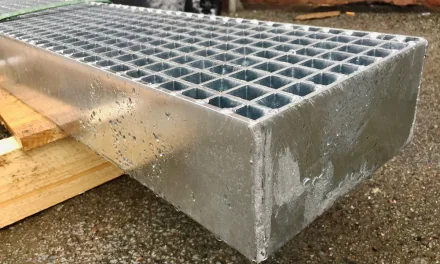
The appropriate type of step depends on the intended use, the environment, cleaning requirements, and the desired clear cross-section. Solid perforated metal steps protect the areas below from falling small parts. Grating steps allow water and dirt to pass through more easily. Special safety steps may be appropriate when there are increased slip-resistance requirements.
| Type of Step | Typical Advantage | Planning Note |
|---|---|---|
| Tear plate step | Solid, sturdy tread | Check drainage and slip resistance |
| Grating step | open cross-section and good drainage | Match the mesh size, support bar, and intended use |
| Security Level | Enhanced slip resistance thanks to a special surface | Determine the load and the required rating group |

These documents will help expedite your request
To provide a reliable quote, rotec requires, if possible, a PDF drawing and, if available, a DXF file. In addition, please specify the material, material thickness, quantity, surface finish, performance class, and delivery date. If structural requirements or component specifications are available, please include these documents with your inquiry.
Do you need checker plate steps for a new or existing staircase?
Send us your drawing or sketch. rotec will assess its technical feasibility, clarify any missing details, and prepare a project-specific quote.
Frequently Asked Questions About Perforated Metal Steps and CE Marking
Do all perforated metal steps have to bear a CE mark?
No, not solely based on their designation. The decisive factors are the intended use, load-bearing function, scope of delivery, and scope of application of the relevant technical specification. Classification should be project-specific.
What is the difference between CE marking and CE certification?
Technically speaking, the CE marking is correct. It is affixed by the manufacturer based on the required assessment and documentation. Depending on the system, a notified body may perform certain tasks, but it does not issue a general CE quality seal.
Is EXC2 a higher load class than EXC1?
No. EXC1 and EXC2 are design classes. They specify requirements for manufacturing, welding, testing, and documentation. The load-bearing capacity must be verified for the specific component.
Who determines the performance class?
The performance class is determined by the responsible designer or structural engineer based on the structure and its intended use.
Does rotec manufacture chequered metal steps based on drawings?
Yes. rotec manufactures products on a project-by-project basis according to approved drawings or agreed-upon sketches. Dimensions, hole patterns, and mounting brackets are designed to fit the specific installation situation.
Can checkered steel steps be supplied hot-dip galvanized?
Yes, hot-dip galvanizing is possible. Suitability and structural preparation are evaluated based on the component, its intended use, and the level of corrosion exposure.
What is the maximum material thickness?
The appropriate material thickness is determined by the stair dimensions, load assumptions, material, and design. A general statement without a drawing and design basis would not be reliable.
Can Rotec also handle sheet metal cutting and bending?
Yes. Laser cutting, bending, welding, and other steps in the Sheet Metal Fabrication at rotec can be coordinated through a single point of contact.
What documents are required to get a quote?
Please provide, if possible, the drawing, material, material thickness, quantity, surface finish, performance class, load specifications, and desired delivery date.
Are custom dimensions available?
Yes. In addition to standard sizes, rotec manufactures checker plate steps tailored to each specific staircase. Feasibility is assessed based on the provided documentation.
Does the CE marking replace a structural analysis?
No. The CE marking does not replace either the structural analysis or approval by the responsible designer.
Where are the checker plate steps manufactured?
Metalworking and production coordination are handled at rotec in Berlin. This keeps communication channels short and allows technical questions to be resolved directly.



 EN
 DE
 ES
 FR
 IT
 NL
 PL
 TR