


Night cooling schools
Night cooling for schools

Night cooling for schools
Night cooling for schools

Night cooling school
Night cooling in a school with Renson ventilation grilles

Night cooling kindergarten

Night cooling kindergarten
Post-cooling with Renson ventilation grilles in a kindergarten

Night cooling for apartments
Night cooling for apartments with Renson ventilation grilles
Night Cooling for Buildings: Energy-Efficient Cooling
Nighttime Cooling for Buildings, also known as nighttime cooling or nighttime ventilation, takes advantage of the lower outdoor temperatures at night to cool heated rooms and the building’s thermal mass. This is particularly beneficial for schools, preschools, office buildings, and other heavily used properties. When properly planned, passive cooling can support summer heat protection, reduce the use of mechanical cooling systems, and create more comfortable indoor temperatures the next morning.
rotec Berlin develops and manufactures custom ventilation solutions for safe nighttime cooling. These include weather-resistant ventilation grilles, burglar-resistant designs, insect screens, matching frame structures, and solutions for integration into windows, facades, and technical openings.
Why Nighttime Cooling Is Becoming Increasingly Important for Buildings
On warm days, buildings heat up due to solar radiation, people, lighting, and electrical equipment. In schools and preschools in particular, a high internal heat load builds up within a short time. If the heat remains in the building overnight, the next day begins with an unfavorable starting temperature.
The Federal Environment Agency points out that individual measures to combat overheating in the summer are often no longer sufficient. The agency cites the combination of exterior sun protection and intensive nighttime ventilation as particularly effective. In addition, solid building components, reduced solar radiation, and minimizing internal heat loads as much as possible can help. Further information is available in the article „Cool Buildings in Summer—Here’s How“ by the Federal Environment Agency.
Limiting solar radiation during the day is also part of managing heat at night. Our article on Exterior sunshades with SUNCLIPS slats explains the planning process for schools and office buildings.
How Nighttime Cooling Works
In nighttime cooling for buildings, appropriate supply and exhaust vents are opened outside of operating hours. If the outside air is cooler than the indoor air, it flows through the building and carries heat away. In addition to the indoor air, solid ceilings, walls, and floors also help cool the space. These structural elements can absorb heat again the following day, thereby delaying the rise in temperature.
Air movement can result from thermal convection, cross-ventilation, or mechanical assistance. Which option is appropriate depends, among other factors, on the building’s geometry, the size of openings, wind conditions, thermal mass, acoustic requirements, and intended use. The specific design specifications should therefore always be determined by the relevant specialist designers.
Nighttime Cooling in Schools and Preschools
Schools and preschools are heavily used during the day. Large numbers of people, digital devices, and large windows can cause the rooms to heat up even more. At the same time, unsupervised ventilation openings must be reliably secured at night against unauthorized entry, driving rain, animals, and dirt.
For nighttime cooling in schools, ventilation openings are often installed in facades, near windows, in hallways, or in stairwells. It is important to have a well-designed airflow path: Fresh night air must be able to flow in, while the warmed air is exhausted at a suitable location. Similar requirements apply to the Nighttime Cooling in Schools. In addition, every project must take into account fire safety, escape routes, fall protection, sound insulation, and the operation of the system.
Ventilation grilles for safe nighttime ventilation
Simply opening a window is often not enough to ensure adequate overnight ventilation when no one is home. Custom-designed ventilation grilles can provide the necessary clear cross-sectional area while also serving as protective barriers. Depending on the installation situation, the following characteristics are relevant:
- sufficient free ventilation cross-sectional area with an acceptable pressure drop,
- Protection against driving rain and rain seeping in,
- Burglary resistance and protection against unauthorized entry,
- Insect or bird protection using appropriate mesh,
- robust, corrosion-resistant, and low-maintenance design,
- Color and architectural coordination with the windows and facade.
The rain protection provided by weather protection grilles does not depend solely on the visible shape of the slats. The installation orientation, air velocity, wind pressure, dimensions, and drainage all influence the result. Our article on Water Tightness of Ventilation Grilles According to DIN EN 13030.
Burglary Protection for Unattended Openings
A key advantage of planned nighttime cooling for buildings is that ventilation openings can also be used outside of operating hours. To achieve this, grilles, frames, fasteners, and adjacent components must be considered as a comprehensive solution. A solid louver alone does not make for a burglar-resistant opening.
rotec tailors the material, substructure, fastening spacings, and accessibility to each specific project. Depending on the level of protection required, additional security measures or reinforced structures may be necessary. Binding resistance classes may only be specified if the necessary documentation for the specific design is available.
Planning: The following information is required
In order to evaluate a solution for nighttime cooling from both a technical and economic perspective, the following project data should be available as early as possible:
- desired or calculated air flow rate,
- existing structural and ventilation openings,
- Permissible pressure drop and required free cross-sectional area,
- Requirements for protection against rain, noise, insects, and break-ins,
- Facade structure, installation conditions, and mounting surface,
- desired material, finish, and color,
- Requirements from fire safety and security plans.
The ventilation strategy and the required opening areas are determined by the responsible specialist designer. rotec then provides support in the design and implementation of the ventilation grilles and connection details. Even for comprehensive System Solutions for the Building Envelope This allows for the early coordination of ventilation, weather protection, design, and installation.
Automatic Control of Nighttime Ventilation
An automated nighttime cooling system can take into account indoor and outdoor temperatures, rain, wind, and operating hours. Opening mechanisms are only activated when conditions are suitable. For schools and preschools, central locking systems, feedback mechanisms, and defined safety positions may also be useful.
To ensure that nighttime ventilation operates reliably, the control system, actuators, ventilation cross-sections, and structural protective measures must be designed as an integrated system. Regular visual and functional inspections help detect dirt, blocked openings, or damaged components at an early stage.
Night cooling is not air conditioning
Night cooling takes advantage of the existing temperature difference between indoors and outdoors. On very warm nights or when internal loads are high, its cooling effect may be limited. Therefore, it does not replace active cooling in every building. It is particularly effective as part of an overall concept that includes solar shading, reduced heat gain, effective building thermal mass, and demand-based ventilation.
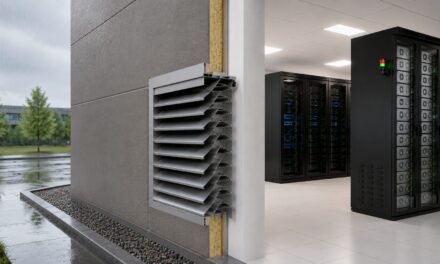
This principle can also be applied in technically complex buildings. Our project contribution to the NIGHT COOLING FOR DATA CENTERS shows just how varied the requirements for airflow, weather protection, and safety can be. The article also provides a more general overview Nighttime Ventilation as an Energy-Efficient Solution.
Project-Based Manufacturing at rotec Berlin
rotec manufactures ventilation grilles and custom designs according to the specifications of each project. Dimensions, frames, louvers, mesh, mounting hardware, and finishes are tailored to the installation conditions. Upon request, rotec provides support throughout the entire process, from design clarification through manufacturing to installation.
The result is not a one-size-fits-all solution, but rather a design tailored to the specific building, its use, and its protection requirements. This combination of ventilation functionality, safety, and architectural integration is particularly crucial for nighttime cooling in schools and preschools.
Are you planning a nighttime ventilation system for a school, a preschool, an office building, or another type of property? Send us any existing drawings, dimensions, and the technical specifications. rotec will review the structural feasibility and develop a suitable solution for ventilation grilles and their installation.
Request a project quote from rotec
Frequently Asked Questions About Night Cooling for Buildings
What is the difference between nighttime cooling and nighttime temperature reduction?
Both terms essentially describe the same principle: cooler nighttime air is used to remove warm indoor air and cool the building's thermal mass. The term "night ventilation" is also frequently used.
For which buildings is night cooling suitable?
This method may be suitable for schools, kindergartens, office buildings, residential buildings, and technical facilities, among other places. A prerequisite is that there is a sufficient temperature difference at night and a suitable airflow path.
Is it safe to leave ventilation openings open at night?
Yes, provided they are designed for the specific situation and protected with appropriate grids, frames, fasteners, and, if necessary, additional safety measures. The requirements must be determined on a project-by-project basis.
Does nighttime cooling save energy?
It can reduce the need for active cooling because it utilizes cooler outside air. However, the actual savings depend on the climate, building design, occupancy, control system, and the overall summer thermal protection strategy.
Who determines the size of the required ventilation openings?
Airflow rates, opening areas, and control strategies are determined by the relevant specialist designers. rotec provides support for the structural design of ventilation grilles, frames, surfaces, and connections.
In-depth study for technical planning: Our contribution to the Night cooling for schools explains secure ventilation pathways, RC2 requirements, and the request for proposals. The technical article on continuous heat loads and IT operating conditions addresses Night cooling for data centers and server rooms.



 EN
 DE
 ES
 FR
 IT
 NL
 PL
 TR
0 Comments